


If you own a home in Canada, you already know that our weather does not go easy on anything outdoors. Your deck, your driveway, your garden beds, and yes, your aluminum fence all take a beating from October through April. And even once the snow melts and summer shows up, UV rays and humidity bring their own set of challenges.
Here is the thing most homeowners and contractors overlook: aluminum fencing is marketed as "low maintenance," and that is absolutely true compared to wood or wrought iron. But low maintenance is not the same as no maintenance. Skipping a few simple seasonal tasks can quietly shorten the lifespan of your fence, and worse, it can void your manufacturer's warranty without you even realizing it.
This checklist walks you through what to do each season so your fence stays sharp, functional, and fully covered under warranty. Whether you installed your fence yourself or hired a contractor, these steps apply across the board.
Why Seasonal Maintenance Matters More in Canada Than Anywhere Else
Canada throws everything at your fence. We see temperature swings of 50 degrees or more over the course of a single year. In parts of Ontario, Alberta, and British Columbia, the freeze-thaw cycle can repeat dozens of times between November and March. Each time the ground freezes and thaws, it expands and contracts, and that puts real pressure on your fence posts and their footings.
Then there is the salt. If your property sits near a road or driveway that gets treated with calcium chloride or rock salt through the winter, that salt spray can land on your fence panels. Over time, even high-quality powder-coated finishes can be compromised if salt residue is left to sit season after season.
This is something almost nobody talks about in the fencing world, and it is one of the most common questions Canadian homeowners have: does road salt actually damage aluminum fencing? The short answer is yes, it can, but only if you let it build up. A simple spring rinse goes a long way.
Spring: The Most Important Season for Fence Care
Start with a full walkthrough.
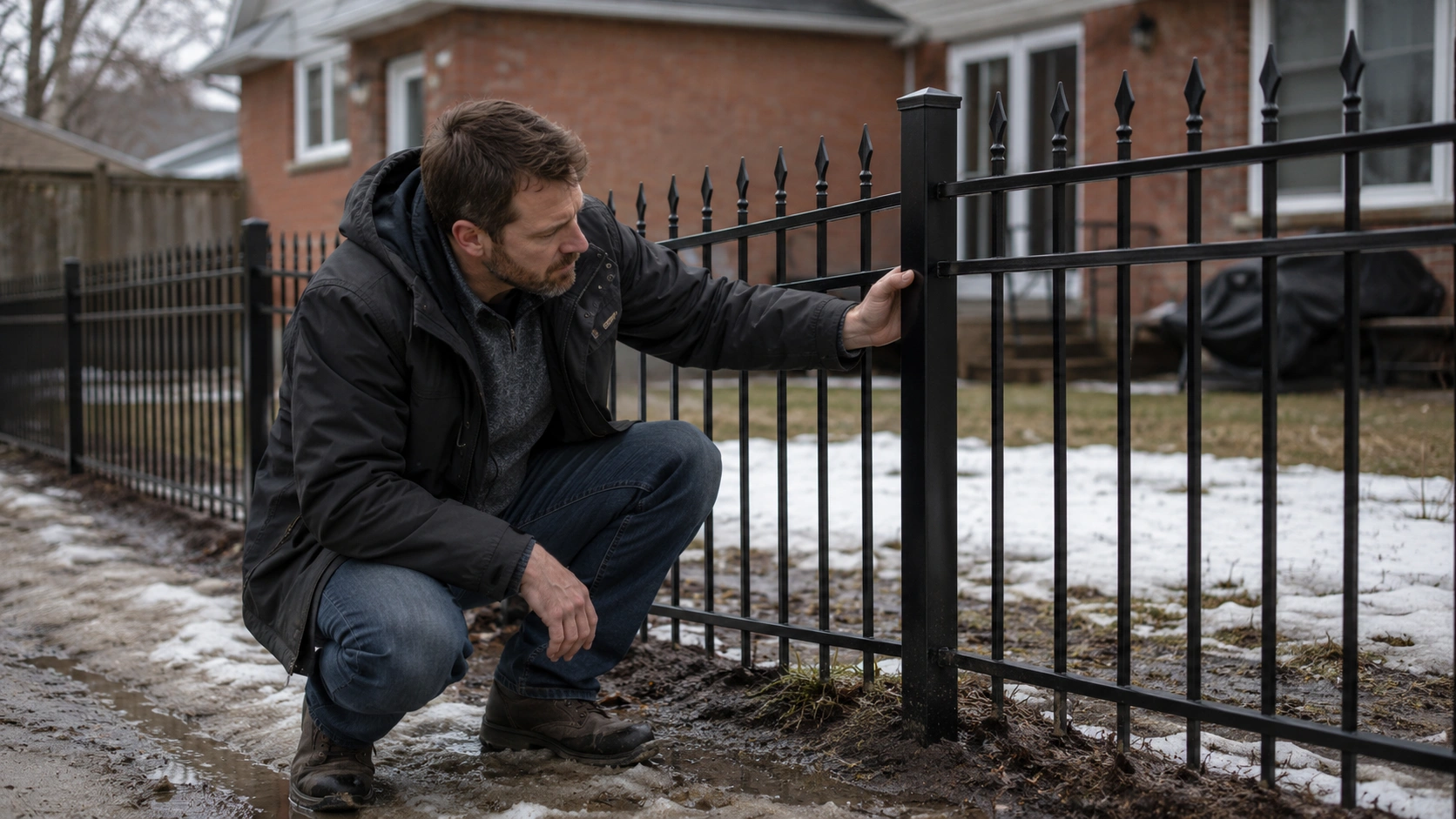
Walk the entire perimeter and look for panels that have shifted, posts that are leaning, or sections where the bottom rail has lifted off the ground. Frost heave is the number one cause of post movement in Canadian installations, and catching it early means a quick fix instead of a full panel replacement.
Check every post for plumb.
Use a level. Even a slight lean of two or three degrees can put stress on the rail connections over time, and that kind of structural issue is typically not covered under warranty if it results from poor post maintenance or inadequate footing depth.
For residential installations, products like the Medallion Fence Fairmont™ Series are engineered with 5/8" x 5/8" pickets and 1-1/4" x 1-1/4" rails, which provide solid durability for standard residential use. But even the best-engineered panels need properly maintained posts to perform as intended.
Next, give your fence a thorough wash.
Use a garden hose and a soft-bristle brush with mild dish soap or a specialized aluminum cleaner. Avoid pressure washers on high settings because the concentrated spray can damage the powder coat finish. This step removes the salt residue, grime, and organic buildup from winter. It is simple, it takes about an hour for most residential properties, and it is the single most effective thing you can do to protect both the finish and your warranty.
One question that comes up constantly from Canadian homeowners is whether they can use vinegar or bleach to clean their aluminum fence. Vinegar is fine in a diluted solution. Bleach is not recommended. It can react with certain powder coat finishes and cause discolouration that will not buff out.
Summer: Inspect, Tighten, and Touch Up
Summer is about fine-tuning. The ground has fully settled from spring thaw, so this is the right time to do a second post check. If a post was slightly off in April, you will know for sure by July.
Go through every gate in your fence line.
Gates take the most abuse of any fence component because they move. Hinges can loosen, latch pins can wear down, and self-closers can lose tension. If you have a pool enclosure, your gate hardware needs to meet provincial building code requirements, and a gate that does not self-close and self-latch properly is a code violation in every province.
For homeowners with sloped or uneven terrain.
The Hillcrest™ Series is specifically designed as a rackable residential fence, meaning it adjusts to follow the contour of your property. Even rackable panels, though, need periodic checks to make sure the racking joints have not shifted beyond their intended range.
Summer is also the time to address any chips or scratches.
Even a small nick can become an entry point for oxidation if left exposed over a full winter cycle. Most manufacturers sell touch-up paint matched to their standard colour options. Apply it on a dry day when temperatures are above 15 degrees Celsius for the best adhesion.
Fall: Prepare for What is Coming
This is your last chance to button things up before winter hits. The fall checklist is short but critical.
Clear any debris from the base of your fence.
Leaves, mulch, and garden waste that pile up against the bottom rail trap moisture. In a Canadian winter, that trapped moisture freezes and creates ice that pushes against the panel, potentially bending the bottom rail or shifting the post. It is a small detail that prevents a big headache.
Trim back any vegetation that is growing through or against your fence.
Vines and shrubs might look nice in summer, but once they freeze, they become rigid, and their expansion can warp pickets or pop them out of the rail channels. This is especially important for estate-grade fences like the Wellington™ Series, where the 3/4" x 3/4" pickets and refined styling are meant to be a visual centrepiece of your property, not buried under overgrown hedges.
If you live in a region that gets heavy snowfall, consider the placement of your snow removal equipment.
Snowblowers and plows are responsible for more fence damage claims than any weather event. A misdirected snowblower can bend pickets, crack post caps, or chip the finish in seconds. Mark your fence line with tall stakes before the first snowfall so you and your snow removal crew know exactly where to stop.
Winter: The Off-Season is Not a Free Pass
You are not going to be doing much hands-on maintenance in January, and that is fine. But there are a few things to keep an eye on.
If snow piles up against your fence to a height that reaches the top rail or higher, knock it down.
The weight of packed snow, especially the wet, heavy snow common in Southern Ontario and the Lower Mainland, can put lateral pressure on the panels that they were not designed to handle continuously.
Watch for ice buildup on gates.
When gates freeze shut and someone forces them open, that is how hinges get bent and latch assemblies get stripped. A quick spray of silicone lubricant on the hinges and latch mechanism in late fall can prevent this.
For commercial and institutional properties using heavier-duty systems.
The Oxford™ Series with its 1-1/2" x 1-1/2" rails and 2-1/2" x 2-1/2" posts offers greater structural resistance to snow load and impact. But even these systems are not indestructible, and the warranty assumes reasonable care.
Keeping Your Warranty Intact: What Most People Do Not Know
Here is a topic that rarely gets discussed, and it is one of the biggest sources of frustration for Canadian fence owners. Most aluminum fence warranties, including the 25-year warranty offered by Medallion Fence, are conditional. They cover manufacturing defects, finish integrity, and structural performance under normal conditions. What they do not cover is damage caused by neglect, improper installation, or unauthorized modifications.
That means if you drill into a rail to mount a light fixture and it voids the finish warranty in that area, you will not find out until you file a claim. If your installer set posts at 36 inches deep instead of the recommended 48 inches for your region's frost line, and frost heave pushes them out of alignment three years later, that is an installation issue, not a manufacturing defect.
The best way to protect your warranty is to document your maintenance. Take photos during your spring and fall inspections. Keep receipts for any touch-up paint or replacement hardware you purchase. If you ever need to file a warranty claim, this kind of documentation makes the process dramatically smoother.
Final Thoughts
Your aluminum fence is one of the most durable investments you can make for your property. Products like the Fairmont™ Series, Wellington™ Series, Hillcrest™, and Oxford™ Series from Medallion Fence are engineered with Armour-Shield corrosion protection and built right here in Canada to handle Canadian conditions. But even the toughest fence needs a little attention each season. A couple of hours spread across the year is all it takes to keep your fence looking great, performing properly, and staying fully protected under warranty for decades.
Request a Quote
Planning a new fence installation or replacing an aging system? Request a quote from Medallion Fence to explore options built for the Canadian climate.
Request a Quote