


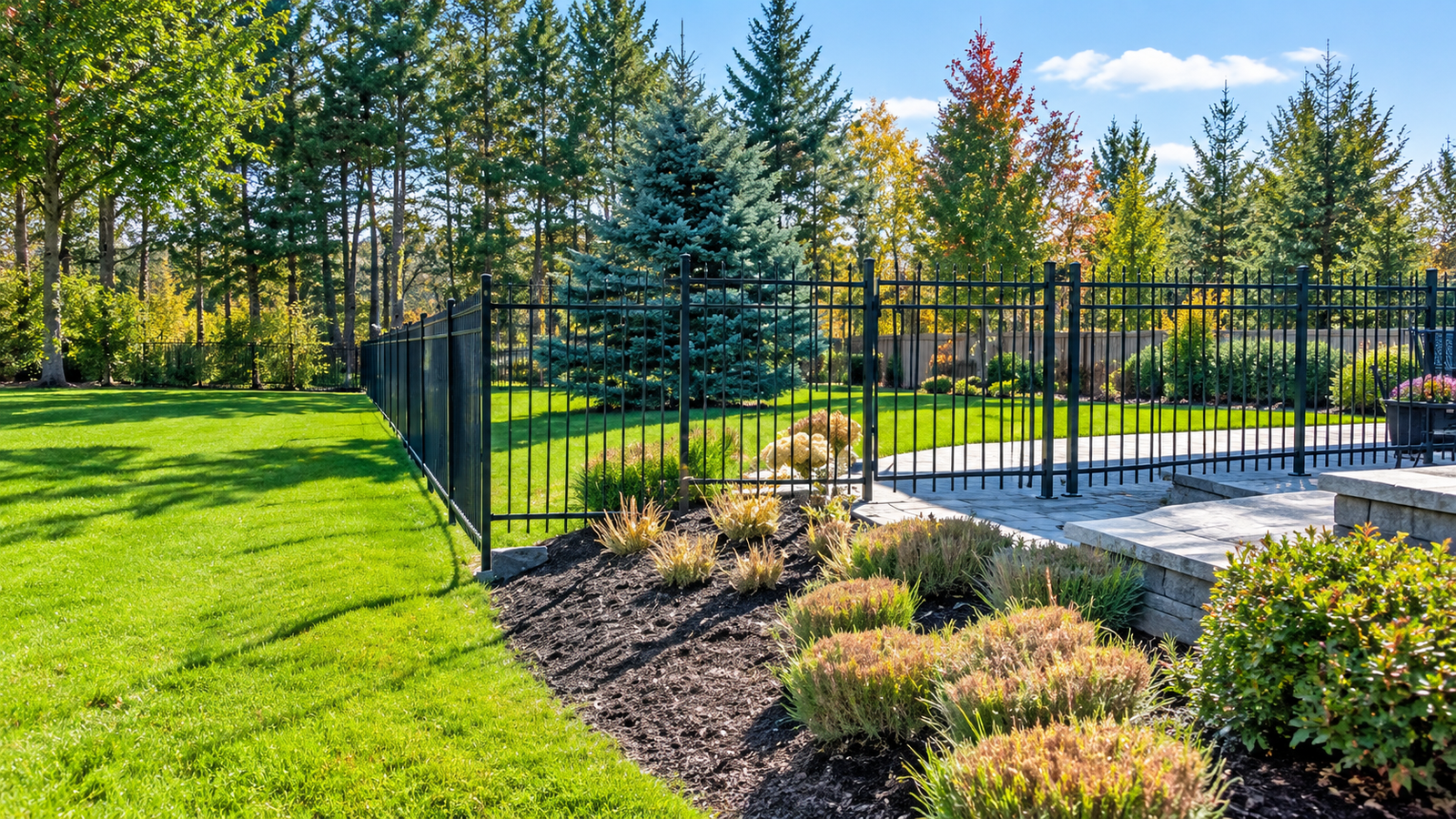
The blog cover image is for reference purposes only and does not depict the actual Medallion Fence product.
If you are reading this, you are probably standing at the beginning of a fencing project and feeling a bit overwhelmed. Maybe you are a homeowner staring at a tired chain-link fence that has been rusting since the early 2000s. Maybe you are an architect specifying perimeter enclosures for a new subdivision in Brampton. Or maybe you are a contractor trying to figure out which ornamental fence system will actually survive five Ontario winters without flaking, warping, or needing a callback.
Whatever brought you here, this guide is going to walk you through the decisions that actually matter when buying ornamental fencing in Canada. Not the surface-level stuff you have already seen on a dozen other websites, but the real questions that come up on job sites, in design meetings, and during those late-night Google searches after you have just received three wildly different quotes.
Let's get into it.
Aluminum or Steel? The Question That Changes Everything
This is always the first fork in the road, and there is more nuance here than most people realize.
Aluminum ornamental fencing is lightweight, naturally resistant to corrosion, and works beautifully for residential and light commercial applications. It will not rust. Period. For a homeowner in, say, Burlington or Oakville who wants a clean sightline around a backyard pool, aluminum is almost always the right call. It is easy to handle during installation, which keeps labour costs lower, and it requires essentially zero maintenance beyond the occasional wash.
Steel ornamental fencing is heavier, stronger, and better suited to applications where structural integrity is a priority. Think institutional perimeters, commercial properties, school boards, and municipal facilities. Steel provides superior impact resistance and can accommodate longer unsupported spans between posts without deflection. For architects specifying perimeter security on government buildings or contractors working on multi-unit developments, steel is often the only option that meets the structural performance criteria in the project spec.
Canadian Climate Considerations
Here is where it gets interesting for Canadian buyers specifically. Our freeze-thaw cycles are brutal. A fence system that works perfectly in Texas or North Carolina might start showing coating failure within three winters up here. That is why the finish system matters almost as much as the base material. Look for multi-stage corrosion protection. Galvanization alone is not enough. You want a system that combines hot-dip galvanization or galvanic priming with chromate conversion coating and then a UV-stable polyester powder coat on top. Medallion Fence, for example, uses their proprietary Armour-Shield coating on steel and Alu-Tuff finish on aluminum, which are specifically engineered for Canadian climate conditions.
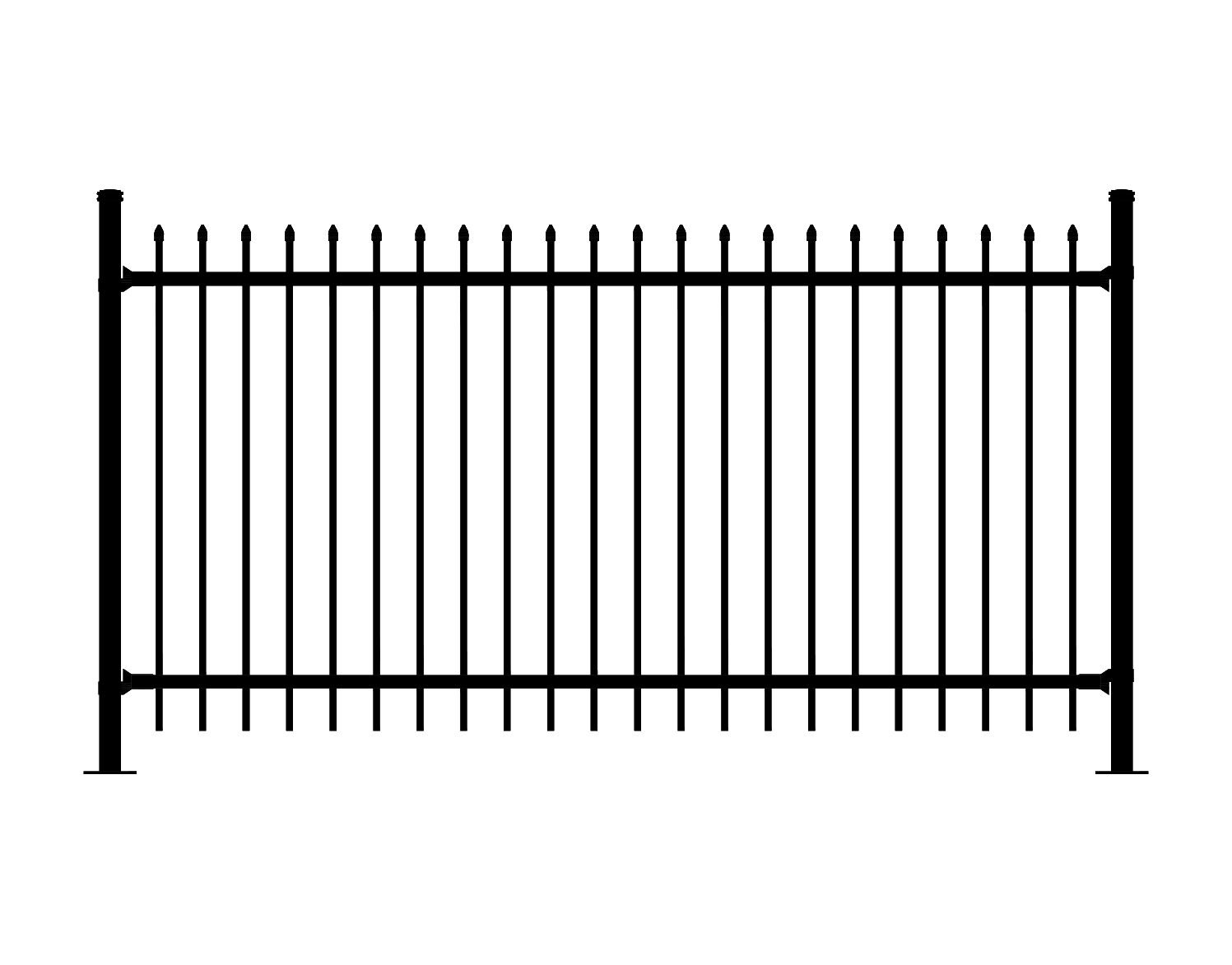
Fairmont Series
The Fairmont Series is a great example of a residential-grade ornamental fence that balances aesthetics and durability. It uses 1-1/4" x 1-1/4" rails with 5/8" x 5/8" pickets and a minimum 2" x 2" post profile. Available in both steel (Armour-Shield) and aluminum (Alu-Tuff), it is one of the most popular choices for homeowners across the GTA.
Understanding Canadian Building Code and Municipal Bylaws
This is the part of the conversation that almost nobody talks about clearly, and it trips up homeowners and contractors alike.
In Canada, fence regulations are governed at multiple levels. The National Building Code provides baseline guidance, but the real teeth are in provincial building codes and municipal bylaws. And those bylaws vary dramatically from one city to the next.
In most Ontario municipalities, a fence in a rear yard can be up to 2 metres (roughly 6 feet) without requiring a permit. Front yard fences are usually capped at 1 metre (about 3.3 feet). But if your property is on a corner lot, there are often additional sightline triangle restrictions to maintain visibility for traffic. If you are enclosing a swimming pool, you are looking at a whole separate set of requirements under the Ontario Building Code, which typically mandates a minimum 1.2-metre fence height with a self-closing, self-latching gate and no horizontal rails or features that could serve as a climbing aid for small children.
For architects working on commercial or institutional projects, the requirements go deeper. You may need to meet CPTED (Crime Prevention Through Environmental Design) guidelines, which influence picket spacing, panel height, and sightline considerations. Specifying a fence with picket spacing no greater than 100mm (roughly 4 inches) is standard practice for child safety compliance on school and daycare perimeters.
Pro Tip for Contractors
Here is a tip that saves contractors a lot of headaches: before you even price a job, pull the fence bylaw for that specific municipality. What flies in Vaughan might get a stop-work order in Mississauga. And if the property backs onto a conservation area or is within a heritage district, you may need additional approvals from the conservation authority or heritage committee.
Welded vs. Bolted Assembly: Why It Matters More Than You Think
This is a specification detail that separates commercial-grade fencing from the stuff you find at big-box stores, and it is worth paying attention to.
Most lower-cost ornamental fences use a bolt-through or mechanical fastener assembly. The pickets are pushed through punched holes in the rails and then secured with rivets or screws. This method works, but over time, those fasteners become potential failure points. Freeze-thaw cycling causes metal to expand and contract repeatedly, and bolted connections can loosen, rattle, and eventually allow moisture penetration into the joint.
Fully welded ornamental fencing eliminates that problem entirely. When pickets are welded to the rails, you get a monolithic panel with no mechanical fasteners to loosen or corrode. The weld joint is actually stronger than the parent material in most cases. It also gives you a cleaner visual profile because there are no bolt heads or rivet caps breaking up the lines of the fence.
For specifiers, this distinction matters in submittals. If your project specification calls for fully welded ornamental steel or aluminum fence panels, make sure your supplier can actually deliver that. Some manufacturers advertise "welded" construction but only weld alternate pickets or use tack welds rather than full fusion welds.
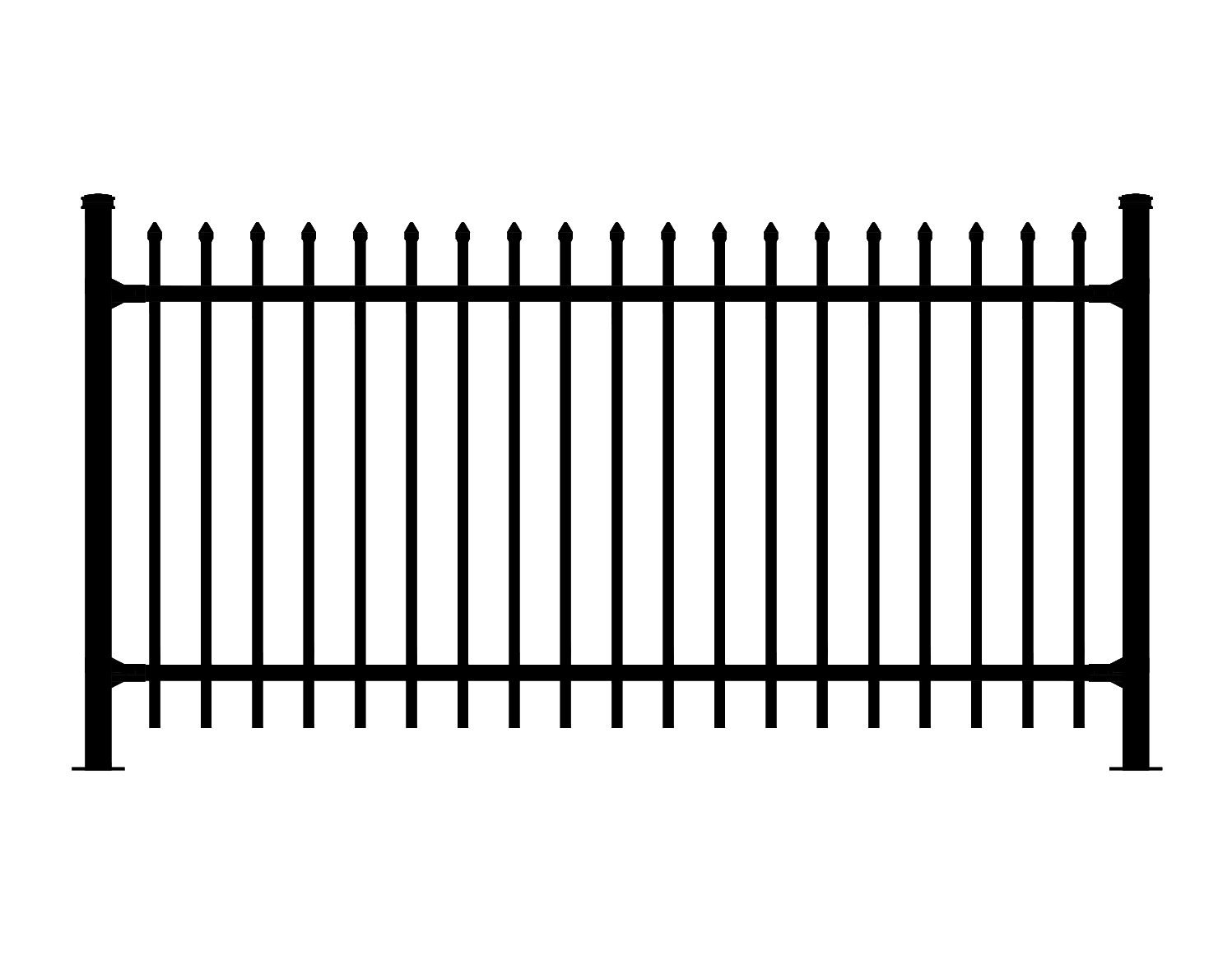
Oxford Series
The Oxford Series from Medallion Fence is designed for industrial, commercial, and institutional applications. It features 1-1/2" x 1-1/2" rails with either 3/4" or 1" square pickets and a minimum 2-1/2" x 2-1/2" post. Every panel is fully welded and manufactured in their Maple, Ontario facility. For architects who need DWG and PDF submittals, they are available for download directly from the product page.
What About Racking? The Sloped-Grade Problem Nobody Warns You About
If your property is dead flat, you can skip this section. But in Canada, especially across southern Ontario and British Columbia where ravines, rolling terrain, and graded lots are common, this is a critical consideration.
"Racking" refers to a fence panel's ability to follow the contour of sloped ground by adjusting the angle of the pickets relative to the rails. A rackable panel keeps the rails parallel to the slope while the pickets remain plumb (vertical). This gives you a clean, professional look that follows the natural grade without the stair-step effect you see with non-rackable panels.
Not all ornamental fence systems are rackable. Many commercial-grade panels with heavier rail and picket profiles have limited racking ability because the tighter tolerances in the punched rail holes restrict angular movement. If your site has a slope greater than about 12 to 15 degrees, you may need to look at stair-stepping the panels and using custom transition sections, or you may need a series specifically designed for racking, like Medallion's Hillcrest Series, which is engineered specifically for residential rackable applications.
Hillcrest Series
The Hillcrest is purpose-built for sloped residential lots. Same 1-1/4" x 1-1/4" rail and 5/8" x 5/8" picket profile as the Fairmont, but with rackable panel construction that adjusts to follow the grade of your property.
Gates: The Detail That Gets Overlooked Until It Is Too Late
The Most Common Mistake
Here is something that happens on almost every residential fencing project: the homeowner spends weeks choosing the perfect fence style, and then the gate becomes an afterthought. That is a mistake, because the gate is the single most used and most visible component of your fence system.
For walk gates (pedestrian access), you want a gate frame that matches the fence panel in both style and structural grade. Self-closing hinges and a gravity latch are standard for pool enclosures. For driveway or vehicular access, you are looking at double swing gates or slide gates, and the engineering requirements change significantly. A double swing gate spanning 12 or 14 feet requires heavier post sections, deeper footing embedment, and properly spec'd hinge hardware to handle the cantilever load without sagging over time.
For high-end residential and commercial projects, arched passage gates and mirror-image double gates add a level of architectural detail that elevates the entire property. These are not off-the-shelf items. They need to be custom fabricated to match the specific fence series and style you have selected.
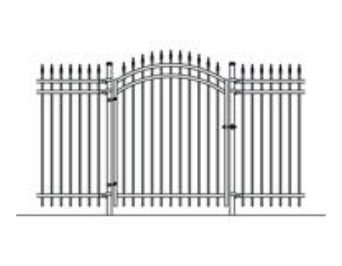
Custom Gates
Medallion offers arched passage gates, mirror-image double gates, and wave-style gates, all custom welded to match your selected fence series. These are especially worth looking at if you are working on estate properties or commercial entrances where the gate is the focal point of the perimeter.
The Warranty Question Canadians Should Be Asking
When you are comparing quotes, do not just ask "how long is the warranty." Ask what it actually covers.
Some warranties cover only the structural integrity of the panel but exclude the finish. Others exclude damage from road salt, which is a pretty significant exclusion if your fence runs along a street in any Canadian city that salts its roads from November through April. Look for warranties that specifically cover corrosion, including salt-air and de-icing salt exposure.
Medallion Fence backs their aluminum products with a 25-year warranty and their steel products with a 20-year warranty. For a Canadian buyer, that kind of coverage signals real confidence in the coating system, because the manufacturer knows exactly what our winters will throw at their product.
How to Choose the Right Series for Your Project
To make this simpler, here is how to think about it based on project type:
Standard Residential
For standard residential properties, the Fairmont Series covers most needs. Clean lines, proven durability, multiple style options from flat-top to decorative ring and spear tops.
Estate & Upscale Residential
For estate residential or upscale properties, the Wellington Series steps up to a 3/4" x 3/4" picket profile, which gives you a more substantial visual presence.
Commercial, Institutional & Industrial
For commercial, institutional, and industrial projects, the Oxford Series or the heavier Preston Series deliver the structural performance and larger post and rail dimensions required by most commercial specifications.
High-Security Applications
For high-security applications, the Hawkstone Series uses 2" x 2" rails, 1" x 1" pickets, and 3" x 3" minimum post profiles. This is the series you specify when the project demands anti-climb performance and maximum perimeter integrity.
Pet Owners
And for homeowners with dogs or small pets, the Pet Guard Series adds a secondary horizontal rail at the base of the panel to prevent small animals from squeezing through or under the pickets. This is one of those features that gets almost no attention in generic fencing articles but makes an enormous difference for pet owners.
Why "Made in Canada" Is Not Just Marketing
When your fence is manufactured domestically, you gain a few practical advantages that go beyond national pride. Lead times are shorter because you are not waiting for containers from overseas. Quality control is tighter because you can actually visit the manufacturing facility and see the process firsthand. And warranty claims are handled locally, by people who understand the Canadian market and the conditions your fence is living in.
Medallion Fence manufactures everything in-house at their facility in Maple, Ontario. From CNC punching and welding to powder coating and multi-point quality inspection, every step happens under one roof. For architects and contractors, this also means you can get technical support directly from the people who built the product, which is something you simply cannot get when your fence arrives in a container from a factory on another continent.
Final Thoughts
Buying an ornamental fence is not like picking up a flat-pack bookshelf. It is a long-term investment in your property's security, aesthetics, and value. Whether you are a homeowner making this decision for the first time, an architect specifying for a complex multi-phase development, or a contractor looking for a supplier you can actually rely on, the details covered in this guide are the ones that separate a fence that lasts two decades from one that starts causing problems in two years.
Take the time to get it right. Talk to manufacturers directly. Ask for CAD details and submittals. Verify the coating system. Check the warranty language. And make sure whatever you install is built to handle what Canadian weather actually does to outdoor structures, not what a sales brochure says it can handle.
Ready to Start Your Project?
To explore the full range of ornamental aluminum and steel fence systems, visit Medallion Fence or request a personalized quote.
Visit Medallion Fence Request a Quote