


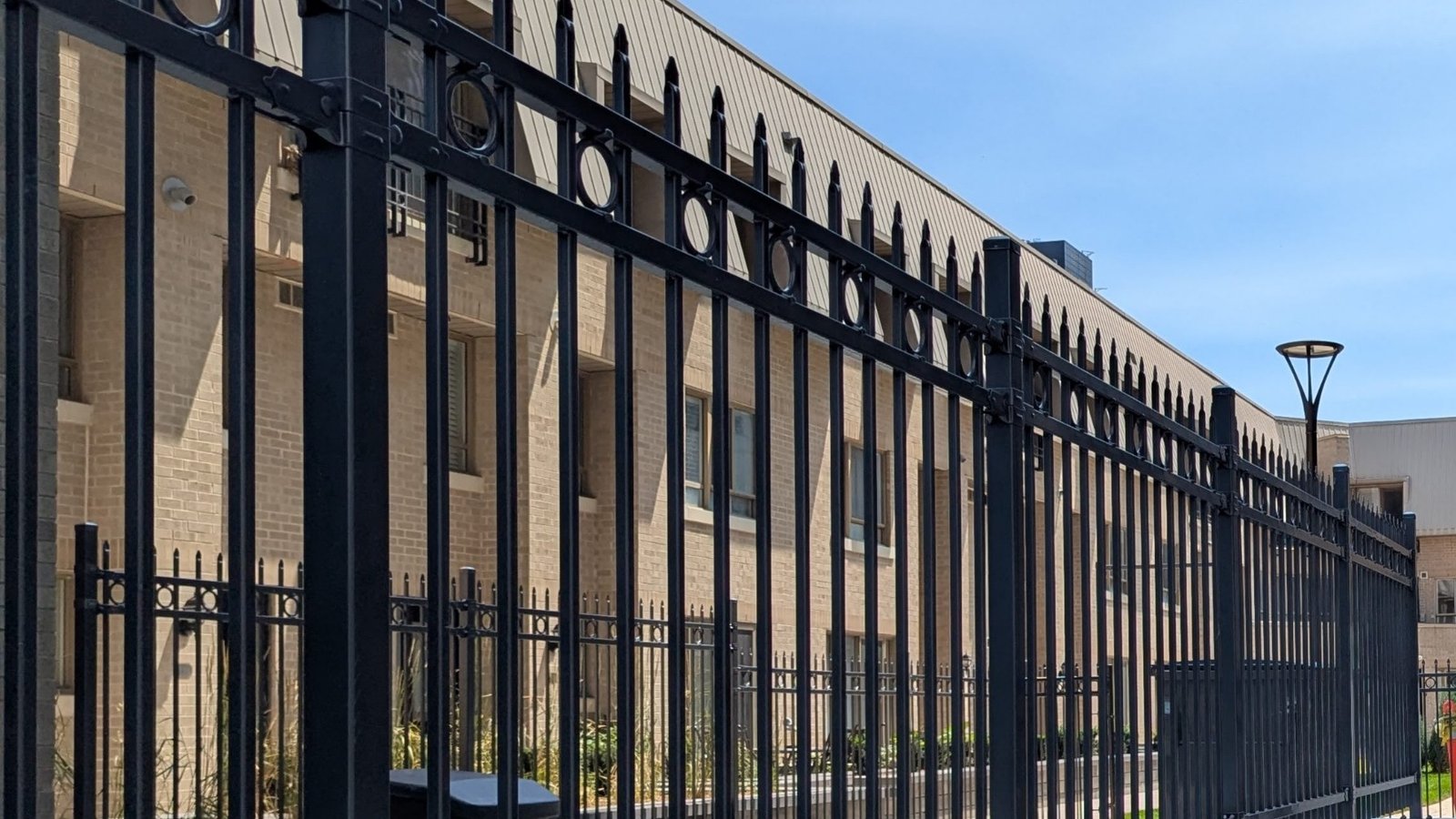
The blog cover image is for reference purposes only and does not depict the actual Medallion Fence product.
Walk into almost any quote meeting in the GTA, Calgary or Halifax and someone will say "wrought iron." The homeowner says it. The landscape architect writes it on the site plan. Half the time the installer says it too. And almost nobody in that room is talking about wrought iron.
That is not a scandal. It is just how the trade talks. But when you are specifying a fence that has to survive forty Canadian winters, road salt and a snowbank leaning on it from December to March, the name on the drawing matters a lot less than what is under the paint. So let's clear up the name first, and then spend most of our time on the part that actually decides how long your fence lasts.
True wrought iron is a museum material now
Real wrought iron is a very specific metal. It is almost pure iron, with a carbon content below about 0.08 percent, and it carries fine threads of glassy slag running through it. Those slag fibres give it a grain a bit like wood. Break a bar of it and the fracture looks stringy, not crystalline. That structure is a big reason old wrought iron gates and railings have lasted so long.
It was made by puddling, a slow, hot, hand-worked process where a puddler stirred molten pig iron in a furnace to burn off the carbon. Bessemer and open-hearth steel made it uneconomical, and the last commercial wrought iron works in the United Kingdom, the Atlas Forge in Bolton, England, stopped production in the mid-1970s. Today, genuine wrought iron is mostly reclaimed from old structures and re-worked for heritage restoration. It is rare, it is expensive, and nobody is rolling it into fence pickets for a subdivision in Vaughan.
Cast iron is a different thing again. It has roughly 2 to 4 percent carbon, it is poured into moulds, and it is brittle. Many of the decorative finials and rosettes you see on older Canadian fences are cast, while the bars and rails are something else.
So what is a modern "wrought iron" fence?
In Canada, what people call a wrought iron fence is almost always ornamental steel. That usually means mild or low-carbon steel, typically somewhere around 0.05 to 0.25 percent carbon, formed into square or rectangular tube, punched rails and pickets, then welded or mechanically fastened into panels.
Ornamental steel is a good material. It is stronger and stiffer than aluminum of the same profile, it holds up better to impact, and it lets you run heavier posts, wider gates and taller security panels without the fence feeling flimsy. That is why it still shows up on high-end residential, institutional and commercial jobs.
The trade-off is simple. Steel has none of wrought iron's built-in resistance to rust. Leave mild steel bare outdoors in Ontario and you will see orange bloom within weeks. Every bit of its lifespan comes from the coating system. That is the honest headline of this whole article: with ornamental steel, you are not buying a metal, you are buying a coating system with a steel core.
Why the Canadian climate is harder on that coating than you think
According to Environment and Climate Change Canada, about five million tonnes of road salt are used in this country every year. A fence along a driveway, a sidewalk or a busy street lives in that chloride spray all winter. Salt dissolves into meltwater, the meltwater wicks into any scratch or pinhole, and then freeze and thaw cycles work that defect a little wider every week.
Then there is the snowbank. Plowed snow piled against the bottom rail sits there for months as wet, salty slush. That bottom rail and the base of each post take more abuse than the rest of the fence combined. Add string trimmer nicks in summer and the occasional snowblower chip in winter, and you have a fence that is constantly being tested at its weakest points.
What to ask about the coating
Here is the short list of questions we would ask any supplier, including ourselves. If the answers come back vague, that tells you something.
Where does the zinc come from, and how thick is it?
Zinc is the real corrosion protection on steel. Paint and powder are the first line of defence, but zinc is what keeps rust from creeping under the finish once the finish gets damaged. There are two common routes.
Pre-galvanized tube is zinc coated at the mill, before the fence is built. Coating designations like G60 and G90 are common. For reference, G60 works out to roughly half a mil (about 13 microns) of zinc per side, and G90 is about three quarters of a mil.
Batch hot-dip galvanizing happens after fabrication, by dipping the finished part in molten zinc. In Canada this is covered by CSA G164, and in the US by ASTM A123. Batch coatings commonly land somewhere between about 1.8 and 3.9 mils, which is several times thicker than G60.
Neither route is automatically wrong. Thin, uniform mill zinc under a well-applied powder coat can perform very well. But you should know which one you are getting, and it should be in writing.
What happened at the welds and cut ends?
This is the question most people never ask. When pre-galvanized tube is cut, punched or welded, the zinc at those spots burns off or is simply not there. Every picket hole in a rail and every weld bead is a place where bare steel can be exposed. Ask how the fabricator restores protection at those points. A proper answer will mention zinc-rich repair, a pretreatment that reaches into those areas, or galvanizing after fabrication. "The powder covers it" is not a full answer.
What pretreatment goes on before the powder?
Powder coating is only as good as the surface it sticks to. Ask about cleaning and the conversion coating, such as a phosphate step, and whether there is an e-coat primer. An e-coat is applied by electrically charged immersion, so it reaches inside corners and recesses that a spray gun misses. For powder applied over hot-dip galvanized steel, ASTM D7803 sets out the preparation, including a heat step to prevent outgassing, which otherwise shows up as pinholes and blisters in the finish.
What powder chemistry, and what film thickness?
Epoxy powders protect well against corrosion but chalk and fade in sunlight. For an exterior fence, you want a polyester or a super durable polyester topcoat for UV stability. Ask for the specified dry film thickness range and how it is checked. A shop that measures DFT with a gauge on production parts will be able to tell you the number without looking it up.
Is the inside of the tube protected, and can it drain?
Tube corrodes from the inside too. Ask whether the internal surface is coated and how water gets out. In our climate, water trapped inside a picket or post can freeze and expand. Drainage and venting details are a small thing on the drawing and a big thing in year eight.
What does the test data actually prove?
You will hear salt spray hours quoted, usually from ASTM B117. Treat them with care. B117 is a constant salt fog with no drying cycle, which is not how a fence lives. Zinc in particular builds a protective patina through wet and dry cycles, so continuous fog does not represent its real performance. Salt spray hours are useful for comparing finishes under the same test, not for predicting years in Winnipeg. Ask for adhesion results, such as cross-hatch testing to ASTM D3359, impact resistance, and any cyclic corrosion data.
How do I touch it up, and what does the warranty exclude?
Every fence gets scratched. Ask for the matching touch-up product and the procedure before the job is done, not after. Then read the warranty exclusions closely. Look for language about salt, de-icing chemicals, snow storage against the fence and coastal exposure. If you are building near the ocean in Nova Scotia or BC, or along a salted arterial road, raise it at the quote stage.
Why zinc plus powder beats either one alone
Galvanizing industry data shows that a duplex system, meaning zinc under a paint or powder topcoat, lasts longer than the two coatings added together. The published synergy factor runs from about 1.5 to 2.3 times the sum of the two individual lives, depending on how aggressive the environment is. The topcoat slows down how fast the zinc is consumed. When the topcoat finally gets damaged, the zinc underneath keeps rust from spreading under the film. That is why the questions above focus on whether the zinc is continuous, especially at welds and cut edges.
A few things Canadian buyers rarely hear
Pool bylaws can change your panel design.
Toronto's fence bylaw, Chapter 447, is a good example. For metal picket pool enclosures, pickets can be up to 100 mm apart only where the horizontal rails are at least 1.2 metres apart. Where the rails are closer than that, the maximum gap drops to 38 mm. A standard three-rail panel can fail on that detail alone. Check your own municipality, because the rules vary from city to city.
Footings matter as much as finish.
Posts need to be set below local frost depth, or frost heave will rack the panels, crack the coating at the brackets and open the door to rust.
You can repaint ornamental steel later, but a field-applied paint will not match a factory-cured powder over a proper pretreatment.
Get the system right on day one.
For heritage work, the conversation changes.
If you are restoring a genuine historic wrought iron railing, that is a conservation project, not a fence purchase, and it calls for a specialist.
The bottom line
When someone asks for a wrought iron fence in Canada, they almost always mean ornamental steel. That is fine. Just stop judging it by the name and start judging it by the coating system. Ask where the zinc is, how thick it is, what happened at the welds, what pretreatment sits under the powder, and what the warranty says about salt.
Bring us your specification
At Medallion Fence, we manufacture ornamental steel and aluminum fencing in Maple, Ontario, with our own welding and powder coating lines under one roof. If you are an architect, contractor or homeowner working through a specification, bring these questions to us. We would rather walk you through the coating system than sell you on a name.
Contact Medallion Fence