




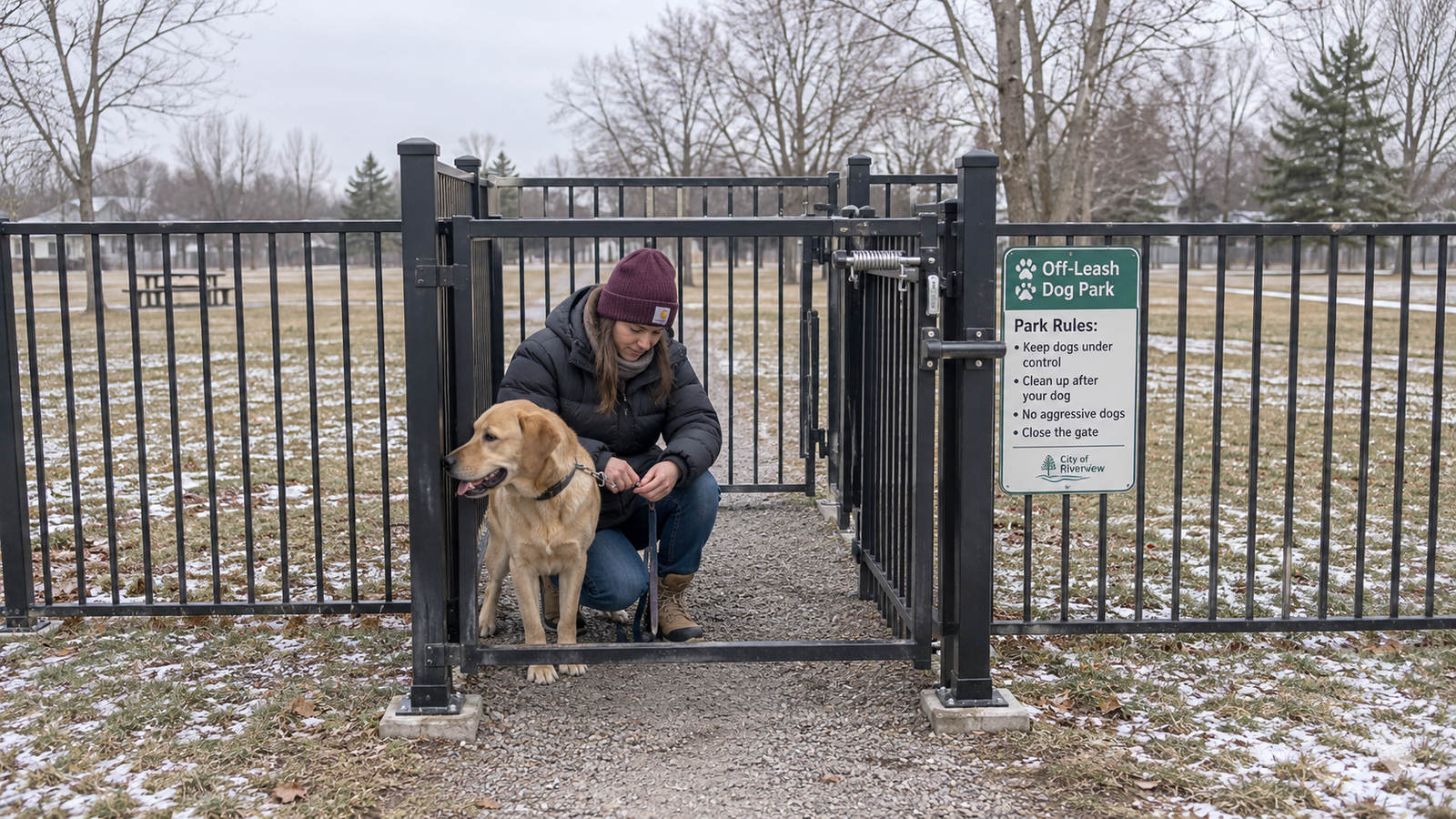
Most dog park complaints that reach a parks department are not about the dogs. They are about the fence. A terrier that slipped between the pickets. A gate propped open by someone carrying a coffee and a leash. A row of posts that leaned over after the first real winter. Fencing looks like the simplest line item on the drawing, and it causes the most grief once a hundred dogs a week and a Canadian freeze-thaw cycle get to work on it.
If you are specifying or reviewing an off-leash area, these are the details worth getting right the first time, because retrofitting a fence after opening day is expensive and public.
Start with the airlock, not the fence line
The single most important part of the whole enclosure is the double-gate entry, sometimes called a vestibule or airlock. The idea is simple. An owner brings a dog into a small enclosed holding area on leash, closes the outer gate, unleashes the dog, and only then opens the inner gate into the park. Leaving reverses the sequence. A dual gate or airlock zone lets an owner bring a dog into a confined space on leash, unleash before entering the park, and reverse the process to leave. The key behaviour is that the first gate closes before the second one opens.
A single gate that opens straight from the sidewalk into the run is a liability. Single-gate entrances allow direct access to the off-leash area from outside the fence line and create a higher risk of dogs escaping. Every experienced operator will tell you the same thing in plainer language: dogs read an open gate as an opportunity, and a momentary opening while someone enters creates real escape risk. A proper airlock also reduces gate-rushing, where dogs crowd a new arrival at the entrance and injuries follow.
Two things get missed on airlocks. First, Size it for how people actually behave, not the minimum on paper. You need room for one person, one excited dog, and often a second person waiting, without anyone having to back into a gate. Second, make it accessible. That means enough maneuvering space near the latch and gate swing, a stable pad at the entry to prevent rutting, and a layout that does not force sharp turns. A wheelchair user or someone with a mobility aid should be able to manage both gates alone.
And add a separate maintenance gate. Staff should not be dragging a mower or a gravel cart through the public airlock. Some municipal bylaws already require this. One typical standard calls for a minimum five-foot fence with separate double-gated entry and exit points, plus separate gates for maintenance access.
Picket spacing is where small dogs win
Here is the detail that generates the angriest emails. Standard ornamental aluminum fencing, the black steel-look product you see on most parks, has picket gaps of just under four inches. That spacing is fine for a Lab. It is an open door for a Chihuahua or a Dachshund. A documented case at one municipal park found the gap between slats sat at just under four inches, which was just enough for a small dog to squeeze through. In another town, a 20-pound Jack Russell pushed his head between the aluminum bars in the large-dog area and got onto the adjacent road.
The working rule from the trade is straightforward. Small dogs need gaps no larger than two inches, medium dogs up to four inches, and large dogs up to six inches. For a small-dog zone, that means specifying tighter "puppy picket" panels, which add extra vertical bars on the lower portion so gaps drop from four inches to roughly one and a half or two inches. If you use welded wire or chain link instead, panels of two-inch by four-inch or four-inch by four-inch spacing in a heavier gauge reduce the chance of paws, snouts, or heads getting caught.
Two spacing problems are not about the panel at all. The bottom gap matters as much as the pickets. On flat ground the fence should sit close to grade, and anything more than an inch or two becomes an escape route for small dogs. And post spacing drives sag. Posts set too far apart let the fence sag over time and open up gaps that did not exist on day one. Keep runs tight and the bottom rail low.
Height, and why Canadian snow changes the math
The published range for dog park fences is roughly five to seven feet above the surface. In Canada the commonly cited floor is 1.5 metres. Both the Medicine Hat Police Service best-practices report and the reference book Dog Park Design, Development, and Operation put the minimum fence height at 1.5 metres (about five feet). Toronto reached the same conclusion at High Park, where the study recommended raising the fence to 1.5 metres to meet best practice. A practical split many parks use is six-foot fencing through the large-dog area and four to five feet in small-dog zones.
Now the part generic guides skip, because most of them are written for California. Snow steals your fence height. A plowed windrow or a drift packed against the outside of a five-foot fence can give a determined dog a ramp to the top rail by February. This is practical judgment rather than a code number, but it should shape two decisions: do not design the perimeter where snow gets pushed or blown against it, and give maintenance a plan to clear the fence line, not just the paths. A fence that contains dogs in July and fails in January is still a failed fence.
Footings: the part that fails quietly
This is the most Canadian issue on the list and the one that rarely makes it into a design review until it is too late. Fence posts set above the frost line get pushed upward by freezing soil, which loosens posts and misaligns the whole fence line. The fix is depth. Posts have to sit below the local frost line, and that depth is regional: Calgary's frost line is around 1.2 metres, about four feet, Alberta generally runs four to five feet, and most of Eastern Ontario is roughly 1.2 to 1.5 metres. Good practice is to set the footing at least six inches below the frost line, not just to it. Confirm the number with the local building department rather than copying a spec from another city. (As an aside, if a supplier talks about "frost fence," that is a Canadian term, common in Quebec, for chain-link.)
Questions Canadian parks departments actually get asked
A few recurring ones worth having answers ready for:
Will the gates still work at minus 25?
Spring-loaded self-closing hinges and spring latches can stiffen or ice up in deep cold and wet-freeze conditions. This is practical experience, not a published figure, but it is worth specifying cold-rated, serviceable hardware and checking latch function through the winter. A self-closing gate that no longer self-closes is how most "someone left the gate open" incidents actually start.
Chain link or ornamental?
Chain link is cheaper and does the containment job. Ornamental aluminum looks better next to a streetscape and ages well, but costs more and needs its picket spacing checked for small dogs. Pick based on adjacency and budget, not looks alone.
Who is liable if a dog gets out?
That is a legal question for your municipality, not a fencing one, and the honest answer is that it depends on your bylaw and signage. The design lesson is simpler: the airlock, the spacing, and the footings are your defensible evidence that the enclosure met a recognized standard.
Is there a Canadian template to follow?
Yes, several municipalities have published criteria you can reference, including the City of Greater Sudbury's approved off-leash design criteria and the City of Edmonton's Dogs in Open Spaces Strategy covering its network of off-leash areas. Read one close to your climate before writing your own spec.
The short version
Spend the money on three things: a real double-gate airlock sized for how people move, picket or mesh spacing matched to the smallest dog you expect (two inches or tighter for small-dog zones), and footings set below your local frost line with margin. Height matters, but a six-foot fence with four-inch gaps at the bottom and a frost-heaved gate is not a six-foot fence. It is a complaint waiting for spring.