




Aluminum Fence Systems
Aluminum Fence Systems
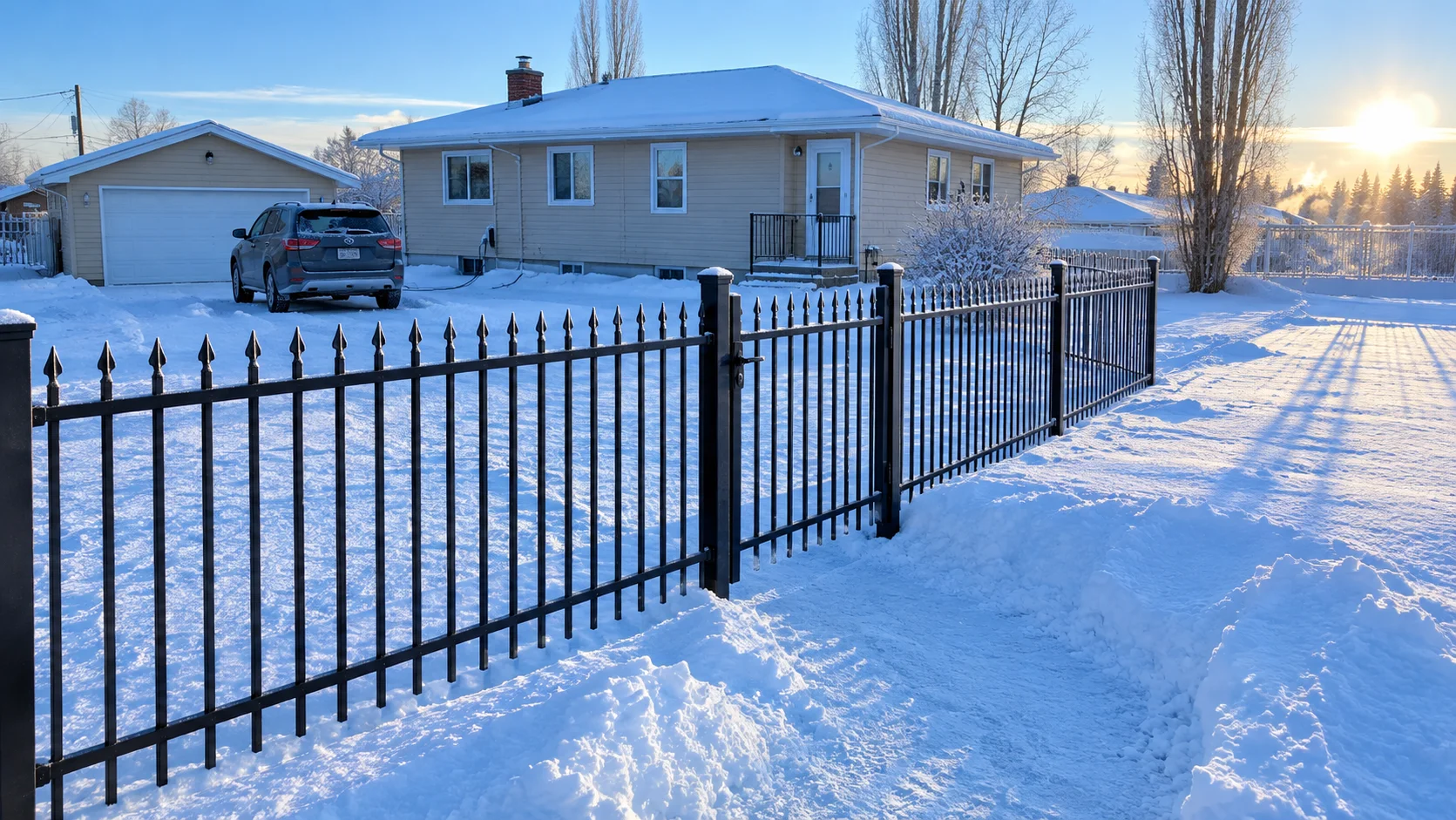
The blog cover image is for reference purposes only and does not depict the actual Medallion Fence product.
Every March the snowbanks shrink and the damage shows up. A post at the end of the driveway leans a few degrees toward the street. A panel along the parking lot is bowed inward where the windrow sat for eleven weeks. A gate that closed fine in November now drags, and the latch no longer lines up.
None of this happened in one dramatic moment. Most of it built up slowly, and most of it could have been predicted at the design stage.
If you specify, install or manage steel fencing anywhere a plow operates, winter is your governing load case. Wind and people leaning on the fence come second. This article covers what actually fails, why it fails, and the details that keep a steel fence straight and plumb through a Canadian winter.
It helps to separate the problem before solving it.
A blade, a wing plow or a pickup with a front plow catches a post or panel.
Windrows and storage piles sit against the fence for months. As they consolidate, they also drag downward on anything buried inside them.
Frost heave jacks posts out of the ground, and refrozen meltwater locks bottom rails and gates in place.
Each one needs a different fix. Heavier pickets do nothing for a post that is heaving out of the ground. A deeper footing will not save a panel that a loader pushes snow into after every storm. Most failed winter fences were designed for one of these loads and ignored the other two.
Direct strikes cluster at predictable spots: the post beside a driveway apron, the corner of a parking lot, the gate posts at an entrance, and anywhere a plow turns or backs up. The operator is working at night, often on a 12 hour shift, and by mid-January the fence line is buried and invisible.
The failure pattern is consistent. The post yields just above the footing crown, where the bending moment peaks. Bracket fasteners shear. The connection between panel and post lets go, and the load carries into the next bay, so one strike can damage two or three sections.
Upsize terminal, corner and gate posts even when the line posts stay standard. The ends of the run take the hits.
Install snow stakes or reflective markers taller than your expected snow depth before the first plowable snowfall, not after it.
Put sacrificial protection such as bollards, armour stone or a raised curb where plows turn.
Pay attention to panel construction. Riveted panels rack when a fastener lets go. Every Medallion panel is fully welded with stainless steel MIG welds, so racking at the joints isn't the weak point. The posts and the bracket connections are. At driveway openings and lot entrances, specify heavier posts. The Oxford spec sheet lists HSS post options in 3, 4 and 6 inch square.
People underestimate plowed snow because they picture what falls from the sky. Fresh snow is light, often somewhere between 50 and 150 kg per cubic metre. Plowed snow is not the same material. The blade compacts it, road slush adds water, and every freeze-thaw cycle densifies it further. Laboratory testing of compacted snow has worked with densities from roughly 430 up to 540 kg per cubic metre.
Here is a rough estimate. Take a windrow 1 m high and 1 m deep along one 2.4 m (8 ft) panel, at 400 kg per cubic metre. That is about 960 kg of snow sitting against and around a single section of fence. It is not all lateral pressure, but it does not need to be.
The less obvious problem is settlement drag. As a deep pile consolidates, it creeps downward. Any horizontal member buried in it, mainly the mid and bottom rails, gets pulled down with it. This is why rails come out of winter bowed downward with stressed picket connections, even when no plow touched the fence.
Then there is salt. Brine-laden slush gets thrown against the bottom 600 mm of the fence all winter. Wherever ice or a blade chips the powder coat, chloride reaches the metal underneath, and corrosion starts creeping under the finish. That is why the metallic coating under the paint matters more than the colour on top. Medallion's Armour-Shield steel is made from tube that is pre-coated with an aluminum-zinc layer (AZ50, ASTM A792) and finished in a super durable polyester powder coat, with a zinc-rich epoxy powder primer or E-coat available as options. For any run within splash range of a salted road or lot, specify the primer. It costs far less than a corrosion repair two winters later.
This is where homeowners get caught most often. The grass between the sidewalk and your fence is very often city property, not yours.
In Winnipeg, for example, the City right of way on residential streets runs at least 3 metres back from the curb to the property line. The city has also said it will not respond to damage caused by the weight of snow, or to damage to property that encroaches into its right of way.
Smaller municipalities say the same thing in their policies. The Township of Huron-Kinloss states that fences damaged by snow impact from Township equipment are the owner's responsibility to repair, and the Township is only liable at Council's discretion where there is sufficient evidence of direct contact. In Newfoundland, Portugal Cove-St. Philip's does not pay for damage within the street reservation, including fences, and does not pay for damage caused by the weight of snow.
The rules vary by municipality, but the pattern holds. If your fence sits in the road allowance, or the damage came from pushed snow rather than direct blade contact, you are likely paying for it.
Confirm the property line with a survey or reference plan before setting a single post. Do not trust the edge of the lawn.
On parking lots, show snow storage areas on the site plan and keep them away from fence lines. Storage is often dumped at the low corner of the lot, which also collects meltwater that refreezes at the fence base.
Where a fence must border a plowed surface, a working rule (not a code requirement) is to hold it 1.5 to 3 m back from the plowed edge, or to put a curb or barrier between the two.
A tight gap of an inch or two under the bottom rail looks clean on install day. By February, the grade has heaved, packed snow has frozen around the rail, and a plow scrape has caught the bottom edge.
In active snow areas, consider 75 to 100 mm (3 to 4 in) of clearance where the site allows it. Before you do, check your local pool enclosure bylaw and any pet containment needs, since many pool bylaws limit the gap under a fence. Follow the grade instead of stepping panels, so the clearance stays consistent across the run. On sloped driveways, a rackable panel such as our Hillcrest series follows the grade, so you don't get a large gap at one end of a panel and a buried rail at the other.
For gates on commercial lots, a cantilever slide gate is worth the cost. It has no ground track to clog with ice. Cantilever gates are a standard Medallion gate configuration, so they can be specified from the start rather than added as a custom item. Swing gates need cleared arcs to open at all, and their latches should sit high enough that they don't end up buried.
Posts must bear below frost penetration depth. Roughly 1.2 m is a common minimum in much of southern Ontario, and Prairie municipalities often require considerably more. Confirm the number with the local building department rather than copying a figure from another region.
Depth alone is not enough. Frost grips the sides of a footing and lifts it, a process called adfreeze jacking. Smooth-sided formed footings (a sonotube or similar) give frost less to grab than a rough, flared hole. Avoid footings that mushroom out wider at grade. Crown the concrete so water runs away from the post, and put free-draining granular at the base so the footing isn't sitting in a puddle.
Most sites do not need a crash-rated bollard. They need a plow guide.
A standard concrete-filled steel pipe bollard, set on its own footing, gives the operator something visible to steer around and takes the hit instead of your fence. Place it at corners, turns and gate openings, several hundred millimetres in front of the fence line. Keep its footing separate from the fence footing so impact energy is not transferred into your posts.
Crash-rated bollards are a different product. ASTM F3016 tests whether a bollard can stop a 5,000 lb test vehicle at 10, 20 and 30 mph. The higher security standard, ASTM F2656, uses a 15,000 lb truck at 30, 40 or 50 mph. Keep in mind that a loaded municipal plow truck is far heavier than the F3016 test vehicle. An F3016 rating tells you how a bollard handles cars at a storefront. It does not tell you how it will handle a plow truck. Specify rated units for pedestrian protection, and use ordinary plow guides for snow operations.
Upgrade the fence spec when any of these apply:
The fence is within about 3 m of a plowed surface.
It borders a snow storage area, or it receives windrows from a loader or skid steer.
The site is plowed under contract at night.
You are in a heavy snow region such as the Lake Huron and Georgian Bay snowbelt, the Ottawa Valley, Quebec, Atlantic Canada or the Prairies.
The fence has already needed winter repairs.
Here is how that maps to our steel lines. Every series is fully welded from tube with a 45 ksi (310 MPa) minimum yield strength, on a standard 96 inch post setting.
1-1/4" square rails, 5/8" or 3/4" square pickets, 2" square posts. These suit back yards, side yards and frontage set well back from the plowed edge.
1-1/2" square 14 gauge rails, 1" square 16 gauge pickets (3/4" on the Oxford.75), and 2-1/2" square 14 gauge posts. This is the sensible baseline for driveway frontage and the edges of parking lots.
2-1/2" x 1-1/2" rails, 1" square pickets and 3" square posts. The deeper rail and larger post suit sites that take regular plow traffic but don't need high-security detailing.
2" square 14 gauge rails, 1" square 16 gauge pickets and 3" square posts. Use this for runs that take windrows every storm, sit beside snow storage, or face the plow at lot entrances.
Why the rail jump matters: Oxford and Hawkstone rails share the same 14 gauge wall and the same 45 ksi steel. Going from a 1-1/2" to a 2" square rail raises the section modulus from roughly 0.19 to 0.36 cubic inches. That's about 85 percent more bending capacity in every rail, and bending is exactly the load a settling snowpile puts on a buried rail. Because our standard post spacing is fixed at 96 inches, shortening the bays isn't a practical option. Rail section is the lever you can actually pull.
You also don't have to upgrade the whole property. Put Hawkstone or Preston on the runs facing the driveway or the lot, and use Fairmont or Wellington for the protected side and rear yards. All of them share the same finish system, so the property still reads as one fence. When you price the upgrade, compare it against two or three springs of repairs, not just the base quote.
Sometimes, but usually only for direct blade contact and only if the fence is on your own property. Pushed snow and weight of snow are commonly excluded. Report it through 311 or public works right away, with dated photos of blade marks. Some municipalities set claim deadlines. Portugal Cove-St. Philip's, for instance, will not consider claims received after May 15.
For pool enclosures and coastal sites, aluminum is a strong choice, and Medallion makes both. Near a plow, steel wins. Aluminum's stiffness is about one third of steel's, so it deflects and kinks more under impact. Along plowed driveways and parking lots, specify steel.
That is rarely practical. If one specific bay takes the windrow every year, consider designing that bay as a removable panel, or leave an opening protected by bollards.
It depends on your policy and whether the city accepts liability. Call your broker before you assume anything.
Medallion's steel fencing carries a 20-year limited warranty covering manufacturing defects and finish performance. A plow strike or a snowpile bending a rail is impact damage, not a manufacturing defect, so it falls outside that coverage. That is one more reason to get the setback, the bollards and the series right at the design stage.
Check every post for plumb, look for cracked footing crowns, and re-tighten brackets. Touch up coating chips the same season with a zinc-rich primer before topcoat, because rust that starts in April spreads under the coating by fall.
Install markers taller than expected snow depth at every corner and opening.
Walk the line with your plow contractor and point out the fence, the gates and where snow should and should not go.
Clear debris from gate swing areas and slide gate rollers.
Touch up any bare steel before the salt arrives.
A steel fence in Canada is not judged on install day. It is judged the first week of April. Design for the plow, the pile and the frost, and that inspection becomes a short walk instead of a repair bill.