


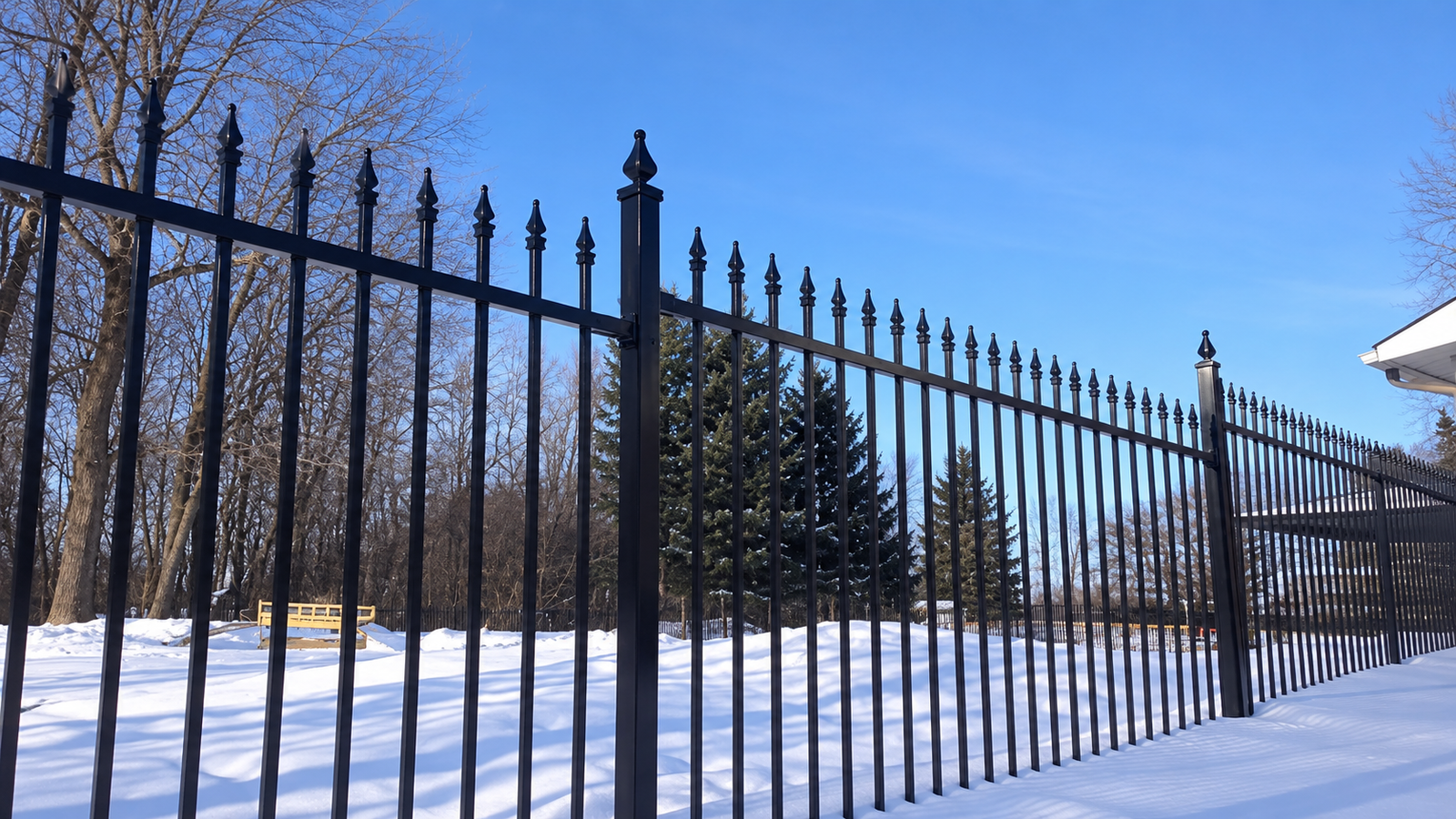
The blog cover image is for reference purposes only and does not depict the actual Medallion Fence product.
Walk through any building supply yard in Ontario this year and you will see maple leaves on almost everything, fence panels included. Since the tariff fight with the U.S. kicked off in 2025, "Canadian" has turned into a sales pitch. A lot of people are using the word loosely.
For a homeowner, a loose claim is irritating. For an architect writing a Section 32 31 19 spec, or a contractor certifying materials on a federal job, it can cost real money. Three different tests are now in play, set by two different arms of the federal government, and they don't measure the same thing. A steel fence can pass one and fail another.
Here is how each test works, where steel fencing tends to get caught, and what paperwork to ask for before a product goes on your drawings or into your bid.
Product of Canada: the 98 percent test
The Competition Bureau's enforcement guidelines were refreshed in March 2025, but the substance hasn't really moved since 2009. The Bureau generally won't challenge a "Product of Canada" claim if two conditions hold:
Condition one
The last substantial transformation of the good happened in Canada.
Condition two
At least 98 percent of the total direct costs of making it were incurred here.
For steel fencing, 98 percent is brutal. If the coil or tube came from a mill outside Canada, the claim is effectively dead. Even with Canadian steel, imported hinges, gravity latches or self-drilling fasteners can blow through a 2 percent margin on a small residential gate package. "Product of Canada" carries no qualifier, which is exactly why so few metal products can honestly use it.
Made in Canada: 51 percent, plus words most people leave off
The cost bar drops to 51 percent of total direct costs. The last substantial transformation still has to happen in Canada, and the claim needs a qualifying statement. The Bureau's own examples are "Made in Canada with imported parts" and "Made in Canada with domestic and imported parts."
So a brochure that says "Made in Canada" and stops there is already on thin ice, even if the plant is in the GTA.
What counts toward direct costs? Materials, direct labour, and overhead tied directly to manufacturing, such as plant utilities and equipment depreciation. General corporate overhead usually doesn't count.
Here is the rule that catches people. If you buy steel from a Canadian service centre that imported it, that steel is generally not a Canadian cost. A Canadian invoice address doesn't change where the metal came from.
What "last substantial transformation" means for a fence panel
The Bureau's test is a fundamental change in form, appearance or nature, so that the result is new and different from what went in. Applied to ornamental steel fence:
Cutting, welding and coating in Canada
Cutting and punching tube, then robotically welding pickets to rails into a rigid panel, then pretreating and powder coating it, makes a strong case for substantial transformation wherever that work happens.
Touch-ups on an offshore panel
Taking a finished, welded, coated panel made offshore and adding post caps, touching up the paint or re-boxing it is almost certainly not substantial transformation.
Knock-down kit assembly
Assembling a knock-down kit from components made elsewhere is a grey zone. Don't assume it qualifies.
The Bureau does enforce this. The Commissioner of Competition went after Moose Knuckles over "Made in Canada" parkas that were largely made in Asia and finished in Canada, and the matter ended in a consent agreement at the Competition Tribunal. Swap the parka for a fence panel and the logic is identical.
Buy Canadian: a completely different question
The federal Policy on Prioritizing Canadian Materials in Federal Procurement took effect December 16, 2025. It covers federal construction and defence contracts of $25 million or more that need at least $250,000 worth of steel, aluminum or wood products, where a Canadian source of supply exists. PSPC says the materials must be made in Canada, not just sold by Canadian companies. Suppliers certify before bidding and keep records through the contract to prove compliance.
Two things trip up fence trades on these jobs.
First, the $250,000 trigger counts all the steel, aluminum and wood on the contract, not the fence alone. On a $40 million federal building, the structural steel clears that line by itself. Your $80,000 perimeter fence gets swept in anyway. The general contractor signs the certification, so the obligation flows down the chain. The fence sub is the one who gets the phone call asking for proof.
Second, this test looks at the material, not the label. Government summaries say "manufactured or processed in Canada." At least one Toronto procurement law firm reads the steel requirement as melted and poured in Canada, and aluminum as smelted and cast here. Until your solicitation says otherwise, plan for the stricter reading.
That has a practical consequence. A fence that honestly qualifies as "Made in Canada with imported steel" under the Competition Bureau test can still fail a federal materials certification. The two systems ask different questions.
Also worth knowing
The companion policy that scores bids on Canadian suppliers and Canadian content now reaches contracts of $5 million and up.
The materials mandate itself still sits at $25 million.
Provincial and municipal work runs on its own rules. Ontario's MTO, for example, has drafted guidance that defines Canadian steel by a mill test certificate from a Canadian mill.
Always read the tender in front of you, not the press release.
The questions nobody gives a straight answer to
"The company is Canadian and the warehouse is in Vaughan. Isn't that enough?"
No. Ownership and warehouse location count for nothing under either the Bureau test or the federal materials policy. Where it was transformed and where the steel was made are what count.
"Does Buy Canadian apply to my backyard, my condo or my city park?"
Not directly. It governs federal procurement. Ottawa has said it will apply the approach where possible to Crown corporations and to federal grants and contributions programs. A federally funded municipal project may carry conditions, so check the funding agreement. For a private home, it doesn't apply.
"The brochure just has a maple leaf, no words. Is that fine?"
Not necessarily. Under the Competition Act, a claim is judged by its general impression, not only its literal words. A flag beside a panel photo can be read as an origin claim, so hold it to the same standard.
"Is Canadian steel fencing going to cost me more?"
Often yes, sometimes not by much. It depends on the product line and on tariffs that keep shifting. On federal work, PSPC's public summary lists exceptions for unavailability and for significant project delays. A cheaper import isn't on that list.
"What about the gate hardware?"
Ask. Hinges, latches, closers and panic hardware are frequently imported. They count in the direct cost math, and on a federal job a reviewer may well ask about them.
What to put in the spec
Here is sample submittal language for Part 1 of a decorative metal fence section. Adapt it to your project and have your own counsel or specifier review it.
"Origin Documentation: Submit the manufacturer's written statement of origin for each fence and gate assembly, identifying (a) the plant location where cutting, welding and coating are performed; (b) the country of melt and pour for all steel tube, bar and sheet, and the country of smelt and cast for all aluminium; (c) mill test reports bearing heat numbers traceable to material supplied for this project; and (d) the country of origin of gate hardware. Origin representations shall comply with Competition Bureau enforcement guidelines. Unqualified 'Made in Canada' claims will not be accepted."
What to ask any supplier, including us
Before a steel fence goes on your drawings or into your bid, every supplier should be able to hand you the following without hesitation. If they can't, that tells you something.
Red flags to watch for
"Canadian" without paperwork
A supplier who says "Canadian" but can't produce mill paperwork.
"Product of Canada" with imported hardware
"Product of Canada" printed on a steel panel with imported hardware.
Inconsistent origin claims
An origin claim that reads differently in the brochure than in the submittal package.
Three labels, three different tests, two federal bodies. "Product of Canada" demands 98 percent Canadian direct costs. "Made in Canada" demands 51 percent plus a qualifying statement about imported parts. "Buy Canadian" on federal work can demand melt-and-pour origin for the steel itself — a bar a product can clear under the Competition Bureau's test and still fail on a government site. The word on the brochure is the start of the conversation, not the end of it. Ask for the mill test reports, the plant address and the exact wording of the claim, in writing, before anything goes into your spec.
Specifying a steel fence for a Canadian project?
Talk to us about plant locations, mill traceability and the exact origin claim we put in writing — for ornamental steel fence, gates and hardware.
Request a Quote