


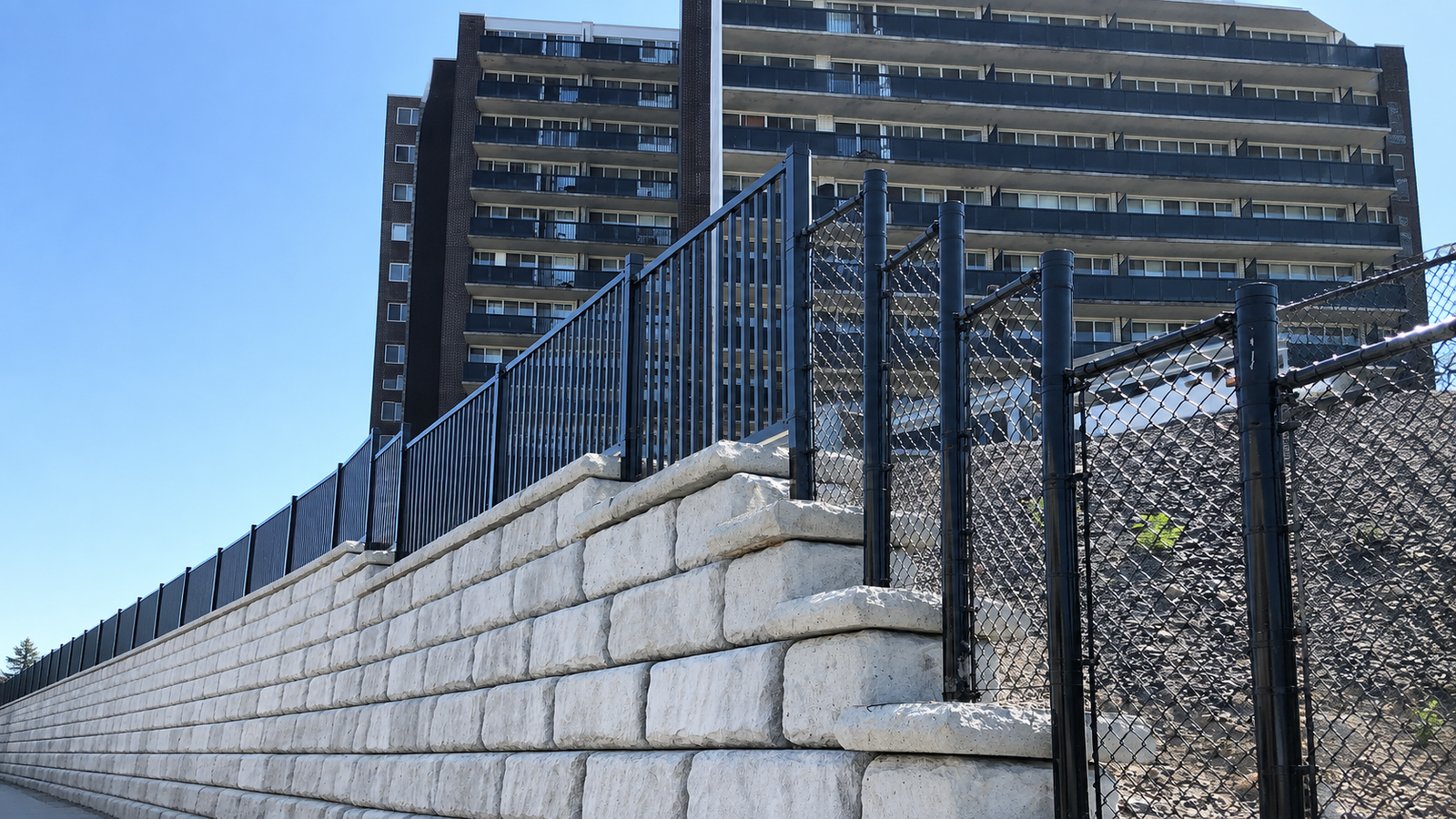
The blog cover image is for reference purposes only and does not depict the actual Medallion Fence product.
Drive through almost any employment area in Canada, from Vaughan and Mississauga to southeast Calgary, and you'll see the same perimeter over and over. Galvanized chain link, three strands of barbed wire, a couple of bent posts where a plow clipped them in February, and privacy slats that went from green to grey years ago.
Chain link became the commercial default for good reasons. It's cheap per metre, every fence crew in the country can install it, and nobody gets second-guessed for specifying it. But a default isn't automatically the right choice. If you're an architect drawing a perimeter for site plan approval, a contractor pricing Division 32, or an owner deciding what faces the street, the useful question is narrower. Where does ornamental steel earn its premium over chain link, and where is chain link still the better call?
This post tries to answer that honestly, including the places where we'd tell you not to buy what we make.
Two systems that behave differently
Chain link is a tension system. Woven wire fabric is stretched between terminal posts and held with tension bars, bands, a top rail or tension wire. In Canada it's covered by the CAN/CGSB-138 series (fabric, framework, installation and gates). Ontario provincial work also references OPSS 541. Its strength depends on fabric tension and on the terminal posts staying plumb. Cut the fabric or lean a corner post, and the whole run starts to sag.
Ornamental steel is a frame system. Tubular pickets pass through rails and are welded into rigid panels, which are then bracketed to posts. The relevant ASTM specifications are F2408 for galvanized steel pickets and F2589 for black steel. Each panel carries its own load, so damage stays local.
Nearly every cost, security and maintenance difference below follows from that one distinction.
Lifecycle cost, without made-up numbers
We won't publish a per-metre price. Pricing moves with steel costs, height, grade, region, frost depth and site access, and any national figure you find online is a guess. What we can give you is the framework a quantity surveyor would use:
Total cost of ownership = installed cost + routine maintenance + expected repairs + any replacement during the hold period + the cost of failures (theft, trespass, liability claims) minus residual condition at the end.
Chain link wins the first line almost every time. It gives ground in the others:
Repairs are small but frequent.
Typical events include cut fabric, a top rail bent by a forklift or a climber, bottom fabric curled by plow windrows, and snapped tension wire. Each one is cheap, but they keep coming back.
Slats change the engineering.
Privacy slats turn an open mesh into something close to a sail. They add wind load the original post spacing and footings may not have been designed for, and they catch drifting snow.
Coatings age near salted roads.
Plain galvanized fabric along arterial roads will eventually show rust staining. Polymer-coated fabric, such as black vinyl to ASTM F668, lasts longer, but the coating can be breached at ties and cut ends.
Appearance triggers replacement.
Plenty of chain link gets torn out not because it failed, but because it looks tired when the building goes up for lease or sale.
Ornamental steel has its own costs:
Higher first cost and heavier handling.
Panels are built to the run, so field changes are harder than with chain link.
Like any fence, it depends on its footings.
Frost heave affects both systems, but a rigid welded panel is less forgiving of post movement than flexible fabric, so footings below frost depth matter more.
On the plus side, maintenance is mostly washing and touching up chips, and a vehicle strike usually means replacing one panel rather than re-tensioning a run. Coating quality decides how well it ages. Look for a hot-dip galvanized substrate, a conversion coat and a UV-stable powder topcoat. Medallion steel is backed by a 20-year warranty.
To run the comparison properly:
Price both systems on the same footprint and height.
Pull the last few years of fence repair invoices from comparable sites in the portfolio.
Apply your actual hold period.
On a short hold with no public frontage, chain link usually comes out ahead. On a 15 to 25 year hold, or along a street frontage that tenants and reviewers will look at, the gap narrows and often flips.
Security: what each system actually does
Chain link on its own is not a security fence. Standard diamond mesh gives toeholds, and the fabric cuts with hand tools in seconds. It can be hardened with smaller mesh, outriggers and barbed wire where your by-law allows; ASTM F2611 covers chain link security fencing. Once you add slats, you've also blinded your own cameras and patrol sightlines.
Ornamental steel slows people down differently. Vertical pickets offer no mid-height foothold when the style is chosen correctly, and tubular pickets generally need power tools to cut, which makes noise. ASTM F2814 is the ASTM guide for designing ornamental steel picket systems for security purposes. It frames the goal as increasing intrusion delay time, and lists hardening options from top-mounted accessories to infill such as expanded metal or chain link mini-mesh. That's the honest framing for both systems: no fence stops a determined intruder. A good one buys delay and keeps the site visible.
One practical note for specifiers.
If security is the brief, choose a style where the pickets extend past the top rail, and avoid decorative elements that create a ladder.
What municipalities expect along the street
There is no national rule. On commercial and industrial land, fencing is usually settled at site plan approval. In Ontario, section 41 of the Planning Act lets a municipality require walls and fences as conditions of approval.
Two developments shape how that plays out now.
First, Bill 23 (2022) narrowed site plan control. It pulled architectural details and landscape design aesthetics out of scope and exempted residential projects of 10 units or fewer. You may see fewer redline comments that simply say "upgrade fence for appearance." CPTED review, urban design guidelines and municipal standard drawings still drive the conversation, and each municipality applies the change differently.
Second, municipal standards often specify chain link deliberately. Brampton is a good example. Its Subdivision and Site Plan Fencing and Wall Standards call for:
a 1.2 m decorative metal fence along frontages between local residential streets and arterial roads where homes face the arterial
1.2 m chain link along parkland and hazard land boundaries and along public walkways
precast concrete walls next to industrial sites where outdoor storage is permitted
Brampton also publishes standard detail drawings for both ornamental metal fence and chain link.
The takeaway is that ornamental steel's natural territory is the street frontage and the public face of a site. It is not every lot line, and in some locations the municipality will dictate something else entirely. These standards also generally apply when you file an application. Existing chain link usually stays until a new approval triggers review.
Before design development:
Pull the municipality's standard drawings and urban design guidelines.
Raise the perimeter at pre-application consultation.
Call out picket clear opening, rail and post sections, and the finish system on the drawings. "Black metal fence" is not a specification.
Appearance and resale: the honest version
We don't know of reliable Canadian data that puts a number on how much fence type moves a commercial property's value, and we won't invent one. Commercial value comes from income and cap rates, not fencing.
Where the fence does show up is in two places:
Leasing.
A tenant tour starts at the property line.
Due diligence.
A building condition assessment lists deferred maintenance and near-term capital items. A sagging, rust-stained chain link run with broken slats becomes a line item, and line items become negotiating points. A well-maintained ornamental perimeter rarely makes that list.
The same logic applies at a smaller scale to estate homes and small mixed-use buildings.
Oxford, Preston or Hawkstone: which one fits
All three are fully welded and manufactured in Maple, Ontario. Each style has downloadable DWG and PDF details for your drawing set. Confirm spans, heights and gate details on shop drawings.
Oxford
1-1/2 in. x 1-1/2 in. rails, 1 in. square pickets (3/4 in. in Oxford.75), 2-1/2 in. minimum posts. Rated industrial, commercial and institutional. This is the most direct replacement for chain link along a street frontage. It suits retail plazas, office parks, institutional fronts, and the front of an industrial unit where the side and rear lines stay chain link.
Preston
2-1/2 in. x 1-1/2 in. rails, 1 in. square or 3/4 in. x 1-1/2 in. rectangular pickets, 3 in. minimum posts. The deeper rail reads heavier and gives more section. It fits mixed-use and multi-residential frontages, main entrances, and places where the fence sits next to masonry and needs to hold its own visually.
Hawkstone
2 in. x 2 in. rails, the same picket options, 3 in. minimum posts. It's the only one of the three rated for high security. Use it where you'd otherwise default to chain link with barbed wire: fleet yards, equipment compounds, logistics sites and utility perimeters. Check first whether your municipality requires a solid wall instead, as Brampton does next to outdoor storage.
Questions we hear that rarely get a straight answer
Can I put ornamental steel on the street side and chain link everywhere else?
Yes, and on many industrial sites it's the most sensible spend. Make the transition at a common post, use black polymer-coated chain link so the colours read together, and keep the changeover out of the main sightline from the street.
Will the city make me rip out my existing chain link?
Generally no, unless you trigger a new approval such as an addition, a change of use or a new site plan application. Confirm with your local planning department.
Will a reviewer accept black vinyl-coated chain link instead?
Sometimes, especially on side and rear lines. On the main frontage it depends on the municipality. It's worth asking at pre-application consultation, because it can be a legitimate cost-saving compromise.
What about snow?
Plan snow storage away from the fence line. Chain link fabric curls and stretches under plow windrows. Ornamental panels handle it better, but leave clearance under the bottom rail and don't let windrows pile against the pickets all winter.
Steel or aluminum?
Steel for impact resistance and security. Aluminum for coastal or very high-salt locations where vehicle impact is unlikely. Our steel vs aluminum guide covers this in detail.
The bottom line
Chain link is still the right answer for back lot lines, temporary enclosures, some municipally mandated locations, and short holds where first cost is everything. Ornamental steel wins along the street, at entrances, on sites that need visibility and delay together, and on longer holds where repeated repairs and a tired perimeter quietly cost more than the upgrade.
Run the numbers on your own site. If the frontage matters, the answer usually becomes clear.
Need details for a site plan submission?
Medallion supplies DWG and PDF drawings for Oxford, Preston and Hawkstone and ships to every province.
Request a quote at medallionfence.com.