


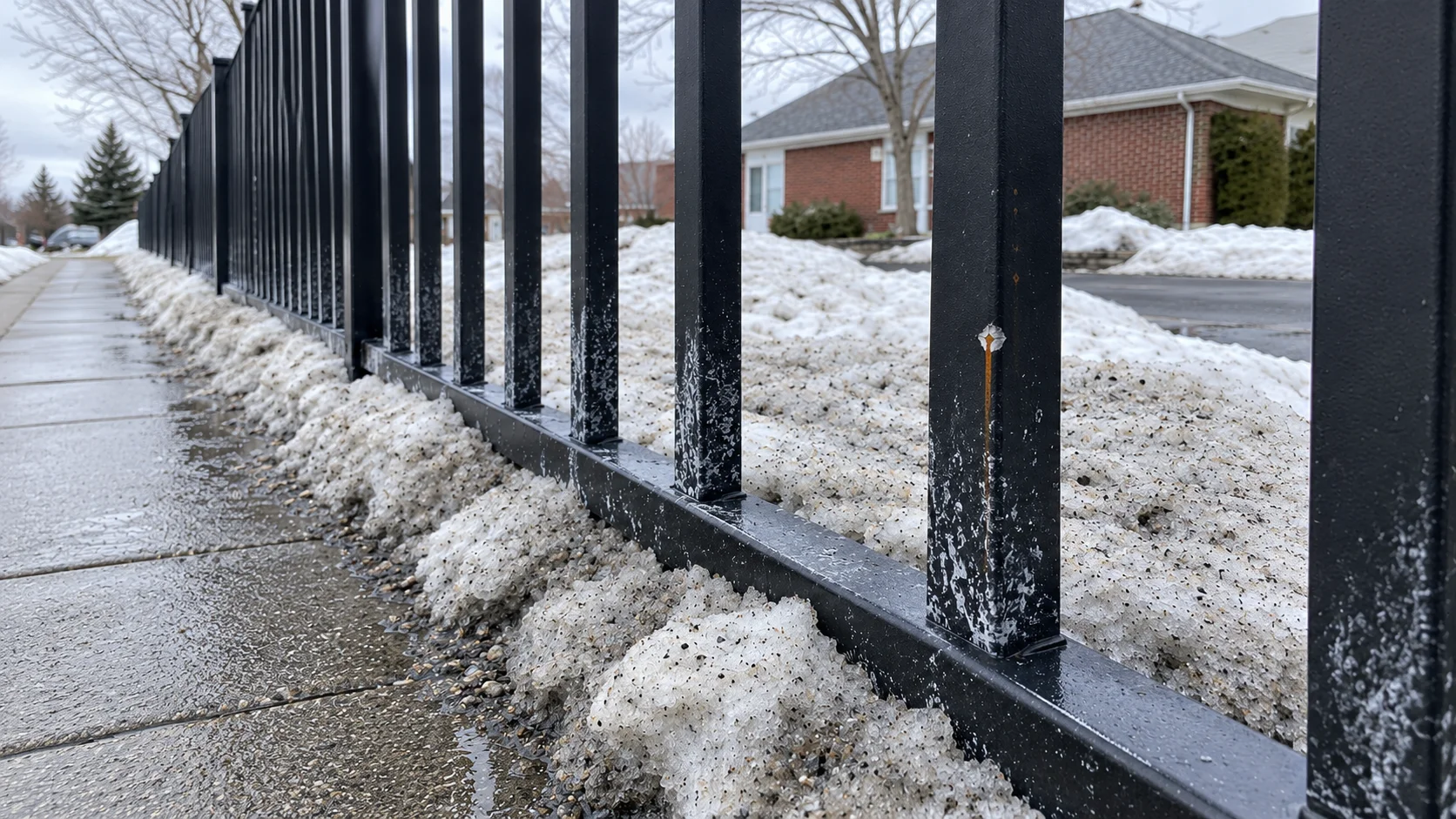
The blog cover image is for reference purposes only and does not depict the actual Medallion Fence product.
Short answer: yes, a steel fence can rust in Canada. The useful question is not whether it will, but where it starts, how long that takes, and which of the three or four layers on your fence gives up first.
Most articles on this answer the question with the paint. Paint is the easy part to talk about because it is the part you can see. The layer that decides whether you are replacing panels in year nine or year thirty is the metallic coating underneath, and almost nobody explains it to homeowners before they sign.
So here is that layer, in plain language, for the three options you will hear named: hot-dip galvanized, Galvalume, and ZAM.
Why the Topcoat Is Not the Answer
Picture a typical powder coated steel fence picket in cross section. Steel in the middle. A metallic coating of zinc or a zinc alloy bonded to it. A pretreatment layer. Then powder coat on the outside.
The powder coat is a barrier. It works beautifully right up until something breaks it. A string trimmer at the bottom rail. A hockey stick. A shovel. The installer's drill bit. A gate latch rubbing in the same spot for six winters. Once the barrier opens, the powder coat does nothing for the hole, because polyester powder has no galvanic activity. It cannot protect steel it is not touching.
The metallic coating can. Zinc corrodes in preference to steel, so a small scratch gets covered by zinc corrosion products and the steel underneath stays intact. That is why the question "how thick is your powder coat" is much less interesting than "what is under it."
Hot-Dip Galvanized: What G60 and G90 Actually Buy You
Galvanized means a zinc coating applied by dipping steel in molten zinc. For sheet steel, which is what fence tube is rolled from, the amount of zinc is stated as a coating weight.
G60 is 0.60 oz per square foot, about 180 g per square metre, counting both sides of the sheet together. G90 is 0.90 oz per square foot, about 275 g per square metre, again both sides combined. (GalvInfo, GalvInfoNote 1.1)
That "both sides combined" wording is where people get fooled. Split G60 evenly and each face carries about 90 g per square metre of zinc. At zinc's density that works out to roughly 12 to 13 microns per side. G90 gives you about 19 microns per side. For comparison, a sheet of printer paper is around 100 microns thick.
Worse, the ASTM rules only require that a single spot test on one side holds at least 40 percent of the total both-sides figure. So a G60 sheet can legitimately have noticeably less zinc on the face that ends up pointing at the road.
How long does 12 to 19 microns of zinc last once it is exposed? ISO 9223 puts zinc loss in a typical urban environment, which covers most of populated Canada, at 0.7 to 2.1 microns per year. Industrial and near-coastal sites run 2.1 to 4.2 microns per year. (American Galvanizers Association, ISO 9223 corrosivity categories)
Run the arithmetic, and treat it as an estimate rather than a promise: at the middle of the urban range, the zinc on one face of a G60 tube is good for roughly nine years of exposure, and a G90 tube for roughly fourteen. In a rural Prairie yard with no road salt nearby, both could run two or three times longer. Within a kilometre of saltwater on Vancouver Island, cut those numbers in half.
The important caveat: that clock does not start on installation day. It starts at the scratch. An undamaged powder coat can hold for decades. This is the real reason two identical fences on the same street age differently.
For context on what the standard asks for, ASTM F2408, the specification for ornamental tubular picket fence, sets a minimum of G-90 for industrial applications and G-60 for commercial and residential. Published manufacturer submittals written to that standard call for a minimum of 1,000 hours of ASTM B117 salt spray "without failure," with failure defined as 1/8 inch of coating loss from the scribe or medium number 8 blisters, plus retention of film over 90 percent of the scribed surface under ASTM D3359. (ASTM F2408-16 reapproved 2023; industrial fence submittal, Centurion II)
That 1,000 hour figure is the yardstick worth remembering, along with the fact that a real salt spray result comes with a defined failure criterion attached. Keep both in mind when a salesperson quotes you salt spray hours.
Galvalume: Good Coating, Usually the Wrong Job
Galvalume is a registered trademark for a coating of 55 percent aluminum, 43.5 percent zinc and 1.5 percent silicon. In atmospheric exposure it outlasts plain galvanized by roughly two to four times depending on the environment, and the published exposure data is genuinely impressive: in rural testing it came in 18.7 times better than galvanized, and in moderate marine exposure 8.2 times better. (GalvInfo, GalvInfoNote 1.4)
So why are you unlikely to be offered a Galvalume fence?
Two reasons. First, it is overwhelmingly a roofing and siding product, sold as flat and profiled sheet, not as the welded tube a picket fence needs. Second, and this one matters in a fence context specifically, the licensor states that 55 percent aluminum-zinc sheet should not come into contact with wet concrete, because the alkalinity attacks the aluminum. It is also not recommended or warranted for animal confinement buildings.
Fence posts get set in concrete. That is a straightforward conflict.
None of this makes Galvalume a bad coating. It makes it a coating optimised for a roof, and you should be mildly suspicious of anyone pitching it as a fence upgrade without mentioning the concrete issue.
ZAM: What the Coil Maker Claims, and What the Claim Is Worth
ZAM is a hot-dip coating developed by Nippon Steel: zinc with 6 percent aluminum and 3 percent magnesium. It falls under ASTM A1046, the specification for zinc-aluminum-magnesium alloy coated steel sheet.
Nippon Steel's own technical literature claims ZAM performs 10 to 20 times better than hot-dip zinc coated sheet, and 5 to 8 times better than zinc-5 percent aluminum alloy coated sheet. Both figures are stated as "estimated by salt spray test." (Nippon Steel, Steel Sheet ZAM catalogue U110en)
Read that attribution carefully, because it is doing a lot of work. The claim comes from the company that makes the coil, it is a laboratory salt spray comparison, and it is explicitly an estimate. Any fence company repeating "ten to twenty times" as though it were a field lifespan is borrowing someone else's lab result and quietly converting it into years. It is not a years figure.
What is genuinely interesting about ZAM is the mechanism at damage sites. The magnesium and aluminum leach out of the coating and form a fine protective film over exposed edges and scratches. In other words, the coating keeps working after you cut it, drill it, or scrape it. For a fence, which is drilled, cut on site, and attacked by lawn equipment for its entire life, that behaviour is more relevant than any headline multiple.
The honest summary: ZAM is a real metallurgical improvement with a credible mechanism behind it, the comparative numbers belong to the coil maker rather than to any fence brand, and salt spray hours do not convert to Canadian winters.
A Note on Salt Spray Hours
ASTM B117 runs a continuous 5 percent sodium chloride fog in a heated chamber. There is no accepted conversion from B117 hours to years of real service, and the standard does not claim one. The test is deliberately constant, where real corrosion is cyclic: wet, dry, freeze, thaw, repeat. That is precisely the cycle a Canadian fence lives in, and it is the cycle B117 does not reproduce. The test is a comparison tool between coating systems, not a calendar.
So if a product is tested at 3,000 hours, do not translate that into decades. Translate it into "three times the 1,000 hour threshold used for ornamental fence coatings under F2408." That is a defensible statement. And ask for the report, not the number. A credible manufacturer will hand you the lab document with the panel description, the standard revision, and the failure criteria. Anyone who will not send the report is quoting marketing.
Where Canadian Fences Actually Fail First
This is the part no one writes down, and it has very little to do with coating chemistry.
The sidewalk side goes before the yard side.
On any fence along a municipal sidewalk, the plow throws salted snow against the same face, and that snowbank sits there from January to March. Canada uses roughly five million tonnes of road salt a year, with Ontario, Quebec and the Atlantic provinces using the most. (Environment and Climate Change Canada) Long contact time plus chloride is the worst combination there is for zinc. Walk a fence line in April and you can usually tell which side faces the street without being told.
Gate hardware goes before the panels.
Hinges, latches and self-closers sit at the exact spot where you throw ice melter on the walkway every February. They have moving parts, they have fasteners, and they are often a different alloy than the frame. If one part of the fence is going to annoy you in year seven, it is the gate.
Cut ends are bare steel.
Installers cut panels to fit odd runs. Every cut exposes raw steel, and the picket cap and rail end are where water collects. This is also a warranty issue, which is covered below.
The grade line is a corrosion band.
The few centimetres right at soil, mulch or concrete level stay wet longest and dry slowest. Mulch piled against a post is a wet compress held in place for years.
The inside of the tube matters too.
Water enters through screw holes and uncapped tops, then sits. Internal coating weight is rarely mentioned in residential quotes. Ask whether posts are capped and whether there is any drainage path.
Alberta and the Prairies have a different problem, not a smaller one.
Below about minus 15 degrees salt stops working, so Calgary switches to a sanding mix that is 97 percent gravel and 3 percent salt, plus liquid calcium chloride. (City of Calgary road salt management plan) That is less chloride soaking, but far more abrasive blasting at the bottom rail from plows and blowers. Prairie fences tend to fail by mechanical coating damage rather than salt attack. Different problem, same hole in the powder coat.
Dogs are a real factor.
Repeated urine on the same post base delivers chloride and urea to one small area, over and over, often in a spot that never gets rinsed. Fence companies know this and almost never say it.
White powdery staining on new material is usually not a defect.
Galvanized steel stored in a bundle in damp weather develops wet storage stain, sometimes called white rust. It is cosmetic zinc corrosion product, not failure of the coating.
The Warranty Paragraph Nobody Reads
Pull the actual warranty PDF before you buy, and read the exclusions rather than the headline number. Two real examples from major ornamental fence brands:
Fortress Building Products' 20 year FortressShield warranty on Versai drops to three years for installations one mile or less from the ocean or other saltwater. It also excludes damage from "chemicals used for ice removal," and states that "surface corrosion from scratches, nicks and dents are not covered."
Ameristar's Montage residential warranty is a lifetime limited warranty, but it "does not apply to installations within 1 mile of salt-water coastline," where it becomes a five year pro-rated warranty instead. It also excludes any on-site cutting or welding done without proper sealing, and damage from lawn and garden equipment.
Read those two together and the implications for a Canadian buyer are blunt. If you live in Victoria, Vancouver, Halifax, St. John's or Charlottetown, the headline warranty number probably does not apply to you. If you live anywhere that salts a sidewalk, the single most common cause of fence corrosion in this country may be specifically excluded. And if the installer cuts a panel to fit and does not seal the cut properly, coverage on that section can be gone before you have paid the invoice.
These are not unusual terms. They are normal, and that is the point.
What to Ask Before You Sign
Six questions. They take two minutes and they separate suppliers fast.
What is the metallic coating under the powder coat, and what is the coating weight?
You want a number, like G60, G90, or a g per square metre figure, not the word "galvanized."
Is the inside of the tube coated, and are posts capped?
Which ASTM standard does the system meet?
For ornamental tubular picket fence, F2408 is the relevant one, and it has separate residential, commercial and industrial classes.
Can you send the salt spray report, not the number?
What does the warranty exclude?
Specifically, ice melter chemicals, scratches, and distance from saltwater.
How do your installers seal field cuts, and does that follow the warranty requirement?
If a supplier answers the first and fourth questions without hesitating, you are probably dealing with a manufacturer rather than a reseller.
For Architects and Specifiers
Four lines are worth tightening in a fence spec.
Name the substrate standard and the coating designation, not just "galvanized steel." ASTM A653 with a G-designation for zinc coated sheet, or A1046 if you are specifying a zinc-aluminum-magnesium coating. Note that F2408 is written around galvanized tube, so a Zn-Al-Mg substrate is a substitution that needs stating rather than assuming.
Specify internal coating, because tube interiors are where unspecified work gets cheap.
Require the salt spray report as a submittal, with the standard revision and the failure criteria, rather than a stated hours figure.
Specify the field cut treatment. This is the detail that voids warranties and it is almost never drawn.
One technical note if you are detailing a duplex system of powder coat over galvanized: moisture and air trapped in the zinc layer can outgas during cure and produce pinholes and blisters, and zinc oxide and hydroxide on weathered galvanized surfaces inhibit adhesion. Proper pretreatment and a thermal bake before coating are not optional extras. (American Galvanizers Association, preparing HDG for powder coating)
So Does It Rust?
Eventually, somewhere, yes. Steel is steel.
But a fence does not fail as a fence. It fails at a scratch, a cut end, a gate hinge, or the twelve centimetres above grade on the street-facing side. The coating system decides how fast that one spot spreads.
Galvanized with a properly applied powder coat is a proven, well-standardised system, and for most Canadian yards away from the coast it is enough. Galvalume is excellent metallurgy aimed at roofs, and the wet concrete restriction makes it an awkward fit for posts. A zinc-aluminum-magnesium coating like ZAM brings something genuinely useful to a fence, which is that it keeps protecting the places you damaged, though the headline multiples belong to the coil maker's lab and not to your backyard.
Ask what is under the paint. That one question tells you more about your fence's next twenty years than the colour chart ever will.