




Most steel fence specs spend a page on picket size, post wall thickness and powder coat colour. Then they give one line, if that, to how the panel is actually held together.
That is backwards. On an ornamental steel fence, the picket-to-rail joint is where performance is decided. Load concentrates there. Water sits there. Coating is thinnest there. And when someone shows up with a pry bar at 2 a.m., that is where they start.
Choosing a joint type also means choosing how the fence will eventually fail. This guide ranks the three construction methods on the criteria that matter for commercial and institutional work in Canada: failure mode, tolerance and security. We manufacture fully welded panels, so we will tell you where welded construction wins and also where it doesn't.
The three methods, defined properly
Welded panels
Welded panels have pickets fused to the rails. There are two main designs. In a through-rail design, the picket passes through a punched rail and is welded at the intersection. In a face-welded design, the picket is welded to one face of the rail. A panel welded in a controlled factory and a panel welded on site in February are not the same product, even if the drawing looks identical.
Bolted, or component, panels
Bolted, or component, panels are held together with screws, bolts or rivets. They often ship knocked down and get assembled on site.
Roll-formed panels
Roll-formed is the term most often misused. Roll-forming describes how the rail is made: coil steel is run through a series of forming stands until it becomes a channel. It says nothing about how the picket is held in place. Most roll-formed systems lock pickets mechanically, with an internal retaining rod, a crimp, or a rotating lock. So when a supplier says "roll-formed," ask the follow-up question: what is actually holding the picket?
How bolted panels fail
Loss of preload
Vibration, gate slam, thermal cycling and frost movement slowly back fasteners off. A loose picket starts to rattle, the rattle wears through the coating at the hole, and the hole starts to rust.
Galvanic corrosion
Stainless fasteners on zinc-coated steel look like an upgrade. In wet, chloride-heavy conditions, the coating around the hole sacrifices itself to the fastener.
Field-drilled holes
Every hole drilled on site leaves a ring of bare steel that no factory finish ever covered.
Exposed fasteners
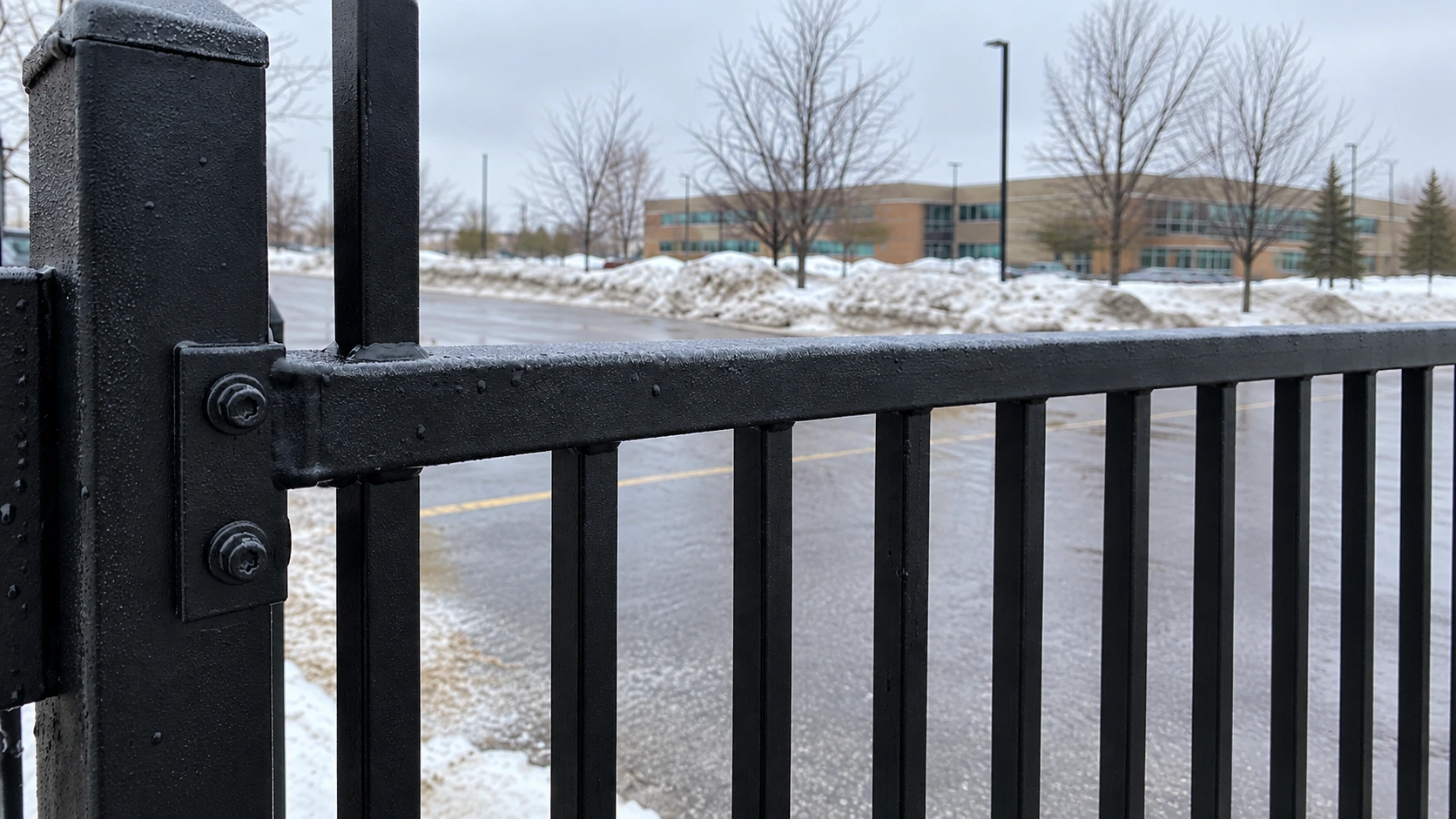
Every visible bolt head is a potential attack point. Bolted construction starts with a security disadvantage, and tamper-resistant hardware can only reduce it.
How roll-formed, mechanically locked panels fail
Lower joint stiffness
A mechanical lock allows some rotation. That rotation is what makes the panel rackable, and it is also why the panel can shift out of square under lateral load, such as a person climbing it or a plowed snowbank leaning on it.
Hidden corrosion
Punched holes in pre-coated coil expose steel edges, and those edges rely on the surrounding coating for protection. If the retaining rod is plain steel, or the rail channel traps water, corrosion develops inside the rail where nobody inspects it.
Picket creep
A worn or under-designed lock lets pickets slip or spin. Picket spacing then drifts, which becomes a code problem on pool enclosures.
How welded panels fail, and what prevents it
Welding has real failure modes, and a manufacturer who pretends otherwise isn't worth your time.
Coating loss at the joint
Welding heat burns off metallic coating right at the weld. If the panel is welded after it is finished, or touched up in the field with a spray can, the weld becomes the first place rust appears. The fix is about sequence. At our Maple, Ontario facility, punching, welding, powder coating and inspection all happen in-house, and the finish goes on after the welds are made, so no weld is left exposed.
Weld metal that rusts
A standard carbon steel weld bead is just more steel waiting to corrode. Our spec sheets call for stainless steel MIG welds, so the weld metal itself resists rust. The heat-affected area next to the bead still depends on pretreatment and powder coat, which is why sequence matters as much as filler.
Fatigue at the weld toe
Gate leaves and panels next to operators see repeated loading. Weld quality and member size both matter here. On our Oxford commercial series, rails are 1-1/2" square 14 gauge, pickets are 1" square 16 gauge, and posts are 2-1/2" square 14 gauge, with HSS posts available at 3", 4" and 6".
Rigidity on grade
A conventional welded panel holds its rectangle, so on a slope it has to be stepped. This is the one area where welded construction gives up ground, and it is covered below.
Tolerance: where your install budget goes
Welded panels leave little margin for layout error. A standard Oxford panel is 93-1/4" (2369 mm) wide on a 96" (2438 mm) standard post setting. That means the layout has to be right before concrete goes in. Cutting a welded panel in the field leaves an uncoated rail end and removes a factory weld. On a commercial job, the post layout should be surveyed, not paced off.
Grade changes are the second tolerance issue. There are three honest options with welded construction:
Step the panels
Clean and rigid, but every step leaves a triangular gap under the bottom rail.
Extend the pickets
Our Oxford drawings note that pickets can be lengthened to accommodate grade changes, so the bottom line can follow the ground while the panel stays fully welded.
Use a rackable welded panel
Our Hillcrest series is welded and racks up to 36". Be clear about its class, though: it is a residential series with 5/8" pickets and 1-1/4" rails. It is not a substitute for Oxford on a commercial perimeter.
Thermal movement is the tolerance issue almost nobody calculates. Steel moves about 12 millionths of its length per degree Celsius. Take a 2369 mm panel from minus 40 in January to plus 35 on black powder coat in July. It changes length by just over 2 mm. Across a 100 m run, that adds up to roughly 90 mm. Bracketed panels absorb this at every post. Long runs that are site-welded continuously to posts do not, and the movement ends up as cracked coating at the welds.
Security: what the joint actually controls
The joint determines how three common attacks play out:
Spreading pickets apart
A welded through-rail joint resists this best, because the picket is captured by the rail and fused to it.
Removing pickets
Bolted panels are weakest here. Mechanical locks with no exposed hardware fall in between.
Climbing
This depends on rail placement and picket tops, not the joint.
There is a point most suppliers skip. On a welded system, the weak point moves from the picket joint to the bracket that connects the panel to the post. That is still a bolted connection. Our spec sheets list tamper-proof nuts as an option for exactly this reason. On any public-facing commercial run, specify them.
For high-risk sites, ASTM F2781 rates how long a fence system holds out against manual tools at low, medium and aggressive threat levels. If forced-entry resistance is a design requirement, ask for test data on the exact panel and post combination being quoted.
The ranking: commercial and institutional steel perimeters
This is our assessment for typical ornamental steel systems.
Overall ranking by criterion
Overall, factory-welded construction wins on the criteria that define a commercial perimeter: strength, security and finish integrity. It loses on site tolerance and single-picket repair. Good layout, extended pickets and correctly specified brackets close most of that gap. Nothing makes a bolted joint behave like a welded one.
Canadian questions that rarely get a straight answer
Will frost heave wreck a welded fence?
Not if the footings are right. A rigid panel transfers differential post movement straight into its brackets, so footing depth is non-negotiable. Ontario's building code sets 1.2 m as the working foundation depth for the Toronto area, and it is a sensible benchmark for commercial fence posts on GTA clay. Outside the GTA, use local frost depth or the geotech report.
Can a plowed snowbank damage a fence?
Yes. A compacted windrow against a parking lot fence applies real lateral load for months at a time. Rigid welded panels with heavier rails handle this better than mechanically locked infill, but posts and footings carry the load, so do not undersize them to save money on a lot perimeter.
Will my fence pass a Toronto pool inspection?
Joint type matters less than geometry here. Toronto's fence bylaw limits picket spacing to 38 mm where horizontal rails are less than 1.2 m apart, and to 100 mm where rails are 1.2 m or more apart. Our standard Oxford spacing is 3-7/8" (98 mm) between pickets, so check rail spacing against panel height before you order a pool enclosure. Vaughan, Mississauga and other municipalities have their own bylaws, so always confirm locally.
Does a fence need CWB-certified welding?
Not always by law. On commercial spec work, though, ban field welding outright. Factory welding under controlled conditions removes the variable entirely.
What happens after a vehicle hits a welded panel?
You replace the panel, not the picket. Because our panels are made to standard dimensions in Ontario, a matching replacement is a manufacturing order rather than a custom fabrication.
Can we install in winter?
You can, but powder coat chips more easily when handled in deep cold, and concrete footings need cold-weather protection. Budget for both, or schedule the work for the spring.
Spec language you can lift
These clauses can be adapted for Division 32 31 00:
Panels shall be factory welded, with pickets inserted through precision-punched rails and welded at every intersection. Field welding is not permitted.
All welding shall be completed before finishing. No uncoated weld metal is acceptable.
Minimum members: rails 1-1/2" square 14 ga, pickets 1" square 16 ga, posts 2-1/2" square 14 ga, tube to ASTM A787 with minimum yield of 45 ksi (310 MPa).
Panel-to-post bracket fasteners on the public side shall be tamper-resistant.
Field cutting of panels is not permitted without written manufacturer approval and approved touch-up.
Post footings shall extend below local frost depth, minimum 1.2 m in the GTA unless the geotechnical report states otherwise.
The bottom line
The panels in a fence matter less than what holds each picket to its rail. Bolted joints loosen, mechanical locks rotate, and welded joints fail only when the weld is left unprotected or done in the field. Specify the joint first, then pick the style.
For what sits underneath the powder coat, read our guide "Does a Steel Fence Rust in Canada? ZAM vs Galvanized vs Galvalume Explained." For drawings, DWG files and spec sheets on the Oxford, Preston and Hawkstone series, contact our technical team in Maple.
Ready to specify the joint first?
Get drawings, DWG files and spec sheets for the Oxford, Preston and Hawkstone series from our technical team in Maple, Ontario.
Contact the Team