




Aluminum Fence Systems
Aluminum Fence Systems
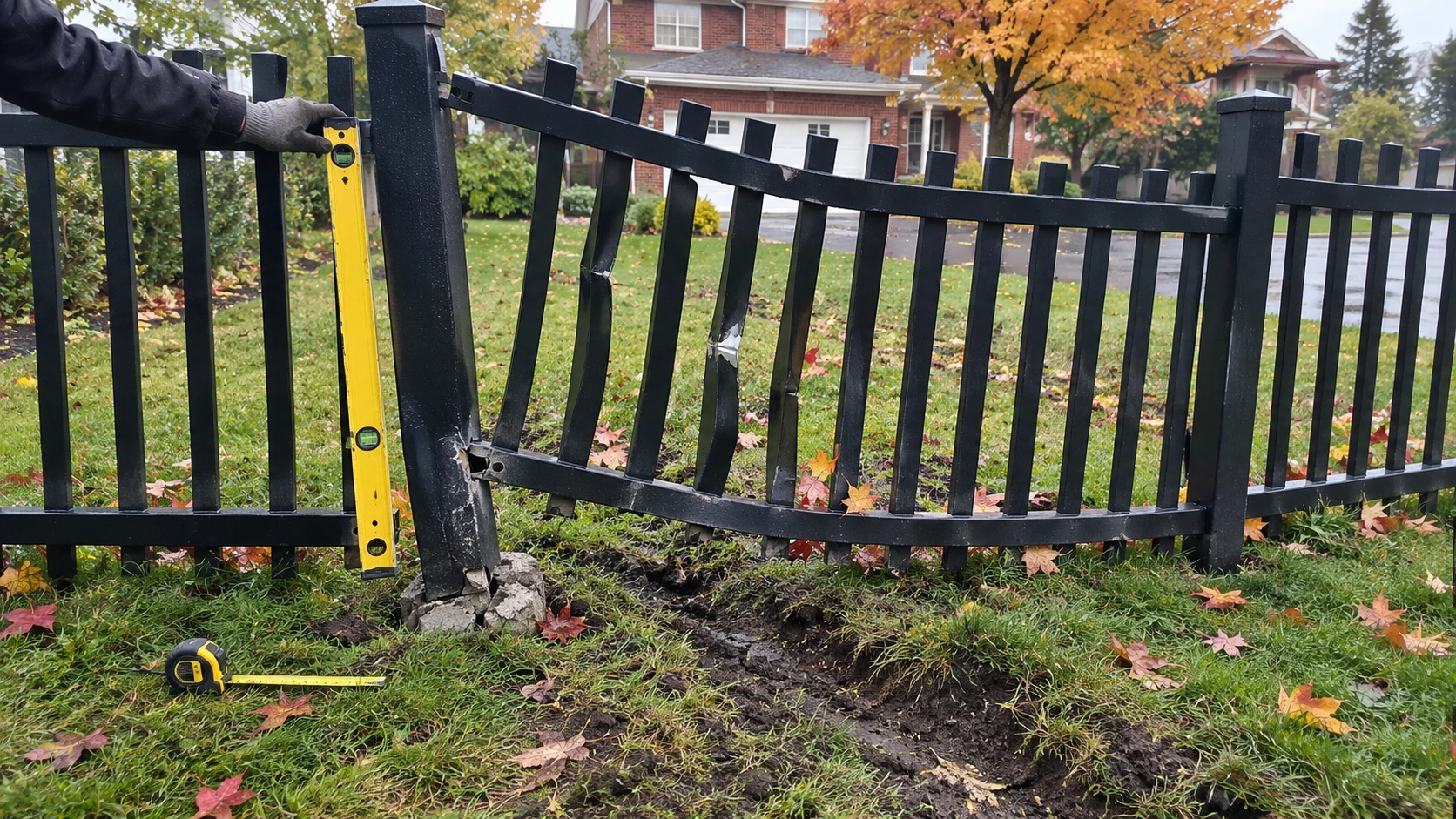
The blog cover image is for reference purposes only and does not depict the actual Medallion Fence product.
Nobody plans for this part. A summer squall rips through the neighbourhood, or a driver misjudges the corner at 2 a.m., and the next morning there's a run of black aluminum fence folded across your lawn like a bent paper clip. The natural reaction is to call someone and get it fixed fast.
That reaction costs Canadians money. The order you do things in after the damage decides how much of the bill you end up paying, and whether the repaired section will ever look like it belongs to the rest of the fence.
This guide covers what a good contractor checks on site, when a section can be repaired and when it has to come out, why colour matching powder-coated aluminum is harder than most people think, and how to build a claim file that an adjuster can't easily pick apart.
You have two jobs in the first 24 hours, and they pull in opposite directions. Insurers expect you to prevent further damage. They also expect to see the damage as it happened.
So secure the site, but don't clean it up. If the fence was part of a pool enclosure, treat it as urgent. Toronto's fence bylaw sets the minimum pool enclosure height at 1.2 metres, and bylaws elsewhere in Ontario, such as Pickering's, cap any opening in the enclosure at 100 mm. A storm-breached pool fence is a liability problem the moment it happens. Rent temporary construction fence panels, close off the gap, and take photos before and after.
What you should not do is drag bent panels to the curb or let a handy neighbour bend things back into place. In Quebec, for example, one condition for SAAQ hit-and-run compensation is that the property was not repaired before the SAAQ assessed the damage. The same logic applies to every adjuster in the country. Evidence that's been thrown out can't support your claim.
An aluminum fence isn't just pickets. It's posts, rails, pickets, brackets, fasteners, footings and a factory coating, all working together. Storms and vehicles break that system in different ways.
Wind loads the whole panel face and pushes that force into the posts. The typical failure shows up at the footing: a post that has rotated in the ground, a concrete collar that has cracked or heaved, sheared rail screws, or a gate that no longer swings true. A falling tree, by contrast, crushes one area.
A vehicle hit is a high-energy point load. The post usually bends at or just above grade, and the force telegraphs down the line through the rail-to-post connections. It's common for the visibly wrecked section to have racked the panels on either side, even when those panels look fine from the street.
Here's what to check, section by section, including at least one full section past the obvious damage:
Put a level on two adjacent faces of every post in the run. Any lean that wasn't there before means the footing moved.
Look for cracked collars, frost-style heave, and on surface-mounted posts, base plate anchors pulled or concrete spalled around them.
Routed holes that have ovalized or torn, and screws that have sheared or backed out.
Kinks, and hairline cracks at weld points on welded panels.
Crazing, cracks or chips along any bend line. This one gets missed constantly. A coating that has cracked lets moisture under the film, and on coated aluminum that's how filiform corrosion starts. You won't see it for months, and by then the adjuster has closed the file.
Sag, hinge alignment, and on pool gates, whether self-closing and self-latching hardware still works every single time.
Most fence extrusions are heat-treated 6000-series alloys, typically in T5 or T6 temper. That temper is what makes them stiff. It's also why cold-bending a kinked rail or post back into shape is a bad idea. Straightening work-hardens the metal at the bend, can leave micro-cracks, and almost always cracks the powder coat along the bend line. The fence looks repaired and then fails again in a few winters.
Our practical rule: scuffs and small chips are touch-up candidates. Anything that is kinked, bent or cracked gets replaced.
What gets replaced depends on how the fence was built. Welded panels are replaced as a whole panel. Mechanically assembled systems, where pickets are screwed or riveted into routed rails, can sometimes have individual pickets or rails swapped out, as long as the profile is still made.
Posts bent at grade get cut out and reset. When aluminum goes into concrete, it needs to be isolated, because concrete's high alkalinity attacks aluminum, so embedded aluminum is normally coated with a bituminous or similar barrier. Fasteners matter too. The usual guidance with aluminum components is to use stainless steel fasteners instead of ferrous ones to limit galvanic corrosion. Reset footings below the frost depth your municipality requires, which varies a lot between Victoria and Winnipeg.
Then there's the problem nobody mentions until the quote comes back: discontinued profiles. If the manufacturer has changed rail height, picket spacing or post routing pattern since your fence went in, a "close enough" panel from another line often won't physically fit the existing routed posts. When that happens, or when roughly a third or more of a run is damaged, pricing the full run is usually the more sensible conversation. That's a rule of thumb, not a law, but it reflects how these jobs tend to go.
This is the part homeowners, and sometimes even contractors, underestimate. Ordering a new panel in "Textured Black" from the same manufacturer does not guarantee it will match the fence you installed eight years ago. There are three reasons.
Architectural coatings are rated to AAMA specifications. AAMA 2604 allows a colour change under 5 Delta E after five years of exposure and requires over 30% gloss retention, while AAMA 2605 holds the same colour limit over ten years with over 50% gloss retention. A coating can shift 4 Delta E, pass its spec with flying colours, and still look noticeably different next to a brand-new panel.
Powder is made in lots. Each lot is approved against a colour standard within a tolerance, and the specs measure colour uniformity against limits set by an approved colour range sample. Two lots can both be in spec and still not be identical.
A difference in gloss level changes how a colour reads, especially on dark finishes like black and bronze. Lighter colours tend to show chalking and yellowing instead. Add metamerism, where two finishes match under shop lighting and don't match in noon sun, and you see why eyeballing it in a showroom is unreliable.
Dig out the original paperwork: manufacturer, product line, colour name and code, coating spec, and the powder lot number if it was recorded.
Take readings from the fence itself, not from a colour chip. Measure with a spectrophotometer on both the most sun-exposed and least-exposed sides, since a south-facing run fades faster than a shaded one.
Agree on an acceptable colour difference in writing before anything is ordered. Colour difference is calculated using methods like those in ASTM D2244, the standard practice for calculating colour differences from instrument readings. Without a number on paper, "it doesn't match" becomes an argument with no end.
Consider harvesting panels. Move undamaged original panels from the most visible run, usually the street side, into the damaged area, and install the new panels somewhere less visible, like a side yard. It costs a bit more labour and solves most mismatch complaints.
Full-elevation recoating is a last resort. Field-applied paint on aluminum doesn't perform like a factory powder coat, and proper off-site recoating means stripping and pretreating the metal.
Storm damage goes to your home insurance, usually under detached structures coverage. That limit is commonly set at 10% of the dwelling coverage, though each insurer can choose a different amount. Wind damage to fences is generally covered, and the Insurance Bureau of Canada lists fences among the detached structures that wind damage commonly affects. Don't assume, though. Some insurers sell it differently. Square One, for instance, treats detached structures, fences and landscaping as an optional coverage. Read your wording, and compare the repair estimate against your deductible before you open a claim.
Expect the adjuster to look closely at the footings and posts. Wear and tear, corrosion and pre-existing lean are typical exclusions, so an adjuster may argue that a post leaning after a storm was already leaning. Old photos help here. Check your phone's camera roll, your listing photos if you bought the house recently, and the historical imagery in Google Street View.
Vehicle damage is a different route. If the driver is identified, their auto policy should pay. Third-party liability, which every Canadian driver must carry, covers damage the driver causes to someone else's private property, such as a fence. That keeps the claim off your home insurance history.
In Ontario, get a police occurrence number. Since January 1, 2025, the reporting threshold for vehicle damage has been $5,000, but that threshold isn't the one that matters here. Police services such as Guelph's state that Ontario law requires collisions causing damage to property like signs and fences to be reported to police right away, regardless of the dollar amount.
Hit-and-runs and stolen cars are where homeowners get burned. In one Winnipeg case, a stolen car went through a homeowner's fence, and Manitoba Public Insurance said that when the vehicle is stolen and the driver is unknown, Autopac provides no coverage for the property damage. The homeowner was left with a $1,000 home insurance deductible. Quebec has a specific fallback: the SAAQ may compensate owners of damaged property, including fences, when the responsible driver can't be identified, provided the damage exceeds $500, with compensation capped at $10,000.
If a municipal snowplow did the damage, the claim goes to the municipality, and notice deadlines can be short. Call the city the same week.
This is the question Canadian homeowners ask most, and the honest answer is "usually not, but it depends on the evidence."
Most Canadian policies promise repair with materials of "similar kind and quality," not identical materials. A Nova Scotia small claims decision, Wilson v. Aviva (2015 NSSM 19), is the clearest Canadian example. Wind damaged a home's 20-year-old siding, and matching siding no longer existed. The adjudicator held that "similar" has to mean something and cannot mean "identical," and found that the insurer's plan to reuse original siding where possible and install new siding on one gable met the policy. But he also accepted that the mismatch reduced the home's value. He only awarded $100 for that loss because of the small claims cap on general damages, and wrote that he would have awarded substantially more without it.
He also made a point fence owners should remember: if repairing the damaged part necessarily requires repairing more than that part, the parts clause does not let the insurer escape liability. If a new panel can't physically connect to your existing posts because the profile is discontinued, you're no longer arguing about appearance. You're arguing about whether a repair is possible at all, and that is a much stronger position.
The takeaway: aesthetics alone rarely win full-run replacement. Measured colour data, proof of discontinuation and a clear explanation of why the parts are incompatible often do.
wide shots of the whole property line, mid shots of each damaged section with its neighbours, and close-ups of connections, footings and coating cracks with a tape measure or level in the frame. Add a slow video walkthrough.
Environment and Climate Change Canada publishes historical weather data, including wind gusts, for stations across the country. Save the readings for the date of loss.
the police occurrence number, plate number, driver and insurer details, and witness contact information.
invoice, product spec sheet, colour name and code, coating spec and warranty.
direct damage, work needed for structural continuity, and matching work with its justification. Adjusters approve the first scope quickly. The third scope is where the negotiation happens, so keep it separate so it doesn't hold up everything else.
until the adjuster has seen them and released them in writing.
Winter damage complicates things. If a plow or a skidding car takes out posts in January, a temporary braced repair now and a permanent reset after the thaw is often the right call. Tell the adjuster up front that it's a two-stage repair so the second invoice isn't questioned.
Property managers should confirm whether the fence is a common element or the responsibility of an individual unit before anyone claims, and check how the corporation's deductible is handled. Two parties claiming the same loss creates delays for everyone.
Dealers have the cheapest fix for the colour problem, and very few use it. Keep a record for every job: manufacturer, profile, colour, coating spec, powder supplier, lot number, install date and photos. Better yet, offer customers one spare panel and a post from the same batch to store in the garage. When the storm comes, that spare panel is worth more than any spectrophotometer.
A damaged aluminum fence is rarely a disaster. It becomes an expensive one when the evidence is gone, the wrong party is billed, and a new panel goes up that doesn't quite match the rest. Get the order of operations right and most of those problems never come up.
Speak with our team about your repair or replacement options.
Call 905-832-2922