


Aluminum Fence Systems
Aluminum Fence Systems
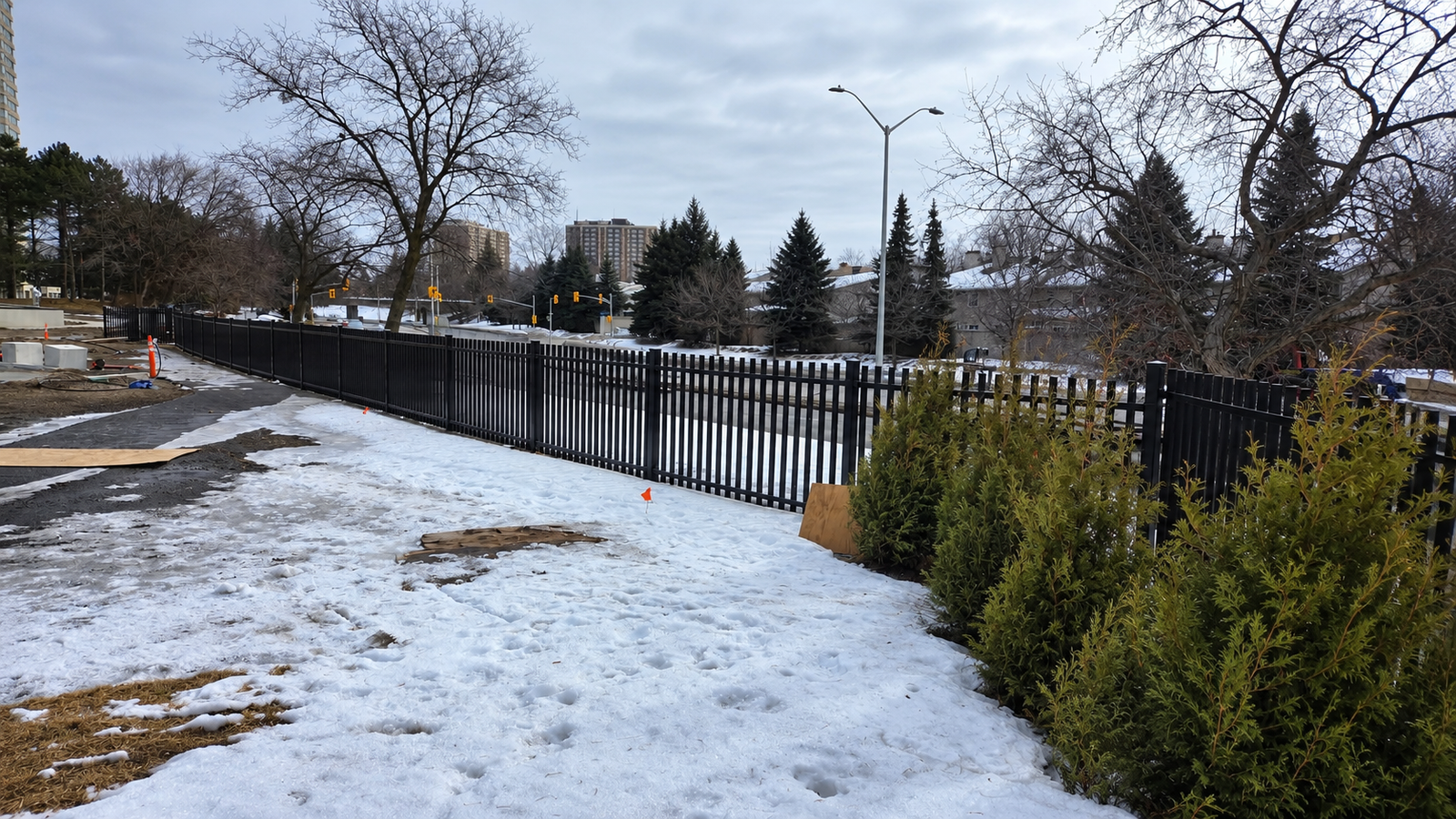
The blog cover image is for reference purposes only and does not depict the actual Medallion Fence product.
Yes. Crews in Ontario, Quebec and the Prairies set fence posts in January every year.
The real question is whether the job follows cold-weather practice or is just being done in the cold. By April, those are two very different fences.
A winter ornamental fence install depends on three things:
getting through frozen ground without wrecking the hole or hitting a utility
getting concrete to cure when the soil around it is pulling heat out
handling powder-coated steel that is less forgiving at minus 20 than it is in July
Here's how each one plays out on a real site.
CSA A23.1 is the standard most Canadian specifications and building officials rely on. Under A23.1, cold-weather conditions apply when there's a probability of the air temperature falling below 5°C within 24 hours of placing concrete, based on the nearest official forecast. In most of the country, that covers everything from late October to April.
Provincial building codes put hard numbers on it. When the air is below 5°C, concrete has to be kept between 10°C and 25°C while it's mixed and placed, then held at no less than 10°C for 72 hours. A23.1's basic curing regime follows the same logic: three days at 10°C or more, or long enough to reach 40 per cent of specified strength.
One point for architects and specifiers. A fence footing is not a Part 9 foundation, and many municipalities never inspect fence posts. That doesn't make the requirement optional. If your Section 32 31 19 (Decorative Metal Fences and Gates) references A23.1, the contractor is bound by it whether or not an inspector shows up.
Frost depth in Canada isn't one number. Industry guidance based on Natural Resources Canada frost data puts the range at roughly 0.5 metres on the BC coast to more than 2.4 metres in parts of northern Ontario and the Prairies. In southern Ontario, about 4 feet (1.2 m) is the working figure. One Canadian fence post patent cites it as a rough guide for that region and notes the real depth depends on local climate. Always confirm with your municipality.
In mid-winter, much of that depth is frozen solid. Frozen clay drills like weak concrete. A standard earth auger will chatter and walk across the surface. You need carbide rock teeth and a machine with enough torque, or you thaw the ground first.
One rule doesn't bend: never pour against frozen soil. Pouring on a frozen subgrade can freeze and crack the concrete before it cures. There's also a spring problem. When the frozen soil under the footing thaws, it settles, and the post settles with it.
Lay them over the fence line a day or more ahead, longer where frost is deep. Hydronic units handle long commercial runs efficiently. Expect rental and fuel charges.
It's common in Canadian winters, cuts frost cleanly with heated water, and is the safest way to expose buried services. It costs more per hole, but on a commercial frontage full of utilities it often pays for itself.
Set sonotubes or sleeves before freeze-up and cap them. Then come back and set posts when you're ready.
Utility locates don't stop for winter. In Ontario, the law requires anyone digging to contact Ontario One Call, and the request has to go in at least five days before the dig. Other provinces run their own services, such as BC 811, Utility Safety Partners in Alberta and Info-Excavation in Quebec. Paint marks on snow disappear with the next flurry or plow pass. Ask locators for flags or stakes, and photograph the marks the day they go down.
This is where most winter fences fail, and the failure is usually quiet. The concrete doesn't crumble. It freezes too early, loses strength and durability, and starts scaling at grade two winters later.
Canadian cold-weather specs commonly require concrete to be kept above freezing until it reaches 7 MPa. A post footing has little mass to hold its own heat and a lot of surface touching cold soil, so it gets there slowly.
Canadian ready-mix plants run hot water and heated aggregate all winter and can deliver concrete at a specified placement temperature. Bagged post-setting mixes are a different product. Most aren't air-entrained, so they won't meet a C-2 or F-2 exposure class. Their own packaging also usually restricts use in freezing temperatures. If a footing sits beside a salted driveway or municipal sidewalk, C-2 is the exposure class that belongs on the drawings.
It speeds up the set, but chlorides and embedded steel posts are a bad combination. A steel post in a chloride-loaded footing starts corroding early. If you need acceleration, specify a non-chloride accelerator in the mix design. Don't let anyone add it at the truck.
Put insulated blankets over the footing and the surrounding ground. Leave the ground heater running if the frost was deep. Keep protection on for the full curing period, then remove it gradually so the surface doesn't take a thermal shock.
Embedded temperature loggers are inexpensive now. The maturity method (ASTM C1074) estimates in-place strength from the logged temperature history. On commercial work, that record answers the question an architect should ask at substantial completion: how do we know these footings never froze?
Sometimes the smarter move is to stop fighting the ground.
Helical piles go into frozen ground with the right equipment. They carry load right away, and installation torque gives a field check on capacity. Many Canadian pile installers work all winter. On long runs or heave-prone clay, price them against thawed-and-poured footings.
Surface-mounted base plate posts work where the fence runs along an existing wall, curb or slab. Check the anchor's evaluation report for minimum base material temperature. Adhesive anchors vary widely, and some won't cure properly in a frozen substrate. Mechanical wedge anchors aren't affected by temperature, but they need proper edge distance.
You can also split the job, which is often the most sensible plan in October. Pour footings or set sleeves before freeze-up, then hang panels in December or January. Panels don't care what the ground is doing.
The ground is only half the story. Coated steel panels are tough, but cold changes how the finish behaves.
All polymers, powder coatings included, become stiffer and more brittle below a certain temperature, and that can reduce adhesion, impact resistance and chip resistance. In plain terms, a knock that does nothing at 15°C can chip the coating at minus 20. Welds, picket ends and bracket contact points are where it shows up first.
Site snow is mixed with sand and road salt, which is abrasive. Stack panels on dunnage, off the ground.
Stay within the manufacturer's racking range and move slowly. [MEDALLION TO CONFIRM: minimum temperature for racking or adjusting panels]
Cardboard and film that get wet and then freeze stick to the finish and hold moisture against it. Store panels dry and under cover.
An impact driver on a cold bracket can crack the coating around the fastener head. Set the clutch low or hand-finish.
Frozen panels brought into a heated shop sweat. Let them reach room temperature and dry off before cutting, assembling or rewrapping.
Field cuts and scratches expose bare steel, and touch-up coatings have minimum application temperatures. [MEDALLION TO CONFIRM: approved touch-up product, its minimum application temperature, and interim protection for field cuts in winter] Log every cut and nick by post number. Order panels to measure so field cuts stay rare.
Thermal movement matters more when you install in deep cold, because every component is at its shortest length. Steel expands about 12 millionths of its length per degree Celsius, and aluminum about twice that. Over a 60°C swing, from minus 30 in winter to plus 30 in summer:
a 2.4 m steel panel grows about 1.7 mm
the same length in aluminum grows about 3.3 mm
Dark coatings in full sun run hotter than air temperature, so real movement can be higher. On bracket systems, don't use up all the slot travel at installation. [MEDALLION TO CONFIRM: bracket slot tolerance and recommended set position for cold installs]
Usually it does. Expect line items for ground thawing, heated concrete, blankets and slower production. Ask each contractor to price winter conditions as a separate itemized line so quotes compare fairly. If a quote has no winter allowance, ask how they plan to handle frozen ground. "We'll just use fast-set" is a red flag.
Usually not. Most municipal pool enclosure by-laws apply year-round, whether the pool is open or closed. If you're replacing an enclosure in winter, any temporary barrier has to comply in the meantime. Confirm with your municipality before the old fence comes down.
Survey bars are hard to find in frozen ground. If the fence sits on or near the line, have the bars located and flagged before snowfall, or hire a surveyor. In Ontario, fences between neighbours fall under the Line Fences Act, so settle the boundary before any post goes in.
It should, if the footings are below frost depth and weren't poured on frozen ground. Gate posts still carry the most load and are the first to show any movement. A good contract includes a spring visit to adjust hinges and latches.
Ask the manufacturer and get the answer in writing. [MEDALLION TO CONFIRM: warranty position on cold-weather installation and handling]
Leave clearance from the driveway edge. A plow blade or a windrow of wet, icy snow piled against panels will do more damage than frost heave ever will. Open-picket ornamental fence doesn't catch drifts the way a privacy fence does, but plow piles are a different matter.
A winter fence is fine when the cold is planned for and a gamble when it isn't. For many projects, the strongest plan is the simplest one: get footings in before freeze-up and let panels go up whenever the schedule allows. If you're reading this in October, there's still time to book that.