


Aluminum Fence Systems
Aluminum Fence Systems
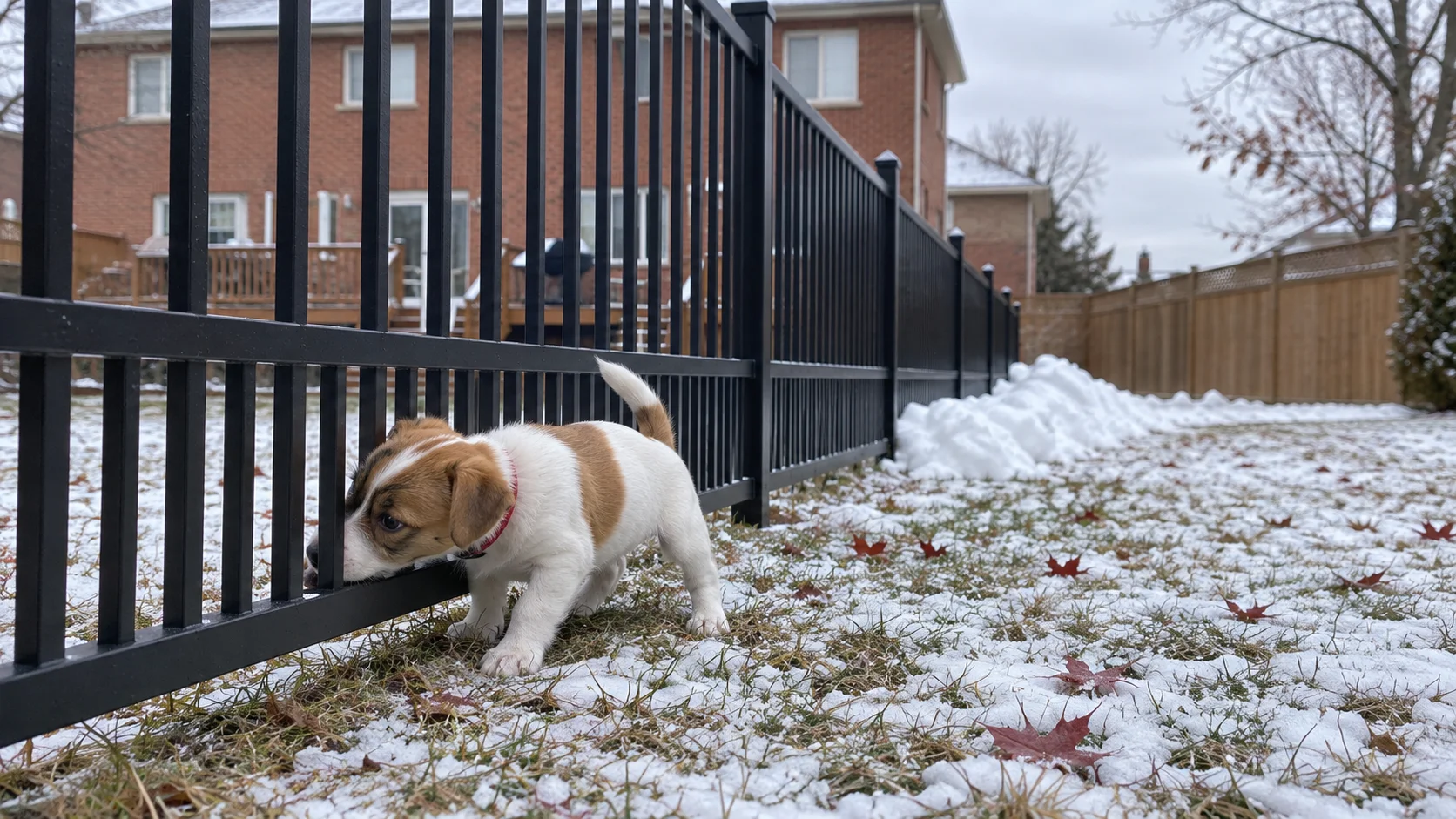
The blog cover image is for reference purposes only and does not depict the actual Medallion Fence product.
When a dog gets out of a yard with an ornamental metal fence, people usually blame the top of the fence. In practice, three other escape routes come up again and again in Canadian yards. The first is the puppy that turns its head sideways and walks straight between two pickets. The second is the terrier that finds the wedge of daylight under a stepped panel on a sloped lot. The third shows up in February, when a snowbank along the property line has quietly turned a 4 ft fence into a 30 inch one.
None of these failures is about strength. A welded panel can be perfectly built and still fail as a dog fence because of spacing, grade or snow. This guide covers all three, with real numbers, and explains where Medallion's Pet Guard Series fits and where it doesn't.
Most residential ornamental fence is designed around the pool code, not around dogs. Pool rules are built on a 100 mm (4 inch) sphere test because the goal is to stop a toddler's head. A small dog is a different problem.
Medallion's standard Fairmont panels have a clear opening of 3-9/16 in (91 mm) between pickets. That passes the 100 mm test with room to spare. It will not stop a Chihuahua, Yorkie, Pomeranian or Shih Tzu puppy, and it often won't stop a slim adult toy breed or a cat either.
Installers use a simple rule: if the head fits, the body usually follows. A puppy's ribcage compresses, and a motivated puppy is very good at testing every gap along a fence line.
Pet Guard is not a separate fence system. It is built on the Fairmont platform, which Medallion classes as residential and light commercial. Fairmont uses 5/8 in square pickets, 1-1/4 in square rails and a minimum 2 in post.
The difference is in the bottom of the panel. Medallion adds a short picket between each pair of full pickets across the lowest 24 in (610 mm). That splits the 91 mm opening roughly in half. On the steel drawings, the result is an opening of about 1-1/2 in (38 mm), with some bays at 1-7/16 in (37 mm). The aluminum drawings show figures closer to 1-9/16 in (39 to 40 mm).
Here are the other key specs from the current shop drawings:
Steel is the stronger and stiffer choice. If you have a large, athletic dog that charges or jumps the fence line, steel will resist that load better.
Aluminum doesn't rust at all, so it is the safer choice in harsh exposures. That includes lakefront lots, properties close to a salted road, and the spot by the driveway where the snowblower throws slush at the fence every winter.
For a small dog in a typical suburban backyard, both will do the job. In that case, choose based on your budget and how much salt the fence will see.
As a rule of thumb, 48 in suits most small and medium dogs that aren't jumpers. Huskies, shepherds, Malinois, doodles with springs in their legs and anything that has already cleared a fence once need 60 to 72 in.
Before you specify height, check your municipal bylaw. Toronto is a good example of why. In a front yard, Toronto caps fences at 1.0 m within 2.4 m of the front lot line and 1.2 m beyond that. In the rear yard, the limit is 2.0 m.
Run the math on the front yard. A 42 in panel is 1,067 mm on its own. Add a 50 mm ground clearance and you are already over 1.0 m. A 36 in panel with the same clearance comes to about 964 mm, which fits. Also check how your municipality measures height, and whether finials and post caps count.
On a slope, a welded panel stays plumb and square while the grade drops away underneath it. A stepped installation gives you a clean top line. The trade-off is a triangular gap that opens at the downhill end of every bay.
You can calculate that gap before the job starts. On aluminum Pet Guard with 90 in (2,286 mm) post centres:
The grade drops about 183 mm (7.2 in) per bay.
It drops about 229 mm (9 in) per bay.
Add your ground clearance to that, and the downhill corner of every panel can end up with a gap larger than the Pet Guard openings you paid for.
Use shorter bays to cut the drop per panel.
Regrade along the fence line.
Fill the triangle with a stone or concrete mow strip.
Bury a galvanized mesh apron on the outside of the fence, which also helps with diggers.
Ask Medallion whether the style you have chosen can be fabricated raked to the slope. Welded panels are usually built to suit the grade rather than racked in the field, so raise this at the quote stage, not during install.
This is the issue almost nobody discusses, and it is the one most likely to cause a winter escape in Canada. Snow raises the ground your dog stands on. Your fence height doesn't change, but the height your dog has to clear does.
Take a 48 in panel set 50 mm off grade. The top of the fence sits about 1,270 mm above the lawn. Now add 450 mm of packed snow along the fence line, which is easy to get once a shovelled walk or driveway windrow is piled there. The dog now faces only about 820 mm, or 32 in. A medium dog can step over that from a standstill.
The same snow cover on a 60 in panel still leaves about 1,124 mm (44 in), which is a much better position.
There is a second winter effect that matters for small dogs. The Pet Guard zone sits in the bottom 610 mm of the panel, so with 50 mm of clearance its top edge is about 660 mm above grade. With 450 mm of snow on the ground, only about 210 mm of tight spacing is left above the snow. A small dog standing on the crust now has its chest level with the standard 91 mm openings. In deep snow, a Pet Guard fence starts to behave like a standard fence.
Never pile shovelled snow against a dog fence line.
Choose the taller height in snow belts and anywhere that drifts collect.
Check the fence line after every major storm, not just in spring.
If drifting is unavoidable along one run, ask about a taller custom Pet Guard zone on those panels only.
Posts that aren't set below frost depth can jack upward unevenly over a few winters. When that happens, a 50 mm ground clearance can quietly turn into 100 mm at one or two bays. For comparison, Hamilton's pool enclosure bylaw requires support posts to be embedded at least 1.2 m below grade. Use your local frost depth, bell or flare the footings in heavy clay, and walk the fence every spring with a tape measure.
Possibly, but don't assume it. The openings pass easily, since 91 mm is under the 100 mm limit that Toronto and most Ontario municipalities use. The question is the rails. Toronto's pool rules require a 1.2 m non-climbable face and prohibit anything between 100 mm and 1.2 m above grade that could help someone climb the outside. Pet Guard adds rail structure low in the panel, so get the plans examiner's sign-off before you build.
Don't count on it. Pet Guard is designed to keep your dog in, not to keep wildlife out. In January 2021, the City of Toronto reported two dogs taken from backyards near ravines and killed by coyotes. The City's advice for areas where coyotes are present is to supervise pets in the backyard and to consider fencing that animals can't climb. If you live near a ravine or green space, no ornamental fence replaces supervision.
It can contribute. Male dogs tend to mark the same few posts every day. Combine that with powder coat chipped by a string trimmer, plus winter salt, and corrosion has a place to start. Keep trimmers away from the posts, touch up chips right away, and rinse the favourite posts a few times a year. Medallion's finishes are designed for salt and freeze-thaw cycles, but no finish is protected once it is chipped down to bare metal.
Neither height nor picket spacing solves digging. A buried apron or a concrete mow strip does.
Before you issue drawings or sign off an install, confirm the following:
The dog's size and breed, plus any escape history.
The bylaw height limit for every run, and how your municipality measures height.
Material choice based on salt exposure and impact load.
Ground clearance, with a target of 50 mm or less under Pet Guard panels.
The slope on every run, and the stepping gap calculated per bay.
Where snow will be stored, and whether any runs need a taller panel.
Post embedment below your local frost depth.
That Pet Guard spacing is included on the gates, with a latch the dog can't nose open.
Pool enclosure approval, if the fence does double duty.
Pet Guard is the right choice when you have small dogs, puppies or cats and you want an ornamental fence rather than chain link. It is strongest on level or graded lots, with a sensible plan for winter snow.
It is the wrong tool if you are trying to stop coyotes, contain a determined digger without below-grade work, or keep in a large athletic dog with a 48 in fence on a lot that drifts deep every winter. The spacing solves the puppy problem. Height, grade and snow are design decisions you still have to make.
Talk to the Medallion team about Pet Guard, or browse every series. Call 905-832-2922 or explore all series.
Contact Us