




Aluminum Fence Systems
Aluminum Fence Systems
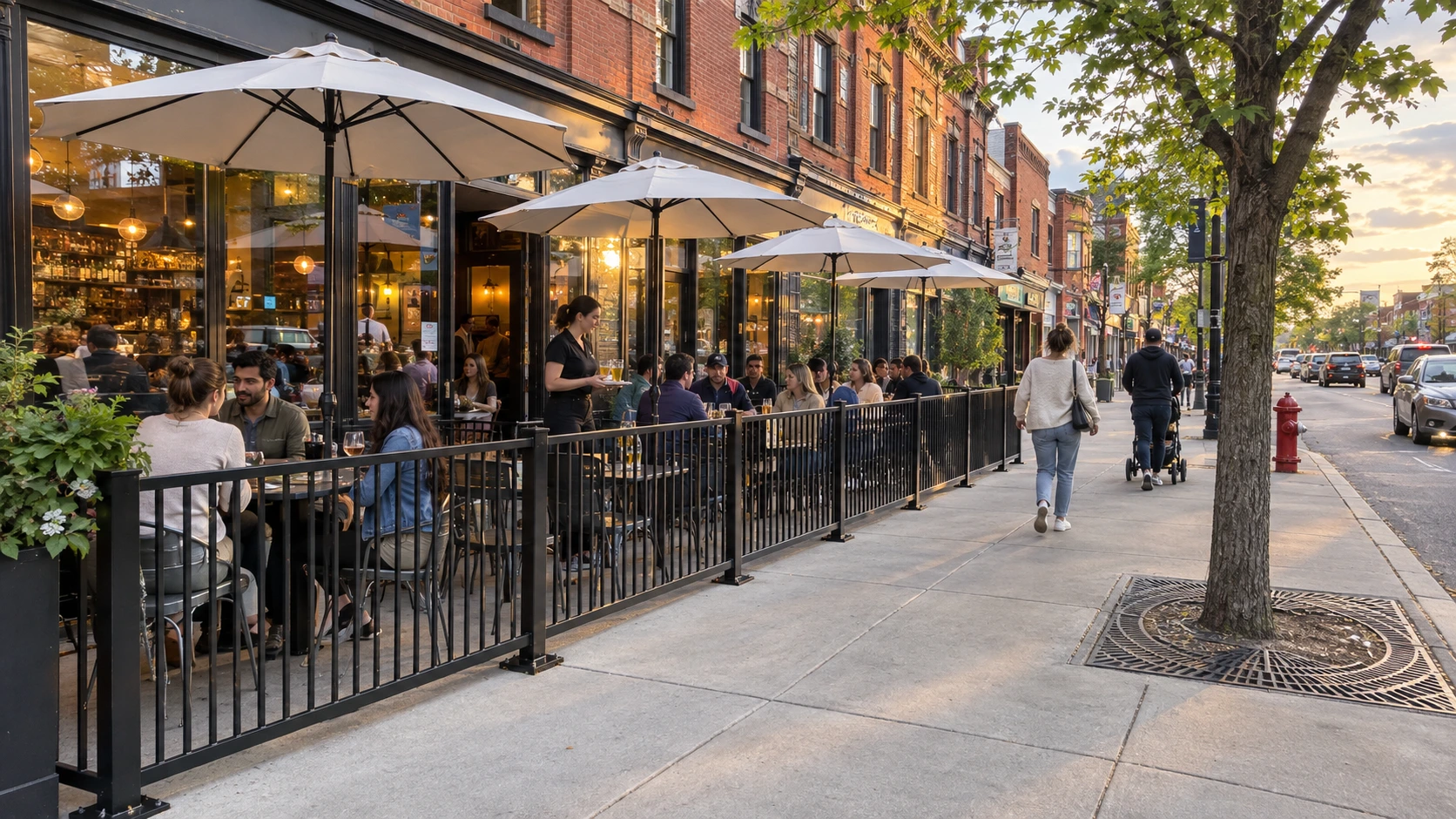
The blog cover image is for reference purposes only and does not depict the actual Medallion Fence product.
Ask a room full of Ontario restaurant owners how tall a licensed patio fence has to be, and most will say 36 inches. Some will say 42. Both numbers come from real rules, but neither one is the AGCO's rule anymore. Building to an outdated number is how operators pay twice: once for the fence, and again for the rework after the municipal inspection.
Maybe you are an architect detailing a new patio, a contractor pricing one, or an operator who wants to be open for the Victoria Day long weekend. Either way, the decisions that matter get made between now and February, not in April. Here is how the rules stack up today, and what they mean for an aluminum barrier specification.
There are two routes, and they lead to very different fences.
The first is a permanent licensed area. An application to the AGCO Registrar is required to add a new permanent licensed area, indoor or outdoor, to increase the capacity of an existing area, or to change the boundaries of an existing licensed area, whether or not capacity goes up. You cannot sell or serve in the new area until your licence is amended, and the AGCO decides whether the change needs public notice. The practical point for designers is that on a permanent patio, the fence line is the licence boundary. Push the fence out 600 mm next spring and you have changed your licensed area on paper.
The second route is a temporary outdoor physical extension under section 153.1 of O. Reg. 746/21. Here the municipality is the approval body. The licensee must be able to show sufficient control over the extension area, the area must allow at least 1.11 square metres per person, and the premises cannot run a temporary outdoor extension for more than a total of eight months in a calendar year. Once the municipality approves, you must notify the AGCO before you start selling and serving on the temporary patio, including a description of its location and dimensions and any conditions the municipality attached to the approval. Whatever barrier the city writes into your approval becomes part of what you report to the province.
This is where most of the confusion lives. The governing standard is Registrar's Standard 6.2. It requires licensees to ensure that the licensed premises are readily distinguishable from adjacent premises to which the licence does not apply.
That is the whole rule. There is no height and no material. In June 2020 the province removed the requirement that licensed area boundaries be defined by at least a 0.9 metre partition, and stated that the change would remain in effect beyond the COVID-19 recovery period.
The 36-versus-42 debate is older than most people realize. Back in 1998, Toronto councillors complained that the province expected boulevard café barriers of at least 42 inches while City by-laws required at least 36 inches, so operators complying with the City could still face provincial fines or work orders. That conflict is gone now, but the folklore stuck.
Do not read "no height requirement" as "no requirement." Readily distinguishable and sufficient control are performance standards, and an inspector judges them on site. Mississauga's temporary extension application, for example, asks applicants to describe the control measures that demonstrate sufficient control over the proposed area. In our view, rope and stanchions are hard to defend on a busy street. A continuous aluminum rail with defined entrances answers the control question before anyone asks it.
In practice, the height comes from two places: the municipal patio bylaw, and the Ontario Building Code when there is a drop.
Toronto's Chapter 742 is the most detailed example in the province, and its numbers are worth knowing even if you work elsewhere.
Frontage and curbside cafés on arterial or collector roads must be fenced. Frontage cafés on local roads do not need fencing, but they need cane-detectable planters or elements at each end.
The top rail must be no lower than 0.9 metres and no higher than 1.2 metres. Opaque parts of the fence or planters cannot exceed 0.9 metres within 30 metres of an intersection.
For cane detection, the fence needs a lower rail between 75 mm and 150 mm above the sidewalk in a contrasting colour, or detectable planter boxes no more than 0.3 metres apart, or a solid base with no gap.
Fencing must be easily removable, must run the full perimeter with gaps only for accessible entrances, must be self-supporting or held by removable plates, and cannot penetrate the sidewalk with footings other than bolt attachments.
It must stay at least 1.2 metres from any fire hydrant and cannot attach to heritage-listed properties, street trees, street furniture or utilities.
Curb lane cafés need a vertical barrier at least 0.9 metres high, with opaque portions no taller than 1.2 metres, plus a 1.0 metre access point for every 15 metres of continuous barrier.
Every permit area needs at least one entrance no narrower than 1.0 metre and no wider than 2.0 metres.
Other municipalities write their own numbers. Ingersoll's temporary private-property patio policy, for instance, requires patio entrances of at least 1.1 metres. A gate detail that passes in Toronto can fail 150 km down the 401.
The Building Code catches people on raised decks and rooftops. Under the 2024 OBC, a guard is required where the fall risk exceeds 600 mm, and openings in a required guard must prevent the passage of a 100 mm sphere. Outside dwelling units, the guard must be at least 1070 mm high. Guards must also resist climbing in the zone between 140 mm and 900 mm above the protected surface. A 36-inch decorative rail with horizontal pickets on a raised patio is not a fence at that point. It is a non-compliant guard.
On public right-of-way, removable is effectively mandatory. Toronto requires curb lane cafés to remove all elements, including fencing, from October 16 to April 30. Curbside cafés not located against the building wall must clear out from November 15 to April 14. A sidewalk café against the building wall can stay year-round if the operator keeps the adjacent clearway free of snow and ice, salts and sands it, and does not store snow in the permit area.
On private property with a permanent licence, fixed usually wins. Core-drilled posts set in non-shrink grout, or surface-mount base plates on adhesive anchors, give you a stiffer rail and no seasonal labour bill. A good middle ground is fixed posts with removable infill panels, or flush-mount sockets that let you pull the posts so a plow can clear the slab.
Whichever way you go, these details separate a ten-year installation from a three-year one. They are industry practice rather than code requirements, so treat them as recommendations.
Aluminum expands about 0.000023 per degree Celsius. A 30 metre run that sees a 70 degree swing between a January night and a July afternoon moves roughly 48 mm (our calculation). Rigid welded runs crack their finish or pop their anchors. Use slotted connections at panel ends.
Ontario road salt plus aluminum plus plain steel fasteners is a corrosion cell. Specify 304 or 316 stainless hardware with nylon or EPDM isolators, 6063-T6 or 6005A-T61 extrusions, and an AAMA 2604 or 2605 powder coat for street-facing work.
Clear glass or vinyl windscreens on top of a rail turn it into a sail. A ballasted removable base that was stable with open pickets may tip once screens go on. Have the engineer check overturning with the screens included.
Removable panels get installed and pulled every year by whoever is on staff that day. Keep panel weights to a two-person lift, add sacrificial feet to protect the finish, and confirm the operator actually has somewhere to store them.
Toronto's application can require stamped architectural or engineering drawings or construction specifications for items such as fencing, platforms and parklet elements. Budget for it.
Toronto's 2026 cycle shows the rhythm. New curb lane permit applications and renewals ran from January 7 to February 11, 2026. The CaféTO Grant opened March 5, the curb lane season began May 1, temporary platforms had to be installed by June 1, and removals ran October 1 to 15. Note the grant fine print: applications must be submitted before any work starts, and projects started before approval are not eligible.
The City has not published 2027 dates as of this writing. If it keeps the same pattern, a workable schedule looks like this:
Survey the frontage, confirm the road classification, and measure the pedestrian clearway. Toronto requires at least 1.8 metres on local roads, 2.1 metres on collector or arterial roads, and 2.5 metres on listed downtown streets where the sidewalk is 5 metres or wider. Map hydrants and utilities against the clearance table.
Finalize the barrier design and shop drawings, get stamped drawings where needed, and lock in fabricator lead times.
File the municipal application. For permanent patios, file the AGCO amendment early, because public notice can add time.
Apply for grants before ordering, then fabricate.
Install, pass inspection, and notify the AGCO before the first drink is poured on a temporary patio.
Skipping steps is expensive. Under Chapter 742, a conviction can bring a fine of up to $100,000, and a continuing offence can add up to $10,000 per day.
No specific fence. It requires the licensed area to be readily distinguishable and under your control. Your municipality may well require a fence, and on a raised surface the Building Code requires a guard.
Only by coincidence. Toronto's 0.9 metre minimum is about 35.4 inches, so 36 inches clears it. On a deck more than 600 mm above grade, you need 1070 mm (about 42 inches) plus non-climbable infill.
In Toronto, bolt attachments are the only penetration allowed, and the system still has to be easily removable. No sleeves, no concrete footings. Expect the City to require the sidewalk restored when you leave.
Yes. You notify the AGCO through iAGCO before serving, and you notify it again if the municipality changes, suspends or withdraws its approval.
On private property, generally yes. On city property, it depends on the café type and its location. In Toronto, curb lane and detached curbside fences must come out every off-season.
Often, but watch the opaque-height limits. Frosted or tinted glass may count as opaque, and screens change the wind load on the posts.
Treat it as a starting point, not an approval. Entrance widths, heights and setbacks vary by municipality, and each city sets its own conditions on temporary patios.
For a guard, a rooftop patio, a screened system or anything on ballast, yes. For a plain 0.9 metre rail on a flat private slab, often not. The approving municipality makes that call, not the fence supplier.
The AGCO tells you what to achieve. Your municipality tells you the dimensions. The Building Code takes over the moment there is a drop. A well-specified aluminum system, with the right alloy, the right coating, isolated fasteners and an honest decision on fixed versus removable, can satisfy all three. The operators who open on time in May are the ones who settled those details in December.