


Aluminum Fence Systems
Aluminum Fence Systems
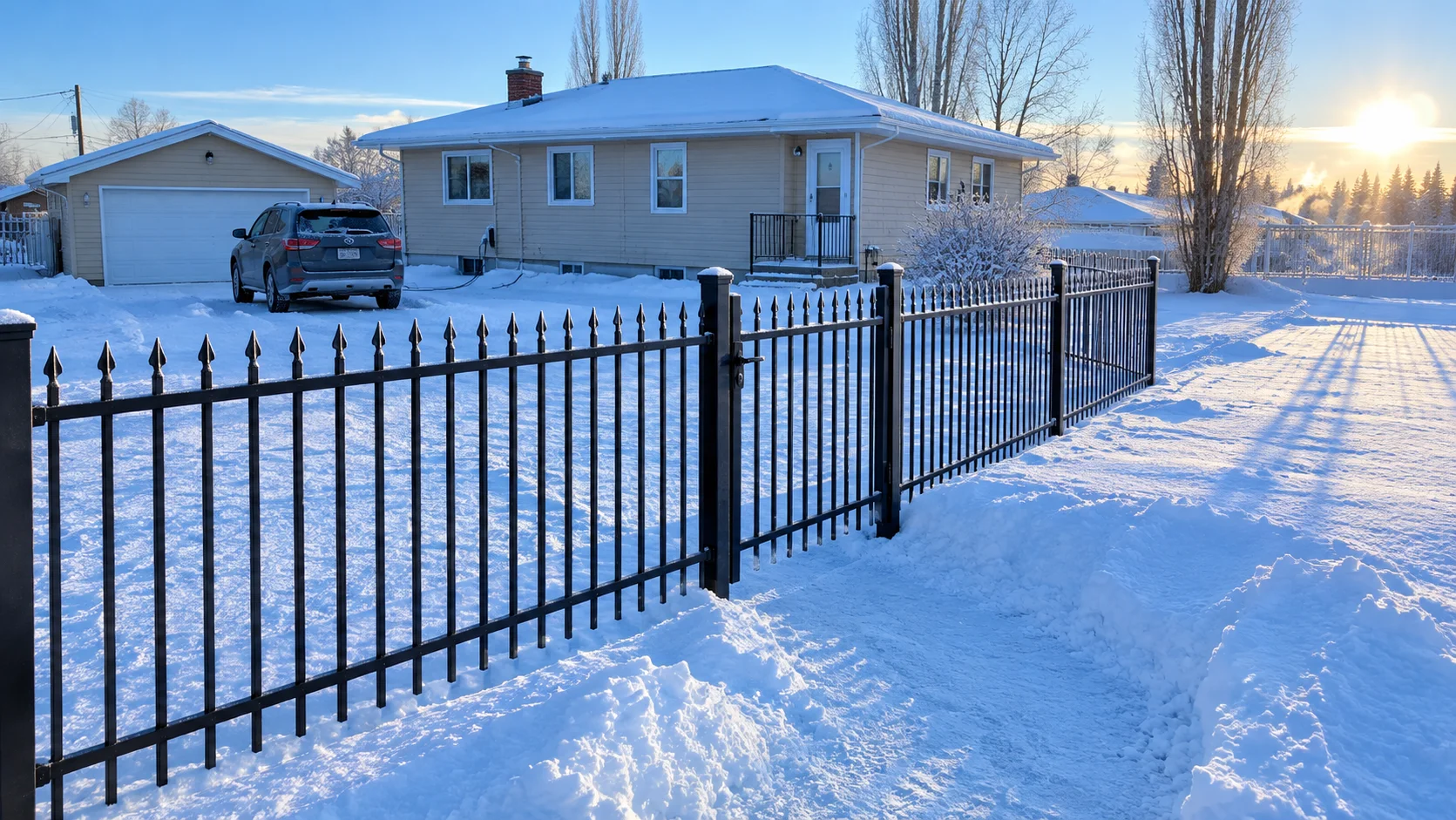
The blog cover image is for reference purposes only and does not depict the actual Medallion Fence product.
Every fall somebody asks the same question. Usually it comes up at the quote stage, standing in the backyard with a coffee, staring at the sample picket like it might shatter in January.
"Won't this thing crack when it hits minus forty?"
It's a fair question. If you've watched a vinyl fence split after a February cold snap, or snapped a plastic shovel on a frozen snowbank, you've earned the right to be suspicious. Cold makes a lot of materials brittle.
Aluminum isn't one of them. The reason is worth knowing, because once you stop worrying about the metal, you can start paying attention to the things that actually go wrong with an aluminum fence in cold weather. And almost none of them are the fence itself.
No. Here's why.
Some metals have what engineers call a ductile-to-brittle transition. Above a certain temperature they bend before they break. Below it, they can fracture suddenly, more like glass than metal. Ordinary carbon steel is the textbook example. It's one of the reasons some steel ships built during the Second World War cracked in cold water.
Aluminum doesn't have that transition at all. It comes down to how the atoms are arranged. Aluminum has what's called a face-centred cubic crystal structure, and that arrangement lets the metal keep deforming instead of snapping, no matter how cold it gets. This is so well established that ASTM and ASME specifications don't even require low-temperature impact testing for aluminum alloys. There's nothing to find.
It actually goes the other way. Aluminum alloys get stronger as the temperature drops. Published data on common wrought alloys shows tensile strength climbing 30 to 40 percent between room temperature and minus 195°C. That's why aluminum gets used for liquefied natural gas tanks and boats built for Arctic ice.
Put that in backyard terms. A bad night in Saskatoon, Thunder Bay or Chibougamau might touch minus 40. LNG is stored at around minus 162. Your fence isn't anywhere close to the limit of what the metal can handle.
So if someone tells you aluminum gets brittle in the cold, they're wrong. If it's a salesperson for a different fence material, they're also selling something.
Here's where the worry has a grain of truth. Aluminum does move with temperature, roughly twice as much as steel. So let's run real numbers for a Prairie yard.
A typical fence section is about 6 feet wide (1.83 m). Most fence extrusions are made from 6063 aluminum, which expands and contracts about 21.8 millionths of a metre per metre for every degree in the cold range. A black powder-coated rail sitting in full July sun gets a lot hotter than the air around it. Let's assume the rail swings from about plus 50°C in summer to minus 40°C in January. That's a 90 degree spread.
1.83 m x 0.0000218 x 90 = about 3.6 mm
That's a little over an eighth of an inch across the whole year, on one panel. On a well-built fence, rails sit in routed post holes or brackets with a bit of play, so each post soaks up its share of the movement. Because the fence is built in sections, the movement never adds up into one long run pushing and pulling against itself.
Where expansion actually shows up:
Rails cut too tight during a hot August install. Come January they shrink a little and can rattle in the brackets.
Rails cut tight during a cold November install. Next July they can bind or bow slightly.
Gates. A 4 foot gate frame moves about 2.4 mm over the same spread, and gates have the tightest tolerances on the property. More on that below.
That sharp "ping" you hear from the fence on a still, cold night? That's usually a rail shifting in its bracket as it contracts. It's normal. It's not a crack.
The spring service calls on aluminum fences tend to land in four buckets. None of them is "the metal broke."
This is the big one. The fence doesn't fail. The ground moves.
When wet soil freezes, ice forms in layers and the soil swells upward. Frozen soil also bonds to whatever is buried in it and lifts it. Engineers call this grip adfreeze. Research from the National Research Council of Canada on posts in heaving soils found that steel tends to get gripped a bit harder than wood or concrete.
In practice, it's usually the concrete footing that gets lifted, with the post along for the ride. A footing that's too shallow, or one that mushrooms out at the top where the hole was overfilled, gives the frost a lip to grab. Heavy clay with poor drainage, which a lot of Winnipeg and Regina homeowners know all too well, makes it worse.
What you'll see in March: one post sitting a centimetre or two higher than its neighbours, a rail on an angle, or a panel that's popped out of its bracket. Sometimes the post settles back after the thaw. Often it doesn't go all the way back.
What prevents it:
Footings below your local frost depth. Get that number from your municipality, not a US website.
Holes with smooth sides, or slightly bell-shaped (wider at the bottom), so there's no lip near the surface for frost to catch.
Concrete finished just below grade or crowned to shed water, never mushroomed over the top of the soil.
A few inches of gravel at the bottom for drainage.
The NRC's key point is simple: an anchor only works if the soil doesn't freeze all the way down to it.
The powder coat doesn't go brittle in the cold either. But it takes hits in winter it never takes in summer. Snowblower augers. Shovel edges. Ice chunks. The city plow throwing a windrow into your corner lot.
Once the coat is chipped, bare aluminum is exposed. On its own, aluminum forms a thin oxide layer and protects itself pretty well. Add road salt or ice melt splashed from the street or tracked along the driveway, and you can get small pits of corrosion starting right at the chip.
At the design stage, ask for the bottom rail to sit a few inches above grade so slush and snowbanks aren't leaning on it all winter. Ask what pretreatment goes under the powder coat, since that has a lot to do with how well the coating holds on when it does get knocked.
Hinges, latches and screws fail long before aluminum pickets do. Two reasons.
First, mixed metals. When plain steel screws touch aluminum and stay wet with salty slush, you get galvanic corrosion. The aluminum around the fastener is the part that suffers. The giveaway is white powdery crust around the screw heads. Good installs use fasteners made for the system, or isolate them with nylon washers.
Second, moving parts behave differently in the cold. Grease thickens. Cheaper self-closing hinge springs can feel stiff. Water gets into a latch during a midwinter thaw (or a Chinook, if you're in southern Alberta) and freezes solid overnight. A latch that won't catch is annoying on a side-yard gate. On a pool gate, where most municipalities require self-closing and self-latching hardware, it's a safety problem.
When a gate starts dragging or won't latch in January, people blame the cold metal. It's almost always the post.
A hinge post that heaves even a few millimetres throws off the latch. Add the 2 to 3 mm of seasonal size change, a drift packed against the bottom rail, and someone yanking it open over a snowbank, and the gate starts to sag.
The fix starts at install. The hinge-side post should be the strongest post on the line: heavier wall, deeper footing. Use adjustable hinges and a latch with some room for movement, so you can tune it in spring instead of resetting a post.
The aluminum doesn't care. The ground and the concrete do. Augering frozen ground is slow and costs more, and concrete has to be protected from freezing while it cures. Plenty of crews stop setting posts once the frost is in, or charge extra for ground thawing. If you're getting quotes in October, ask about timing now. The window closes fast.
For open picket styles, not much, since snow falls through. Privacy panels and tight slat designs are different. Drifts and plow windrows push sideways. On a corner lot facing the prevailing wind, ask about post spacing and post wall thickness.
On cold alone, yes. Vinyl loses impact resistance in deep cold, which is why it's the material that cracks when a snowblower or a stray puck hits it in February. Steel is very strong, but once the coating is breached, rust starts, and salt speeds it up. Aluminum's real weakness isn't cold at all. It's softer than steel, so it dents more easily if a car backs into it. Choose based on impact risk, not temperature.
No. A properly installed fence already has room to move. If you find yourself needing to adjust things every season, that's a sign of an install problem, usually a post.
Ask your installer:
The answers will tell you more about how your fence will look in five years than any brochure.
An aluminum fence won't get brittle in a Canadian winter. The metal gets stronger as it gets colder. What fails is everything around it: footings the frost can grab, chipped coating sitting in salty slush, cheap hardware, and gates hung on posts that move. Get those right at install and minus 40 is just another Tuesday.
Call us at 905-832-2922 or reach out through our contact page to talk through your project.
Contact Us