


Aluminum Fence Systems
Aluminum Fence Systems
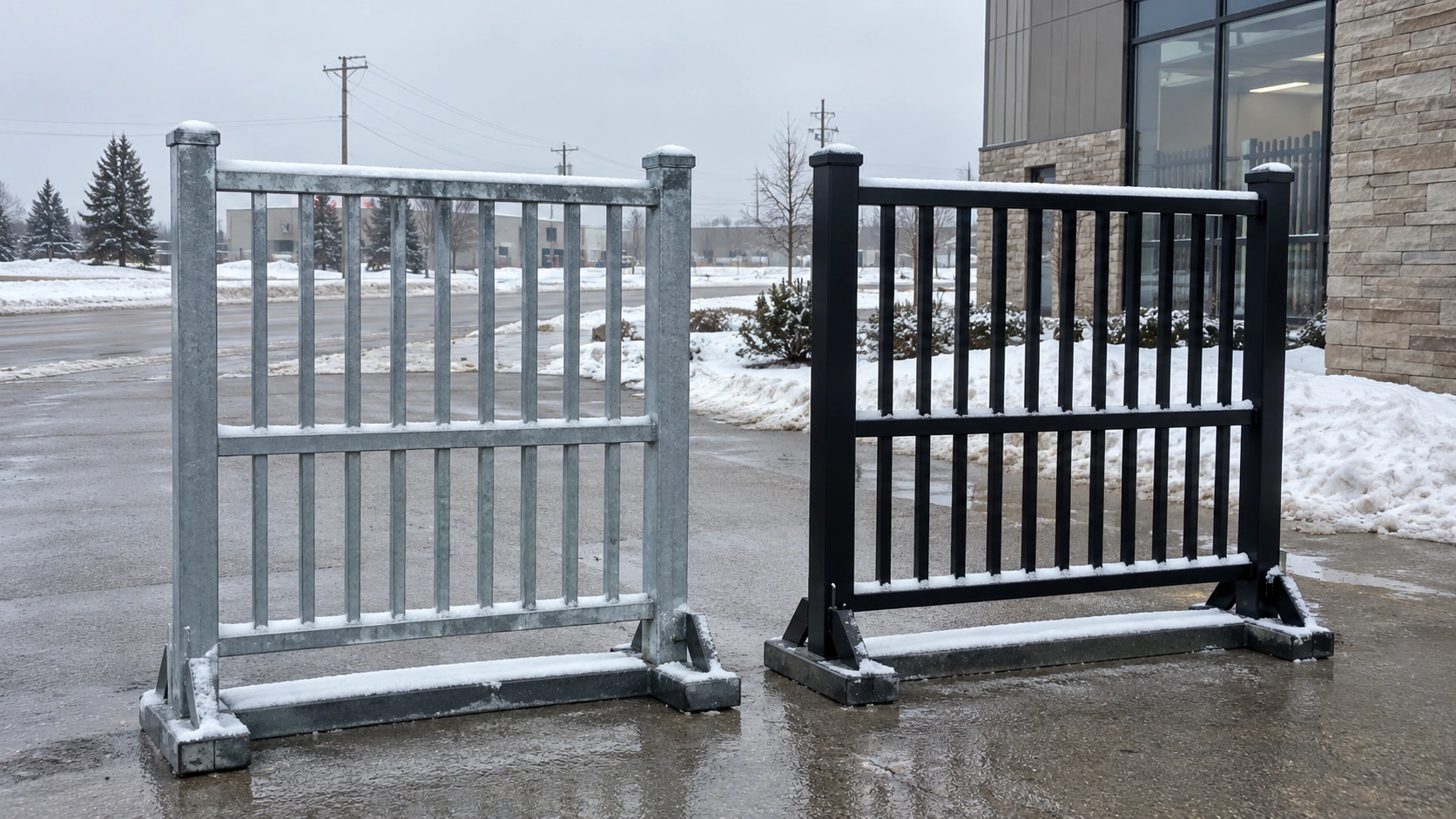
The snow has finally melted, and the fence beside the driveway looks different from the section across the lawn. There is white residue near the bottom rail, a scratch beside the gate latch, and an orange mark around one connection.
Both sections went through the same winter. They did not experience the same exposure.
For Canadian homeowners, architects, and contractors, that distinction matters. A fence beside a salted sidewalk faces different conditions from one behind a landscaped courtyard. Selecting corrosion protection means understanding the coating, the fabrication process, and what happens after installation.
Hot-dip galvanising and Medallion's Armour-Shield system both belong in that discussion. However, they are not entirely separate technologies. Armour-Shield combines a metallic protective substrate with an additional factory finish. The useful comparison is between clearly specified coating systems, including how each protects fabricated details.
Low temperature alone does not explain fence corrosion. Surface moisture, salt deposits, drying conditions, and coating damage all influence performance.
The American Galvanizers Association identifies time of wetness and chloride exposure as factors affecting zinc consumption. Natural wetting and drying also help galvanized steel develop its protective surface patina. (AGA guidance on atmospheric corrosion)
Picture a commercial entrance in Mississauga. The street-facing fence receives traffic spray. Snow cleared from the parking area collects nearby. Meltwater reaches the lower posts, while sheltered connections may dry slowly.
For that project, the specification should address the exposure at those locations. "Suitable for Canadian winters" is too broad to describe the required performance.
Ask where snow will be stored, how meltwater will drain, and which fence sections receive de-icing spray. Those answers help define the coating and maintenance requirements before fabrication begins.
In batch hot-dip galvanising after fabrication, the completed steel article is cleaned and immersed in molten zinc. This differs from continuous coating processes, where sheet steel receives its metallic coating before subsequent forming and fabrication. (AGA explanation of galvanising processes)
Zinc provides barrier protection and sacrificial, or cathodic, protection. It separates steel from the environment and preferentially corrodes to help protect small exposed areas nearby. That protection depends on the remaining zinc and the exposure conditions. (AGA corrosion protection guidance)
For a fence assembly galvanized after welding, the process can coat properly prepared weld areas as part of the completed fabrication. Hollow sections require suitable venting and drainage so the galvanising process can reach the intended surfaces. Weld cleanliness and fabrication details remain important. (AGA welding guidance)
A quotation should therefore identify when galvanising occurs, which standard applies, and what coating coverage is required. The single word "galvanized" leaves important questions unanswered.
Medallion describes Armour-Shield as its proprietary steel finishing system, combining a metallic protective substrate, conversion treatment, and a polyester powder topcoat. Its company page identifies a zinc phosphate conversion coating and a UV-stable polyester finish. (Medallion manufacturing and coating information)
The product drawings provide more specific information about the steel substrate. For example, the Oxford ALDEN Armour-Shield drawing identifies tubing manufactured from pre-coated aluminium-zinc steel with an AZ50 coating designation to ASTM A792/A792M. It also lists a super-durable polyester powder coat and optional zinc-rich epoxy or E-coat primers. (Oxford ALDEN Armour-Shield specification)
ASTM A792/A792M covers steel sheet with a 55% aluminium-zinc alloy coating applied by the hot-dip process. This is distinct from assuming the completed welded fence receives batch zinc galvanising after fabrication. (ASTM A792/A792M scope)
For architects, the practical step is to obtain a current coating schedule for the selected product. Confirm the substrate, pretreatment, selected primer, topcoat, and treatment of fabricated areas. An optional primer should appear explicitly in the approved submission when it is required.
A properly applied powder coating adds an organic barrier over the metallic substrate and provides the specified colour and surface appearance.
That combination is relevant when a fence must resist outdoor exposure while coordinating with an entrance canopy, façade, gate, or landscape scheme. For a homeowner, it means corrosion protection and appearance can be considered within the same factory-finished assembly.
The general principle of combining galvanising with paint or powder coating is established. Such combinations are commonly called duplex systems. The American Galvanizers Association explains that the layers can work together to improve protection, provided surface preparation is appropriate. (AGA duplex systems guidance)
Hot-dip galvanized steel can also receive a powder finish. Consequently, a fair comparison must establish whether the alternative quotation includes bare galvanising or a complete galvanized-and-coated assembly.
Armour-Shield's documented distinction is its specified combination of metallic protection and factory-applied finish. The public documents reviewed do not establish a universal service-life advantage over every alternative galvanized system.
The middle of a fence panel is easy to inspect. The more revealing details are where materials have been joined, cut, drilled, or fitted together.
When steel is coated before fabrication, subsequent work can interrupt the metallic layer. Ask the manufacturer how those areas are prepared and protected before the final finish is applied. A smooth black surface alone does not explain what lies beneath it.
For the contractor, avoid treating field modifications as routine cosmetic work. If a panel needs shortening or a bracket requires another hole, obtain the approved method and repair procedure first.
ASTM A780/A780M addresses repair of damaged and uncoated areas on hot-dip galvanized articles. It describes methods including zinc-rich paint, zinc-based repair alloys, and sprayed zinc. These methods are not automatically interchangeable with repairs to a proprietary multilayer finish. (ASTM A780/A780M repair guidance)
For Armour-Shield, request Medallion's instructions for the specific damage. Repairing the colour coat and restoring protection to exposed steel may require different steps.
A homeowner may reasonably focus on the visible finish. A commercial specifier should also ask about protection inside hollow members.
Request details showing internal coating coverage, closures, and intended drainage arrangements. Confirm how the design handles water entering through joints or openings.
For batch galvanising, venting and drainage are part of the fabrication design. For a factory-coated fence assembled from pre-coated tubing, ask which internal surfaces retain metallic protection and how manufacturing affects that coverage. (AGA design guide for galvanizing after fabrication)
Do not drill extra drainage holes or seal existing openings without the manufacturer's direction. An apparently helpful alteration can change both drainage and coating continuity.
A coating advertised with thousands of salt-spray hours can sound reassuring. The number needs context.
Accelerated testing can support controlled evaluations, but a test duration is not a direct prediction of outdoor service life. The American Galvanizers Association cautions against using salt-spray results to predict hot-dip galvanized steel's field performance or rank it against other coating technologies. Constant laboratory wetting does not reproduce the natural conditions that develop zinc's protective patina. (AGA explanation of salt-spray testing limitations)
If a supplier provides test results, request the test method, specimen construction, coating thickness, acceptance criteria, and whether the sample was deliberately scratched. Ask whether the tested coating build matches the proposed fence.
Field references from comparable exposure conditions can add useful evidence. Neither a test headline nor an attractive installation photograph should carry the comparison alone.
The Oxford ALDEN provides a documented steel option for commercial and architectural perimeter discussions. Its Armour-Shield drawing identifies the substrate and finish system, along with 1-inch square pickets and 1½-inch square rails.
Use the drawing to coordinate the panel specification with the required coating build, repair procedure, and site exposure.
The Preston GUARDIAN is another steel configuration with published Armour-Shield specifications. Its drawing identifies aluminium-zinc pre-coated steel, a polyester powder finish, and optional primers.
For municipal or commercial properties, review its configuration alongside the required height, connections, gate arrangement, and environmental exposure. (Preston GUARDIAN technical drawing)
On exposed galvanized surfaces, a white or grey deposit may be wet storage stain, which forms when moisture remains trapped with limited airflow. Light deposits do not necessarily indicate serious coating damage, while heavy deposits require assessment. Residue on a powder-coated fence could have another cause, so obtain an assessment before choosing a cleaner. (AGA wet storage stain guidance)
Small scratches in galvanized coatings can receive sacrificial protection from nearby zinc. Larger damaged areas may need repair. For a layered finish, report visible damage and use the manufacturer's approved repair system rather than assuming every scratch is harmless. (AGA touch-up and repair guidance)
Ask for a cleaning schedule suited to the exposure. Medallion recommends mild soap and water for routine cleaning. For areas receiving frequent salt spray, discuss rinsing frequency and suitable cleaning conditions with the manufacturer. Avoid creating ice on adjacent walking surfaces. (Medallion care information)
Request the written terms applicable to the quotation. Ask specifically about corrosion, fading, installation damage, salt exposure, maintenance obligations, and field modifications. Record the approved coating system with the purchase documents so any later claim can be assessed against the supplied assembly.
For a reviewable comparison, request the same information from each supplier:
The final selection should reflect the property's exposure and appearance requirements. A sheltered garden boundary, a salted commercial entrance, and a municipal maintenance yard may justify different details even within one development.
For projects considering Armour-Shield, send Medallion the fence layout, preferred series, gate requirements, and a description of salt and moisture exposure. Request the current coating schedule and maintenance instructions with the quotation.
Contact Medallion at 905-832-2922 or info@medallionfence.com to discuss the appropriate steel fencing configuration. Those early details help the architect specify the finish, the contractor preserve it during installation, and the owner maintain it through successive Canadian winters. (Medallion Fence)
Share your fence layout, preferred series, and site exposure with Medallion to get a specification suited to your project.
Contact Medallion