


Aluminum Fence Systems
Aluminum Fence Systems
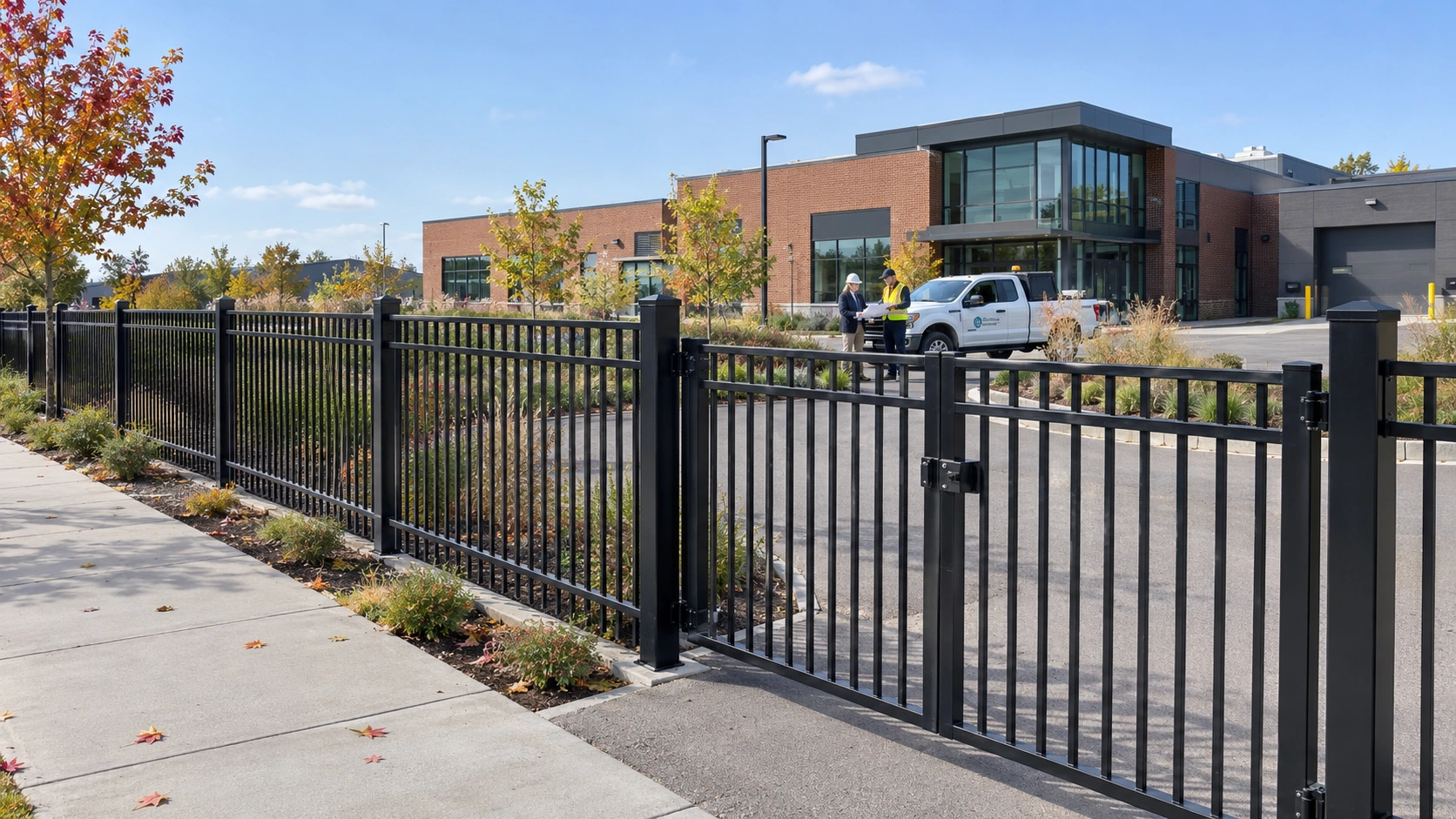
The fence package is ready for approval. The layout works, the gates accommodate maintenance vehicles, and the finish matches the architect's drawings. Then the sustainability consultant asks for the recycled content declaration.
The quotation says "recyclable steel." The manufacturer is Canadian. Neither statement, on its own, answers the question.
For architects, contractors, and municipal infrastructure specifiers, this is where sustainable procurement becomes a documentation exercise. Steel fencing can contribute towards certain LEED materials requirements, but the contribution depends on the rating system, product eligibility, supporting evidence, and project calculations.
That matters on commercial developments, municipal operations centres, and utility campuses where the fencing package needs to satisfy both operational requirements and environmental targets.
LEED certifies projects. It does not certify individual fencing products or endorse manufacturers. A supplier can help document a product's potential contribution, while the project team establishes whether the applicable credit requirements are met.
The first useful question is which LEED rating system and version the project is pursuing.
LEED v4 and v4.1 use materials credit structures that differ from LEED v5. In v5, provisions previously addressed through Environmental Product Declarations, Sourcing of Raw Materials, and Material Ingredients have been incorporated into Building Product Selection and Procurement, with a broader scoring approach.
Consequently, a recycled content calculation prepared for a v4.1 submission should not be carried into a v5 project without review.
Canadian teams should also check applicable addenda and Canadian compliance guidance. CAGBC confirms that v5 credit substitutions are not available for projects using earlier versions.
The examples below explain the v4/v4.1 sourcing approach. They provide a practical starting point for procurement discussions, rather than a universal calculation for every LEED project.
Recycled content measures recovered material already used to manufacture a product. Recyclability concerns what may happen when that product reaches the end of its useful life.
A statement that steel can be recycled does not establish the recycled content of the delivered fence.
For the v4.1 sourcing calculation, postconsumer recycled content receives its full weighting, while preconsumer recycled content receives half weighting. The resulting fraction is applied to the eligible product cost. USGBC's product compliance guidance also identifies a permitted default of 25% postconsumer recycled content for steel products or the steel components within an assembly. That default is a calculation allowance, not evidence of a particular manufacturer's actual recycled content.
For purchasing purposes, request a declaration identifying the supplied product, applicable production scope, and separate preconsumer and postconsumer percentages. If the manufacturer cannot provide product data, ask the LEED consultant whether an allowed default applies.
Assume an eligible fence assembly has a material cost of CAD $40,000. Its documented recycled content, measured across the complete assembly by weight, is 60% postconsumer and 20% preconsumer.
The weighted recycled fraction is:
60% + (20% × 0.5) = 70%
The recycled content contribution is therefore:
CAD $40,000 × 70% = CAD $28,000
These figures are illustrative and do not describe Medallion products.
The distinction between a steel component and a complete assembly matters. If a declaration covers only the tubing, its percentage cannot automatically be assigned to every other component. LEED's assembly calculation accounts for the weight fraction of qualifying components.
Keep installation labour separate from material pricing so the consultant can establish the correct eligible cost.
The CAD $28,000 in the example is a contribution to a project calculation. It does not represent a point awarded to the fence.
Under the published v4.1 BD+C Sourcing of Raw Materials requirements, one point requires qualifying products from at least three manufacturers representing at least 15% of the total value of permanently installed building products. Two points require at least five manufacturers and a 30% threshold. Applicable valuation rules determine the qualifying amount.
This is why coordination across procurement packages matters. The fencing contribution sits alongside other eligible materials, and the final result depends on the project's total calculation.
Buying multiple fence styles from one manufacturer does not satisfy a requirement for multiple manufacturers.
A manufacturing address in Ontario can be valuable to a Canadian buyer. It provides a clear location for discussing fabrication, delivery, and replacement supply.
However, LEED's v4/v4.1 location valuation involves more than the last factory in the supply chain.
The v4 guidance requires extraction, manufacturing, and purchase, including distribution, to meet the 100-mile, or 160-kilometre, location criteria. The qualifying product or portion must also satisfy an eligible sustainability criterion. Distance is measured in a straight line. Eligible local contributions receive a valuation factor of two.
Consider a hypothetical Vaughan project purchasing fencing manufactured nearby in Maple. The fabrication location may satisfy the distance condition. The team still needs to establish the relevant upstream sourcing and purchase locations before applying the multiplier.
If the CAD $28,000 contribution in the earlier example fully met the applicable location requirements, it could become CAD $56,000 for credit calculations. The invoice would remain CAD $40,000.
Medallion states that its fencing is manufactured at its Maple, Ontario facility. That supports a manufacturing-location enquiry, but does not independently establish the origin of every raw material.
Utility and municipal campuses can make scope decisions less straightforward.
A new administration building may sit beside an existing treatment facility, maintenance yard, or electrical compound. The property boundary, construction contract boundary, and LEED project boundary may serve different purposes.
USGBC requires a reasonable LEED project boundary and prohibits excluding portions of a project merely to gain a compliance advantage.
Before assigning a fencing contribution, have the LEED consultant confirm its eligibility under the selected credit and its treatment within the project scope. Identify shared perimeter work, existing fencing, and any sections serving facilities outside that scope.
A standalone fence replacement also should not be presented as creating LEED certification for an existing property.
Recycled content is one material attribute. An Environmental Product Declaration, or EPD, communicates assessed environmental impacts such as global warming potential.
USGBC describes an EPD as a standardised disclosure based on defined product category rules, scope, and assessment methods.
For a municipal owner comparing embodied carbon, request an EPD applicable to the proposed product where available. Check what it covers. A declaration for upstream steel production may not represent the finished fence's fabrication and coating stages.
For comparisons, the declared unit, system boundaries, and assessment methodology need to be compatible.
Neither a high recycled percentage nor a short delivery distance establishes the finished assembly's carbon footprint by itself.
Medallion's published catalogue provides steel product drawings that can support technical selection. The following options are relevant to commercial and municipal perimeter discussions, subject to the project's performance requirements.
The Oxford ALDEN steel drawing identifies ASTM A787 tubing, aluminium-zinc coated steel with an AZ50 designation to ASTM A792/A792M, and a polyester powder coat finish. It also identifies optional primers.
These details help an architect review material construction and help a contractor define the proposed assembly. They should be accompanied by whatever environmental documentation is available for the supplied product.
The Preston GUARDIAN steel drawing provides another configuration for evaluation, with a conventional arrow picket design and published material and finish specifications.
For a utility campus or municipal property, review its geometry, height, connections, and maintenance requirements alongside sustainability documentation. A materials credit contribution does not establish security performance or electrical enclosure suitability.
The public product documents reviewed for this article do not establish a product-specific recycled content percentage or qualifying EPD for these assemblies. Confirm available documentation with Medallion before including either product in a LEED calculation.
Canadian buyers can avoid awkward closeout conversations by addressing several less obvious issues early.
Review what the certificate actually reports. A document establishing steel grade or mechanical properties should not be treated as a recycled content declaration unless it contains the required information.
Establish the full sourcing route against the applicable location criteria. The seller's address alone is insufficient.
Include environmental documentation in the substitution review. Matching height, colour, and picket dimensions does not demonstrate an equivalent materials contribution.
Ask the consultant to calculate the actual effect on the project's credit position. Compare that benefit with documented performance, maintenance requirements, and installed cost.
Yes, recycled content declarations, finish specifications, and repair instructions can inform a residential purchase. Commercial BD+C calculations, however, should not be represented as residential certification requirements.
For municipal asset managers, another useful question is whether individual damaged panels and gate components can be replaced. Request replacement details, maintenance instructions, and written warranty terms. Those documents remain useful long after certification review is complete.
The most effective time to request sustainability information is before purchase approval.
Identify the LEED version and targeted credit in the procurement documents. Request product identification, eligible material pricing, recycled content evidence, relevant sourcing locations, and any applicable EPD. Ask suppliers to state clearly when requested documentation is unavailable.
Coordinate those requirements with the fencing specification so the contractor can price and submit one consistent package. For utility projects, retain the separate engineering requirements for security, foundations, access, and electrical coordination.
When discussing a commercial or municipal fencing project with Medallion, provide the site location, proposed series, quantities, gate requirements, and LEED documentation request together. The team can then discuss the available product information alongside pricing and manufacturing arrangements.
Contact Medallion at 905-832-2922 or info@medallionfence.com to begin that review. A documented product selection gives the architect, contractor, and sustainability consultant a stronger basis for making the fence package count.
Bring your LEED documentation request into the tender process early, and let Medallion help you build the product package the sustainability consultant can actually use.
Contact Medallion