


Aluminum Fence Systems
Aluminum Fence Systems
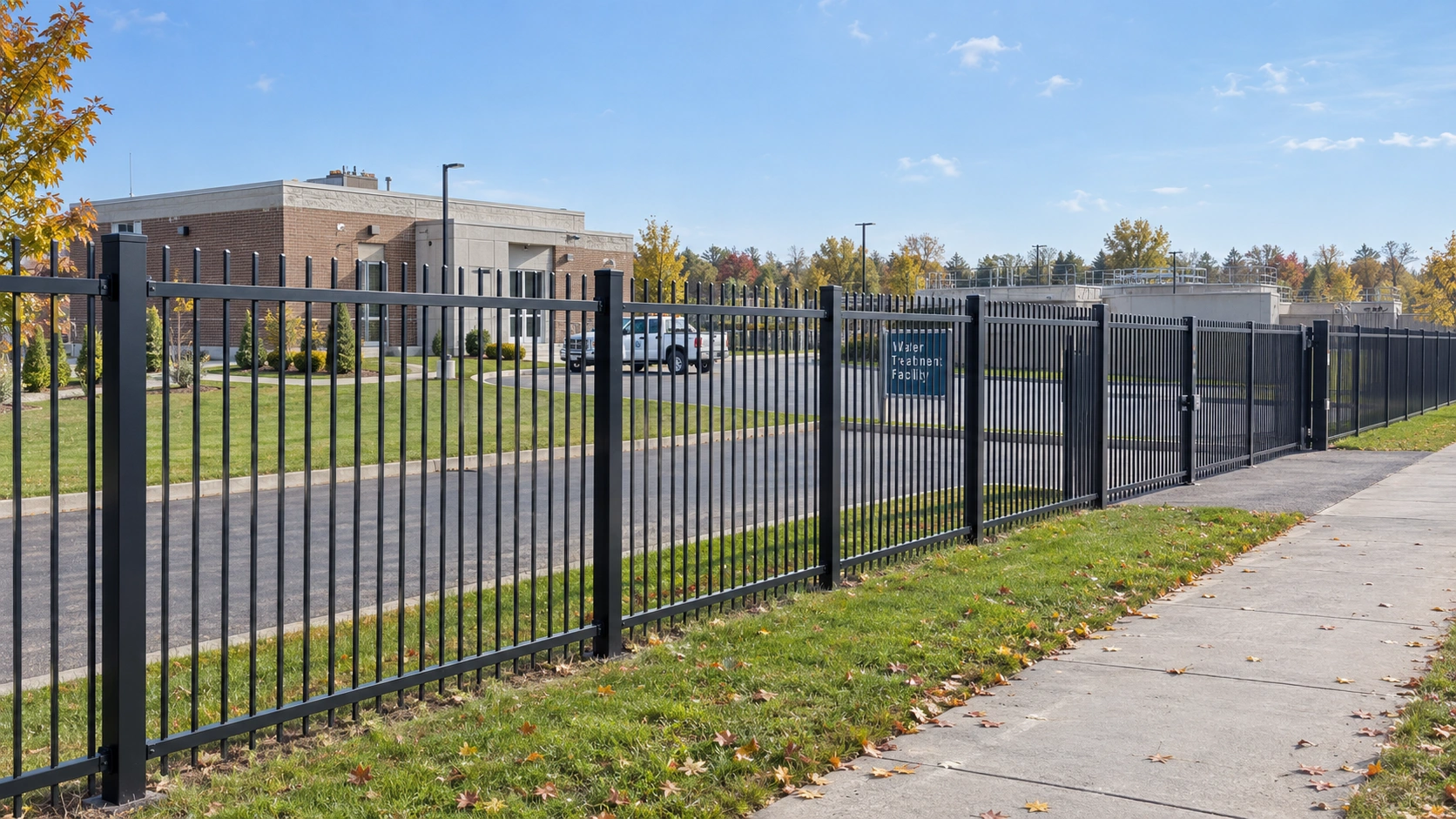
A utility fence earns its keep on an ordinary February morning. The access gate opens after an overnight snowfall. The posts remain aligned through changing ground conditions. A maintenance crew gets its truck inside without blocking the road. Along the neighbouring sidewalk, the boundary is clear and the site looks properly maintained.
For Canadian municipalities and utility engineering firms, those details matter. A fence protects infrastructure that residents depend on every day, often beside homes, schools, trails, and busy streets.
Steel perimeter fencing can provide a durable, visually consistent boundary for these sites. Choosing the right system, however, takes more than selecting a height and colour. Electrical safety, security requirements, ground conditions, maintenance access, and architectural expectations all need a place in the specification.
An electrical equipment enclosure, a treatment plant frontage, and a municipal storage yard can require different fencing on the same property.
The RCMP's Security Fencing Considerations Guide recommends beginning with a threat and risk assessment. It also recognises that a compound may need separate security zones and supporting detection measures. This is useful guidance for infrastructure planning, although it is written for federal government applications and does not replace an owner's project requirements.
Before comparing products, establish what each fence line must achieve. Is it directing visitors towards reception? Restricting access to operating equipment? Protecting stored materials? Separating a public pathway from a maintenance compound?
Ornamental steel may be a candidate for an architectural frontage or an approved perimeter application. Where the owner specifies another fence type, a proposed substitution needs a documented technical review.
That distinction has practical consequences. Winnipeg's wastewater treatment programme civil design guideline, for example, specifies chain-link fencing except where architectural fencing is required or otherwise noted. Municipal specifications can be quite explicit about acceptable construction.
At a substation, a steel fence is also a conductive structure. Its location and connections belong in the electrical design.
During a fault, differences in electrical potential can create touch and step voltage hazards.
Concerns contact with a conductive object while standing on the ground.
Concerns the potential difference between two points on the ground beneath a person's feet.
Alberta's published substation grounding material addresses fence connections, gate bonding, the relationship to the station grounding area, and nearby metal boundary fences. It also distinguishes installations governed by the Canadian Electrical Code from those governed by the utility code. The applicable jurisdiction, adopted edition, and utility requirements must therefore be established for the project.
For the design team, this means coordinating the fence layout with the electrical engineer before foundations are finalised. Gate leaves, removable panels, and connections to adjoining fences deserve explicit details.
A useful tender question is: who supplies, installs, and verifies the required bonding connections? Leaving that responsibility between the fencing and electrical scopes invites a late correction.
A coating specification or a commercial fence designation does not establish suitability for an energised substation enclosure.
Water infrastructure has its own access concerns. Treatment buildings, reservoirs, chemical storage areas, and maintenance compounds do not necessarily share the same operating conditions.
Ontario's drinking-water design guidance recommends fencing or other security measures at water storage sites, together with locks on access hatches and valve and vent housings, and other precautions against unauthorised entry. The fence forms one part of the protection strategy.
Indigenous Services Canada's design guidance similarly calls for controlled pedestrian and vehicle access and protection of critical assets.
A practical design review should follow a delivery through the property. Where does the driver stop? Who authorises entry? Can the vehicle reach its destination without crossing an area requiring tighter access control?
This exercise can reveal a need for an internal gate or separate compound before construction begins. It also helps keep the main entrance workable for staff, deliveries, and emergency attendance.
"Steel fence with black powder coating" leaves too much open to interpretation.
Architects and contractors should request the tube specification, member dimensions, wall thicknesses, connection details, substrate protection, and coating system. The specification should also address repairs after installation damage or approved field modifications.
Medallion's Oxford ALDEN steel drawing identifies ASTM A787 tubing manufactured from aluminium-zinc coated steel with an AZ50 coating designation to ASTM A792/A792M. It lists a polyester powder coat finish and optional primers. These details provide a more useful basis for review than appearance alone.
The project team should confirm the selected finish against the actual exposure. A fence beside a salted access road faces different conditions from one sheltered inside a municipal campus. Coastal salt exposure deserves particular consideration in material selection.
Ask for written maintenance and coating repair instructions at procurement. Operators should know which repair materials are compatible before the first damaged panel needs attention.
A summer site visit can hide an awkward winter problem.
Review the fence layout with the people responsible for ploughing and maintenance. Mark snow storage areas, gate operating space, and access to locks and controls. Ask whether a parked maintenance vehicle or a snow pile will obstruct an inspection route.
Foundation design also needs local input. Request confirmation of soil conditions, frost considerations, drainage, lateral loading, and gate support requirements from the responsible designer. A standard catalogue post detail should be checked against the project conditions before it becomes a construction instruction.
Grade transitions deserve the same attention. Show how panels meet slopes and retaining structures, and define acceptable clearance beneath the fence. That gives the contractor a measurable requirement instead of a visual judgement at installation.
For sites with drainage crossings, coordinate security and civil details. The RCMP guide notes that fences across watercourses can collect debris and that culverts require maintenance to prevent blockages.
The largest vehicle expected during routine operation may be smaller than the equipment needed for a future replacement.
Check gate openings against delivery vehicles, crane access, maintenance equipment, and anticipated component replacement. Review the approach and turning movements as well as the clear opening.
Ask the operator to review the proposed arrangement before ordering. A drawing can show a generous entrance while missing the space needed to approach it.
Medallion lists passage, double-entry, and cantilever gate options in its Oxford ALDEN steel documentation. Its custom gates collection also provides examples of steel gate designs. Final dimensions, supports, hardware, and any automation need confirmation for the intended application.
The Oxford ALDEN is a relevant starting point for reviewing an ornamental steel boundary at a municipal or utility property where that construction is permitted. The published steel drawing lists 1-inch square pickets, 1½-inch square rails, and approximately 98 mm clear spacing between pickets.
For an architect, the value is the ability to review the actual geometry alongside the site's appearance and access requirements. For a contractor, the drawing provides a basis for discussing panel layout and connections.
The Preston GUARDIAN provides another steel configuration for consideration. Its published drawing identifies a conventional arrow picket design, approximately 95 mm spacing between pickets, and height options from 7 to 10 feet.
Review the top profile, rail arrangement, overall height, and proposed location against the owner's security criteria and public interface requirements. The product name alone should never be treated as a security performance rating.
These are manufacturer product illustrations. Selection for a particular utility enclosure remains subject to the project's engineering and owner review.
Several practical questions deserve more attention than they usually receive.
Can a private fence connect to the utility fence? Treat that as an interface requiring the utility's review, especially beside a substation. Provide the proposed location and connection detail before proceeding.
Who maintains the strip outside the fence? Show maintenance access and clarify responsibility where the boundary adjoins a sidewalk, trail, ditch, or neighbouring property. A narrow, inaccessible strip can become an ongoing operating problem.
What happens if a panel must be removed later? Ask whether equipment replacement requires a designated removable section. Coordinate its connections and any electrical requirements in advance.
What does the warranty actually cover? Request the written terms, including finish coverage, installation conditions, exclusions, and repair procedures. Medallion advertises a 20-year warranty on steel fencing, but the project team should review the applicable terms with the quotation.
How should competing prices be compared? Request separate costs for panels, posts, foundations, gates, access controls, electrical coordination, freight, and installation. Include maintenance access and replacement arrangements in the comparison. A price per linear metre cannot explain the whole installed system.
A useful fencing enquiry includes the site plan, approximate perimeter length, required heights, gate schedule, exposure conditions, and owner specifications. Identify which boundaries surround electrical equipment and which serve architectural or general access functions.
That gives the manufacturer and engineering team enough information to discuss a suitable configuration, supporting documentation, and any required modifications.
For a Canadian infrastructure project considering ornamental steel fencing, contact Medallion to discuss product options, pricing, and technical support. Arriving with the operating requirements helps turn an attractive fence selection into a detail the project team can confidently review.
Share your site plan, gate schedule, and exposure conditions, and our team will help you review a suitable steel fencing configuration.
Contact Medallion