


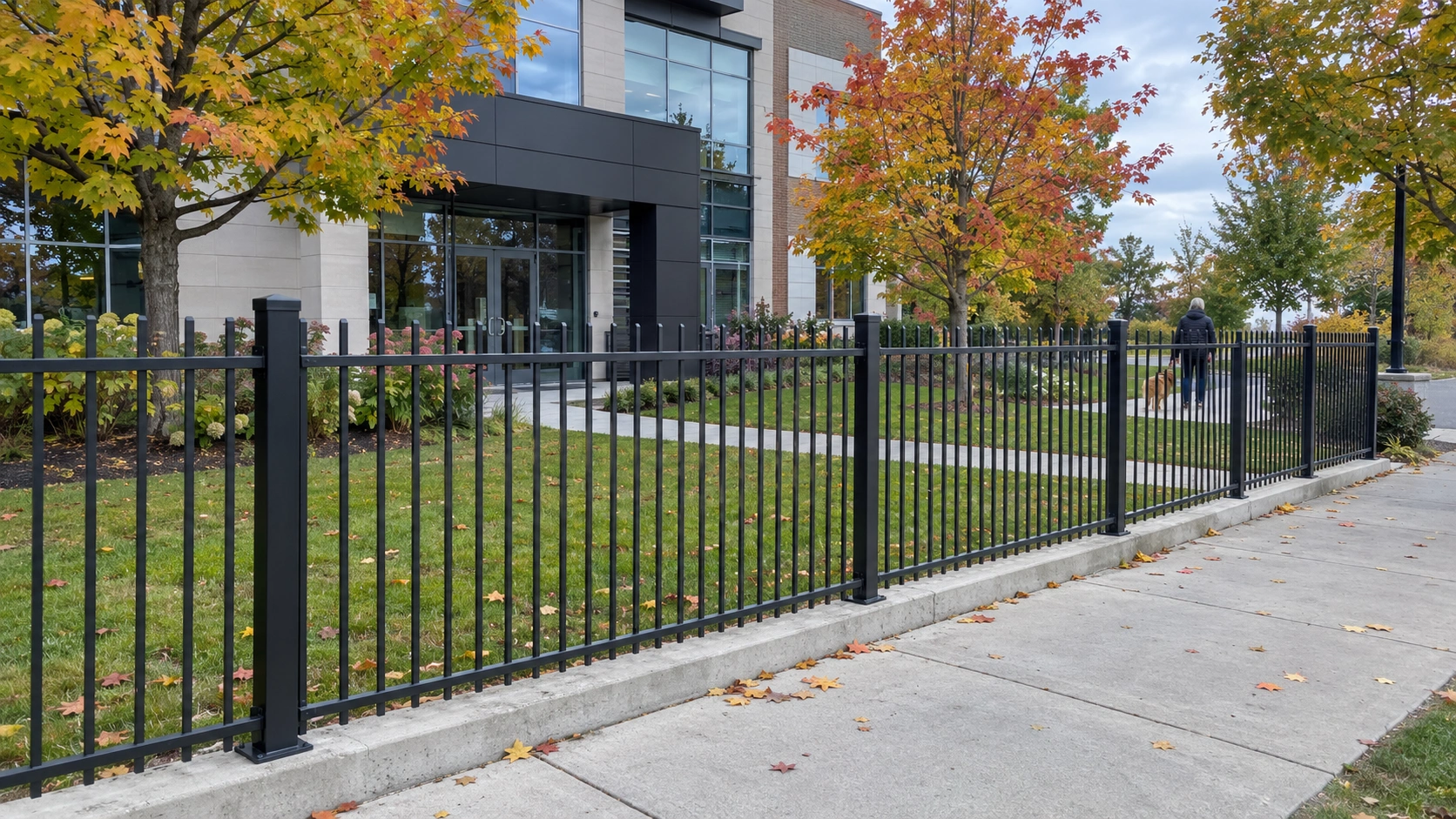
Anyone who has taken a mid-rise, institutional, or infill project through site plan approval in a Canadian municipality knows the pattern. The drawings come back with red-line comments, and buried inside them is a line that reads something like: "Perimeter treatment shall support CPTED principles." No dimensions. No product callout. Just a principle you are expected to translate into a real, buildable, code-legal fence line.
That single line has stalled more projects than most people realize. Yet very few fencing manufacturers in Canada speak the CPTED language directly to the architects and contractors who need to answer it. This article is written to close that gap.
What CPTED Actually Requires at the Site Plan Stage
CPTED stands for Crime Prevention Through Environmental Design. It is a design framework, not a code, but it has been formally adopted into planning review processes in Toronto, Ottawa, Winnipeg, Waterloo, Peel Region, Halton Region, Edmonton, and many others. Toronto operates under Site Plan Control across the entire city (City of Toronto Act, Section 114), and CPTED review is a common condition of approval on institutional, mixed-use, and multi-unit residential files.
The framework has four working principles:
1. Natural surveillance
Sightlines from the street, from adjacent buildings, and from within the site must remain open. A perimeter that blocks visibility is a perimeter that hides activity.
2. Natural access control
Movement onto and through the property must be guided, not just blocked. Entry points should be intentional, defined, and observable.
3. Territorial reinforcement
The line between public, semi-public, and private space needs to be legible without a wall. A person walking past should understand where they are and where they are not welcome.
4. Maintenance and management
Materials must resist damage, corrosion, and graffiti so the site continues to communicate care and control years after handover.
The takeaway for anyone specifying a fence is direct. Solid barriers rarely pass a CPTED review. Transparent, vertical picket systems in steel or aluminum almost always do.
Where Ornamental Steel Fencing Fits
Ornamental steel and aluminum picket systems are the standard CPTED response in Canadian municipal reviews for a reason. They give you four things at once: verticality that resists climbing, visual permeability of roughly 80 to 90 percent, a defined territorial edge, and a finish system that survives Canadian freeze-thaw cycles and de-icing salt.
For a specifier, the technical criteria that usually satisfy a CPTED reviewer include:
Picket spacing
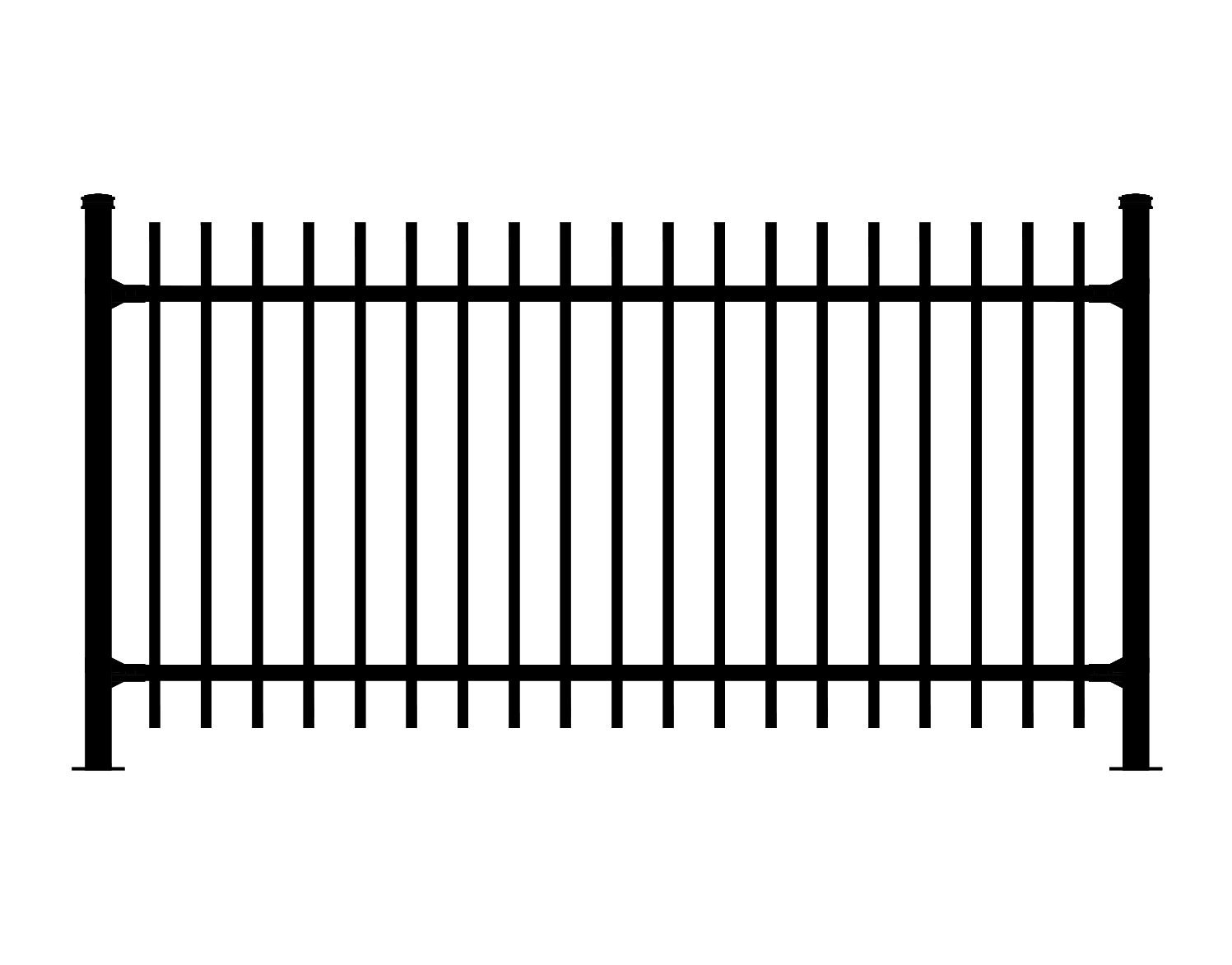
No more than 3-15/16 inches (100 mm) clear opening. This meets pool enclosure requirements under most Ontario, Alberta, and BC municipal bylaws while also preventing a small intruder from slipping through.
Picket profile
3/4 inch or larger square tube for commercial and institutional applications. Anything thinner reads as residential and does not carry the visual weight of a defined perimeter.
Rail dimensions
1-1/4 inch minimum for residential, and 1-1/2 inch or larger for institutional grade. Undersized rails fail on flex loads and telegraph as cheap in a review.
Post embedment
Sized for wind loads under ASCE 7 or the equivalent Canadian equation, particularly on exposed corner lots and along arterial roads.
Full welded construction
Rather than roll-formed or bolted connections. Welded panels do not loosen at the picket-to-rail joint after a decade of thermal cycling.
Powder-coated finish
Over a properly prepared zinc or galvanized substrate. This is the maintenance-and-management principle in practical form.
The Specification Anchor: Medallion Fence Oxford™ Series
For projects across the GTA and elsewhere in Ontario, the Medallion Fence Oxford™ Series is a common specification anchor. It uses 1-1/2 inch by 1-1/2 inch rails, 3/4 inch or 1 inch pickets, and a 2-1/2 inch post minimum, all fully welded. That is the size class most municipal CPTED reviewers expect to see on institutional and commercial perimeters.
Hawkstone™ Series — Higher-Security Perimeters
For higher-security perimeters (transit yards, utility substations, private schools, cannabis production sites) the Hawkstone™ Series steps up in section size and offers a rectangular picket option that raises anti-climb resistance without losing transparency.
Wellington™ Series — Estate Residential and Light Commercial
For estate residential and light commercial work where CPTED still applies because of adjacency to public parkland, transit stops, or walking corridors, the Wellington™ Series carries 3/4 inch pickets on 1-1/4 inch rails, which sits well with both design review panels and homeowner associations.
Questions Canadian Owners and Design Teams Keep Asking (and Rarely Get Answered)
These come up on nearly every project. They are the questions that never seem to get a straight answer from a fence supplier.
Will a 4-foot front yard fence still meet CPTED?
Yes, in most municipalities. CPTED does not demand a tall fence. It demands a transparent one. A 4 foot open-picket ornamental steel section in the front yard supports natural surveillance far better than a 6 foot cedar screen. Most GTA municipalities cap front yard fence heights at 1.0 to 1.2 metres regardless.
Do black powder-coated fences really age better in Canadian winters?
Black is not the issue. The finish system is. A properly galvanized steel picket with a chromate conversion layer and a UV-stable powder topcoat holds up to salt spray from municipal plows for decades. Medallion's Armour-Shield™ system on steel and Alu-Tuff™ finish on aluminum are examples of this multi-stage build. A single-stage painted finish will chalk and rust within two Ontario winters near a road.
What if my site has grade change?
Rackable ornamental panels follow the slope without step-downs, which eliminates the triangular gaps that CPTED reviewers flag as concealment points. Confirm rackability in the shop drawing before submitting for approval.
Can I combine masonry piers with steel infill?
Yes, and it is often the strongest CPTED response for institutional entrances. Masonry piers reinforce territorial edge, steel infill panels preserve sightlines between them. Corner conditions and gate hangings need to be detailed carefully so pier width does not create a blind pocket at the sidewalk.
How do I handle vehicle gates without creating a hiding zone?
Specify a sliding or cantilever gate that opens across an open plane rather than into a landscaped pocket. Match picket profile and spacing to the adjacent fence so the perimeter reads as one continuous line. Medallion offers custom gate fabrication matched to any of their fence series.
What actually happens if a fence fails CPTED review?
Two things, both expensive. The site plan approval is delayed until the drawings are revised, and the contractor eats the cost of any material already ordered against the old detail. This is why the fence decision belongs at the design development stage, not at the tender package.
A Practical Site Plan Submission Checklist
Before sending drawings for CPTED review, confirm the following on Sheet L-series or A-series:
Fence height and setback
Dimensioned against the municipal bylaw.
Picket clear opening
Called out explicitly — not just picket size.
Rail and post section sizes
Noted on the detail.
Finish system
Specified by manufacturer and product name.
Gate locations
Swing directions and clear opening widths shown.
Grade change conditions
Detailed with a rackable panel note.
Adjacent landscaping heights
Called out so shrubs do not eventually block sightlines a reviewer approved on paper.
Municipal reviewers respond well to drawings that answer their questions before they have to ask them. A fence detail that references a manufacturer, a series, a finish, and a spacing dimension gets approved faster than a generic "black metal picket fence" callout.
Canadian site plan approval is not getting simpler. Municipalities in Ontario, Alberta, and BC are all tightening CPTED language in their review checklists, and the perimeter fence is one of the most visible items on the drawing. Choosing an ornamental steel or aluminum system that is built for Canadian conditions, backed by a proper finish warranty, and sized for institutional review is one of the cheapest ways to keep a project on schedule.
Medallion Fence is Canadian-manufactured out of Maple, Ontario, ships to every province, and offers full DWG and PDF shop drawings for architects and specifiers who need something the reviewer can accept on the first submission.
Get a Specification Package Your Reviewer Will Accept
Request drawings, series details, and a quote for your next site plan submission — Medallion ships to every Canadian province.
Request a Quote