


Aluminum Fence Systems
Aluminum Fence Systems
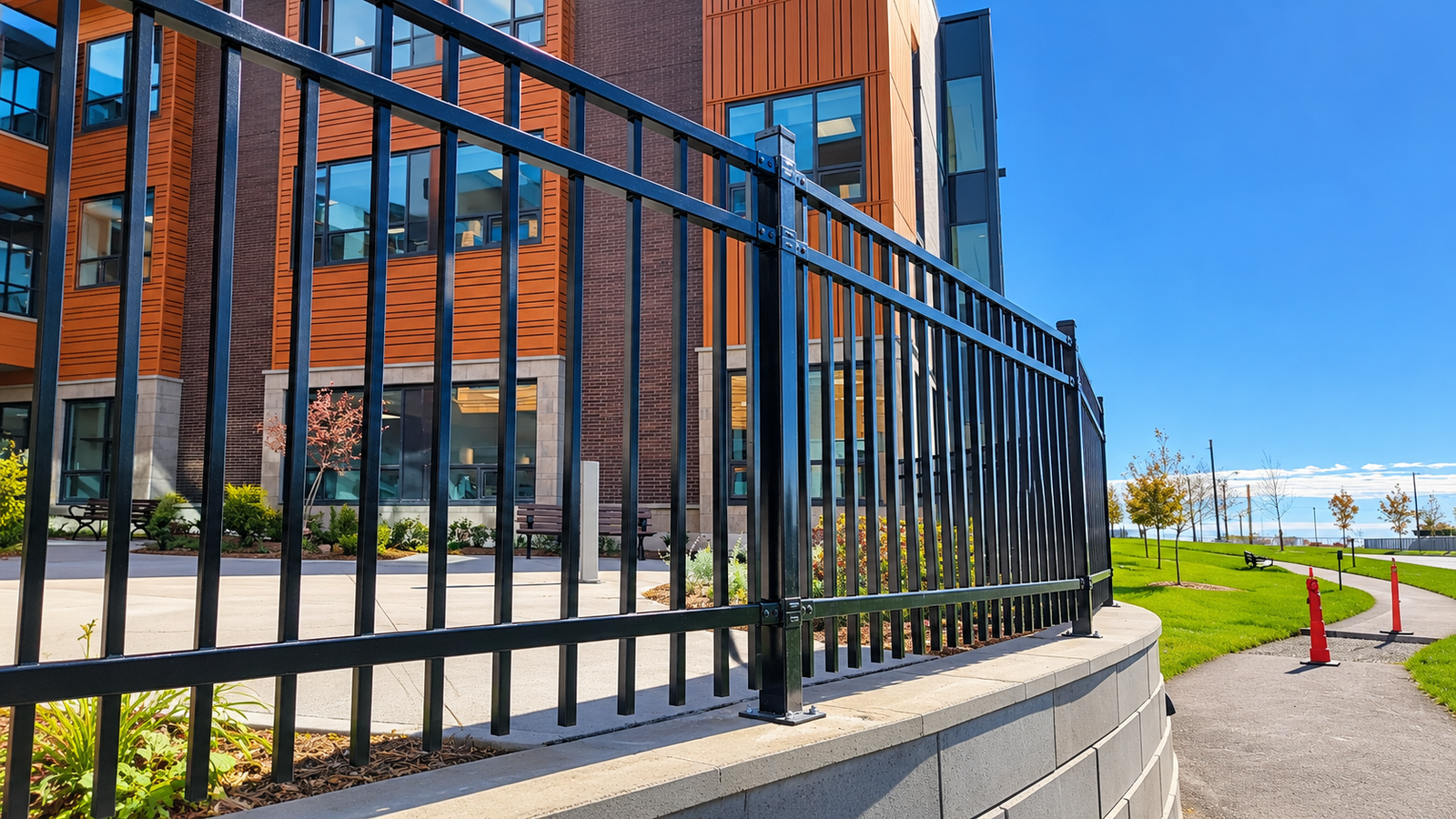
The blog cover image is for reference purposes only and does not depict the actual Medallion Fence product.
If you have ever sat through a school board RFP review in Ontario or Alberta, you know the drill. The project manual lands on your desk, and somewhere in Division 32, there is a fencing specification that needs to be airtight. Not "close enough." Not "we will figure it out during construction." Airtight. Because when you are designing a perimeter for a building full of children or a facility housing sensitive government operations, the spec is the last line of defence against substitution, shortcuts, and products that simply do not belong on an institutional site.
And yet, this is one of the most under-discussed specification challenges in Canadian institutional architecture. Plenty of resources exist for residential fencing. Plenty of general guidance exists for commercial properties. But when it comes to the overlap of child safety requirements, anti-climb performance, accessibility legislation, and lockdown-compatible hardware on a single project? Most architects are stitching together information from four or five sources, and hoping nothing falls through the cracks.
This guide is designed to close that gap. We are going to walk through what belongs in your Division 32 steel fencing specification when the project is a school, a daycare, or a government building in Canada. We will cover the ASTM standards that matter, the critical dimensions that keep children safe, the accessibility requirements most specs miss, and the hardware considerations that school boards and facility managers are increasingly asking about.
Let's start with a question that still comes up on almost every institutional project: why ornamental steel over aluminum, chain link, or welded mesh?
The honest answer is that it depends on the application zone. Chain link still has its place on athletic field perimeters and service yards. But for the primary perimeter of a school, daycare, or government building, ornamental steel offers a combination of structural rigidity, anti-climb geometry, and visual authority that the other options cannot match.
Steel picket fencing, when fully welded (and we will get into why that distinction matters), provides a rigid panel that resists spreading, prying, and forced entry. The vertical picket profile eliminates the horizontal rails that act as a ladder on chain link, and the open sightlines satisfy CPTED (Crime Prevention Through Environmental Design) requirements for natural surveillance. Staff and security cameras can see through the fence line without obstruction, which matters during both daily operations and emergency situations.
For high-security institutional applications like government buildings and secure childcare facilities, look at heavy-duty series that use 2" x 2" rails, 1" x 1" pickets, and 3" x 3" posts. The Medallion Fence Hawkstone Series is engineered at exactly these dimensions for applications where the fence needs to function as a genuine security barrier. Products in this series are fully welded at every picket-to-rail intersection at Medallion's manufacturing facility in Maple, Ontario, and are available with Armour-Shield corrosion protection for steel or Alu-Tuff finish for aluminum.
For school board perimeters and municipal buildings where you need institutional-grade performance but the threat profile does not call for maximum security, the Oxford Series is the workhorse. It features 1-1/2" x 1-1/2" rails with 3/4" or 1" square pickets and a minimum 2-1/2" x 2-1/2" post. This is the specification range that shows up most frequently in Canadian school board RFPs, and for good reason. It hits the sweet spot between structural integrity, budget, and aesthetic expectations.
This is where institutional specs diverge sharply from commercial specs, and where mistakes carry real consequences.
For any fence installed around a school, daycare, or playground in Canada, picket spacing must prevent child entrapment. The widely accepted standard, drawn from CPSC guidelines and applied across Canadian institutional projects, is that a 4-inch sphere (100 mm) should not be able to pass through any opening in the fence. This applies to the gap between pickets, the gap between the bottom rail and grade, and any openings around posts or gate frames.
Why 100 mm? Because gaps between 89 mm (3.5 inches) and 229 mm (9 inches) represent a documented strangulation hazard for young children. A child's body can pass through but the head cannot, or vice versa, creating an entrapment condition. Your spec needs to explicitly state the maximum clear opening dimension between pickets and reference this entrapment range. Do not assume the contractor or manufacturer will know the intent behind the number. Spell it out.
This is also where "fully welded" construction becomes more than a marketing phrase. A bolted or mechanically fastened picket can shift over time, especially under the freeze-thaw cycles we deal with across every province. When that happens, the spacing changes. A fully welded panel maintains its dimensional tolerances for the life of the installation. If you are specifying for a daycare or elementary school, this is not negotiable.
The National Building Code of Canada and provincial codes like the Ontario Building Code do not prescribe a single universal height for institutional perimeter fencing. But the practical standard that most school boards and government facility managers have adopted is 1.83 metres (6 feet) as a minimum, with 2.44 metres (8 feet) increasingly specified for higher-risk facilities, secondary schools, and government buildings.
Height alone does not make a fence anti-climb. The panel configuration matters just as much. Anti-climb performance depends on eliminating horizontal footholds, maintaining tight picket spacing (again, under 100 mm), and using picket profiles that are difficult to grip. Pressed spear points or finials at the top of the picket add a deterrent layer, but the real anti-climb performance comes from the absence of climbable geometry in the panel itself.
When specifying taller panels, post sizing and spacing become critical. A 6-foot ornamental panel on a standard residential post will flex under load. For institutional applications at 6 to 8 feet, you want post centres no greater than 1.83 metres (6 feet) on centre, and post dimensions that match the panel grade. This is not guesswork. Refer to the manufacturer's engineered load tables, and specify the post size in your Division 32 section rather than leaving it to the contractor's discretion.
Here is where a surprising number of institutional fence specs fall short. The Accessible Canada Act (ACA), the Accessibility for Ontarians with Disabilities Act (AODA), and CSA B651 all impose requirements on pedestrian gates in public and institutional settings, and those requirements need to appear in your Division 32 fencing section, not just in your door hardware schedule.
Accessibility Standards Canada guidelines state that manual or mechanical gates should provide a minimum clear opening width of 850 mm.
Gate hardware operating mechanisms must be mounted between 460 mm and 1,100 mm from grade. The hardware itself must be operable with one hand, without requiring tight grasping, pinching, or twisting of the wrist. Lever-style handles and push-pad mechanisms are the standard compliant solutions.
For vehicular gates and double-swing pedestrian gates that serve as primary accessible entry points, you also need to consider maneuvering clearance. Where two gates or doors are in series, the vestibule area must provide a minimum 1,500 mm by 1,500 mm clear floor space, free of door swings and other obstacles, to accommodate mobility aids.
These are not suggestions. On a publicly funded school or government project in Ontario, AODA compliance is a legal requirement. And for projects under federal jurisdiction, the ACA applies. Your gate specification needs to include clear opening widths, hardware mounting heights, operating force limits, and approach clearances. If the spec does not cover these items, you are leaving a compliance gap that will show up during occupancy inspection, or worse, when someone files an accessibility complaint.
Medallion Fence offers custom gate solutions for both walk and drive applications, including arched passage gates and double swing configurations that can be specified with accessible hardware mounting and compliant clear widths.
Over the past five years, more and more school boards and government facility managers across Canada have been asking architects about lockdown compatibility in their perimeter fencing. This is a relatively new specification requirement, and it sits at the intersection of fencing, access control, and emergency management.
What does "lockdown-compatible" actually mean in a fencing context? It means the gate hardware can be integrated with the building's access control and emergency notification systems. In practice, this usually involves specifying gate hardware that accepts electric strikes or magnetic locks, along with a fail-secure or fail-safe locking mode that aligns with the facility's emergency plan. Some school boards want gates that lock automatically when a lockdown signal is triggered. Others want gates that remain unlocked for emergency egress but prevent entry from the exterior.
This is not something you can spec generically. You need to coordinate with the facility's security consultant, the access control integrator, and the gate hardware manufacturer. But what you can do in your Division 32 section is specify the gate frame and hardware prep requirements that make integration possible. Call out the electric strike prep, the conduit pathway from the gate post to the building's access control panel, and the locking mode (fail-secure vs. fail-safe). If the spec is silent on these items, the general contractor will install a standard gravity latch, and you will be dealing with a change order six months later.
Canadian architects typically reference ASTM standards in Division 32 fence specifications because no equivalent CSA standard exists for most ornamental fence products. Here are the ones that matter for institutional steel fencing:
Covers the minimum requirements for tubular steel ornamental fence systems with a protective coating. This is the baseline standard for any ornamental steel fence specified on an institutional project.
Covers aluminum ornamental fence systems and is relevant if portions of your perimeter use aluminum panels.
Covers automated gate design and construction, including slide gates, swing gates, and vertical pivot gates. If your project includes any powered gate, this standard is essential.
Your specification should also reference ASTM A 500 for cold-formed steel tubing and ASTM A 36 for structural steel plates and shapes used in gate frames and posts.
A steel fence on an institutional site in Canada is going to face road salt exposure, freeze-thaw cycling, and in some regions, coastal or industrial atmospheric conditions. The corrosion protection system needs to be part of your specification, not an afterthought.
Look for a multi-layer system that includes hot-dip galvanization or zinc priming as a base layer, followed by a chromate conversion layer, and then a UV-stable polyester powder coat as the finish. Medallion Fence's proprietary Armour-Shield system for steel fencing uses exactly this approach, and it is designed specifically for the salt, moisture, and temperature extremes that Canadian installations face.
Do not accept "powder coated" as a complete corrosion specification. A powder coat applied over bare steel will fail within a few years in a Canadian climate. The galvanization or zinc layer underneath is what provides long-term corrosion resistance.
Your Division 32 specification should require the following submittals from the fencing contractor:
Shop drawings showing panel layout, post locations, gate openings, and hardware locations.
Product data including rail, picket, and post dimensions, material certifications (ASTM A 500, ASTM A 36), and coating system documentation.
Manufacturer's installation instructions.
Warranty documentation, including the coating warranty and the structural warranty.
Samples if required by the project, particularly for finish colour and weld quality.
If you are working on a school board or government RFP, include a requirement for the manufacturer to provide DWG files in addition to PDF shop drawings. This allows the design team to overlay the fence layout on the site plan during review. Medallion Fence provides DWG and PDF downloads for every product in their Oxford, Preston, and Hawkstone series directly from their product pages, which makes the submittal process significantly smoother.
Use this as a starting point when matching a Medallion Fence series to your project's threat profile and budget, then confirm dimensions against the manufacturer's engineered load tables.
Specifying institutional perimeter fencing in Canada is not a copy-paste exercise. The combination of child safety, accessibility legislation, security performance, and climate durability creates a specification profile that is genuinely unique to this project type. If you take the time to get Division 32 right, you protect the facility, the occupants, and your professional liability for the life of the installation.
For technical support, product data, and custom gate solutions on your next institutional project, contact the team at Medallion Fence: info@medallionfence.com | 905-832-2922
Visit Medallion Fence